- Free shipping on all orders over $200 (US) and $300 (International)

$60.00
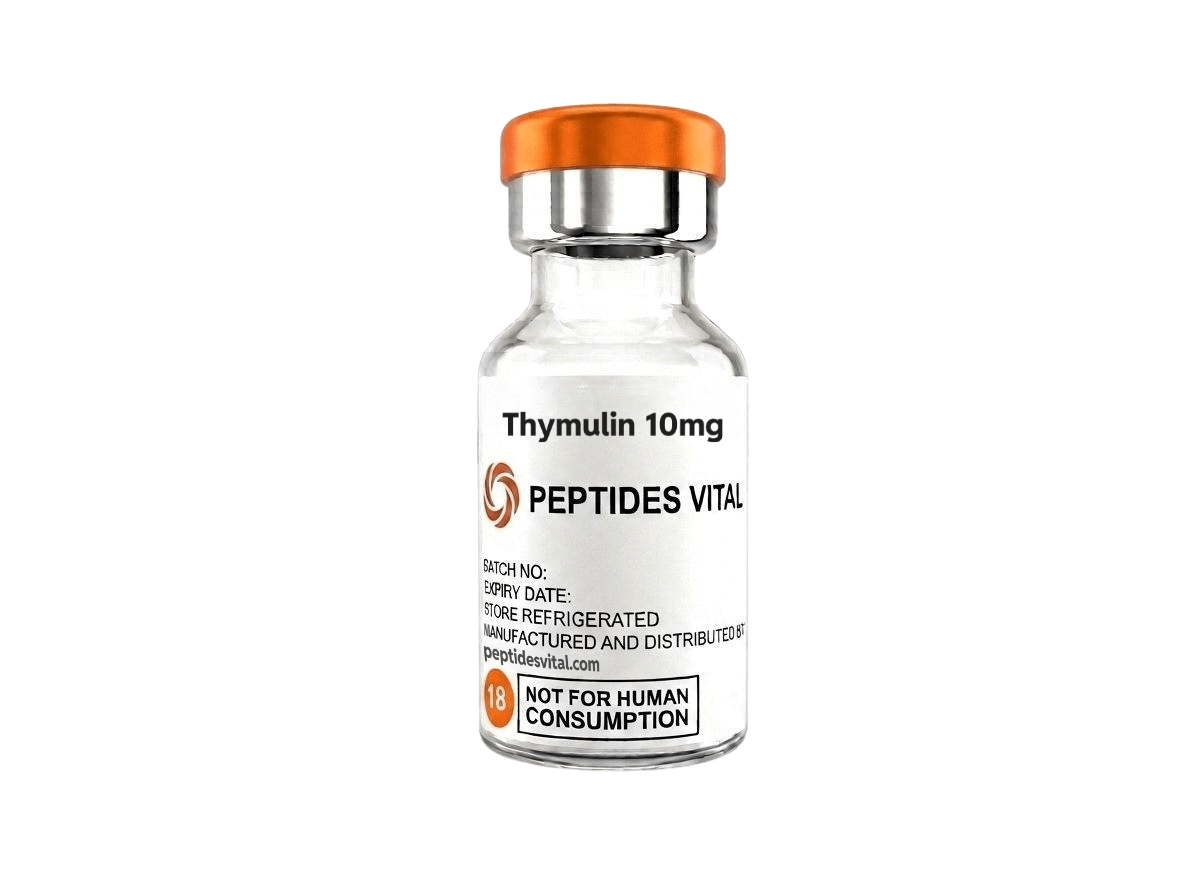
Thymulin is a nonapeptide hormone, a chain of nine amino acids, produced naturally by epithelial cells of the thymus gland. It was first isolated from pig serum by French immunologist Jean-François Bach and colleagues, who named it facteur thymique sérique (FTS) or serum thymic factor, and its structure was characterized in 1977. The peptide has the sequence pGlu-Ala-Lys-Ser-Gln-Gly-Gly-Ser-Asn, the molecular formula C33H54N12O15, a molecular weight of 858.9 g/mol without zinc and CAS number 63958-90-7. Thymulin is unusual among thymic peptides because it needs a bound zinc ion to fold into its active shape; without zinc it is biologically inactive. Each 10 mg kit contains 10 vials of white lyophilized powder, verified by HPLC and mass spectrometry. For laboratory research use only. Not for human or veterinary use.
ℹ️ Note: 1 kit includes 10 vials
Free shipping on all orders over $200 (US) and $300 (International).
Every batch is HPLC & Mass Spectrometry verified. Full lab reports are available for every order within 30 days of purchase.
Your transactions are protected by our private, encrypted network. Supporting secure wire transfers and international invoicing.
Thymulin is a nine-amino-acid peptide hormone made by the epithelial cells of the thymus, the organ where T cells mature. Its sequence begins with pyroglutamic acid (pGlu), a ring-closed residue that protects the peptide’s N-terminus. It is often confused with the thymosins, such as thymosin alpha-1, but it is a different peptide with a different sequence and function.
What sets thymulin apart is its dependence on zinc. The peptide binds one zinc ion per molecule, and only this zinc-bound form adopts the three-dimensional shape needed for biological activity. Without zinc it is an inactive apopeptide. Thymic epithelial cells contain both zinc and the peptide, which suggests thymulin is released already in its active, zinc-bound form. That zinc switch has made thymulin a standard research tool for studying how zinc status affects immune signaling.
Thymulin has been studied mainly in the context of T-cell differentiation, thymic function and immune aging. As the thymus shrinks with age, a process called thymic involution, circulating thymulin declines with it. Researchers have also examined its links to the endocrine system, since it interacts with pathways involving pituitary hormones. For related research compounds, see peptides for longevity research.
This product is strictly for research purposes only. Not approved for human or animal use.
| Property | Value |
|---|---|
| Also known as | Serum thymic factor, FTS, facteur thymique sérique |
| Sequence | pGlu-Ala-Lys-Ser-Gln-Gly-Gly-Ser-Asn (pEAKSQGGSN) |
| Type | Nonapeptide (9 amino acids), zinc-dependent |
| Molecular formula | C33H54N12O15 |
| Molecular weight | 858.9 g/mol (without zinc) |
| CAS number | 63958-90-7 |
| Origin | Thymic epithelial cells |
| Cofactor | Zinc (Zn2+), 1:1 ratio |
| Property | Value |
|---|---|
| Kit | 10 mg, 10 vials per kit |
| Form | White lyophilized powder |
| Solubility | Water-soluble |
| Testing | HPLC and mass spectrometry on every batch; lot COA available |
| Storage | Refrigerate at 2–8 °C (36–46 °F); −20 °C for long-term storage |
Much of the foundational thymulin research came from Mireille Dardenne, Jean-François Bach and colleagues. Their work showed that the peptide binds zinc in an equal ratio, that the zinc-bound form has a distinct three-dimensional structure, and that even mild zinc deficiency lowers serum thymulin activity in animal models and in people. Activity was restored when zinc was added back, both in the body and in lab samples, which led researchers to propose serum thymulin as a sensitive marker of zinc status.
Early studies also examined thymulin’s role in T-cell differentiation inside and outside the thymus, and its ability to restore thymus-dependent immune responses in thymus-deficient and stressed animal models. Later preclinical work explored thymulin in models of inflammation, pain signaling and lung disease.
Most of the evidence comes from animal and cell studies rather than large human trials, and thymulin has never been developed into an approved drug. Every lot is verified by HPLC and mass spectrometry; see how to read a peptide COA and peptide purity vs net peptide content.
Thymulin is studied mainly for its role in T-cell differentiation, thymic function and immune aging, and as a model for how zinc status affects immune signaling.
Zinc binds the peptide in a 1:1 ratio and locks it into its active shape. Without zinc, thymulin is reported to have no immunological activity in research models.
No. Thymulin and the thymosins, such as thymosin alpha-1 and thymosin beta-4, are different peptides with different sequences. They are often confused because all are linked to the thymus.
Preclinical studies link zinc-bound thymulin to T-cell maturation in zinc-deficient and thymus-depleted animal models, and to communication between the immune and endocrine systems. These are research observations, not established clinical effects.
No. Thymulin has never been developed into an approved drug. This product is for laboratory research only.
Refrigerated at 2–8 °C (36–46 °F), sealed, dry and away from light. For long-term storage, −20 °C. Each 10 mg kit contains 10 vials. Here’s why freeze-dried peptides ship safely at room temperature.
| Weight | 10mg |
|---|
Ashly –
Very satisfied with the smooth process and reliable delivery
Adam.j –
Peptides Vitals combines quality with professionalism perfectly
Michael Chris –
Peptides Vitals delivered my order quickly with excellent packaging. Very satisfied with the service.
James Daniel –
The product quality from Peptides Vitals was outstanding. Everything arrived fresh, sealed, and exactly as described.
Andrew Sam –
Great product consistency and excellent standards. I highly rate the quality from Peptides Vitals.
James T. Harrison –
Excellent purity for our immunology study
The 99% purity was clearly reflected in our ELISA results. Very consistent batch-to-batch. Shipped quickly to our lab
Maria Delgado –
Great addition to our thymic peptide research
Thymulin from Peptides Vital has shown reproducible activity in our in vitro models. Packaging was secure and arrived intact
Linda Park –
Reliable delivery and consistent results. Great stability under recommended storage. Shipping to Canada was faster than expected.
Robert Chen –
Highly satisfied with purity and service
Third-party testing confirmed >99% purity. The product page is clear about “research use only,” which we appreciate. Will buy again.
Sarah Mitchell –
Perfect for our aging study
We required Thymulin for a mouse model of immune senescence. This product delivered consistent biological activity. Free shipping over $200 helped too
Anthony Whitfield .R –
Excellent customer service and product
Had a question about storage — support replied within hours. Thymulin worked perfectly in our Western blot validation. Five stars.
Nicole B. Foster –
Very clean peptide by HPLC
Ran an analytical HPLC — single major peak. No degradation after 3 freeze-thaw cycles (aliquoted properly). Very happy with this purchase
Gregory Liu –
Great value for high-purity Thymulin
Compared to another supplier, Peptides Vital offered better price and same quality. International shipping was smooth. Will be a repeat customer
Vanessa Reynolds –
Fast US shipping and proper cold pack handling.