- Free shipping on all orders over $200 (US) and $300 (International)
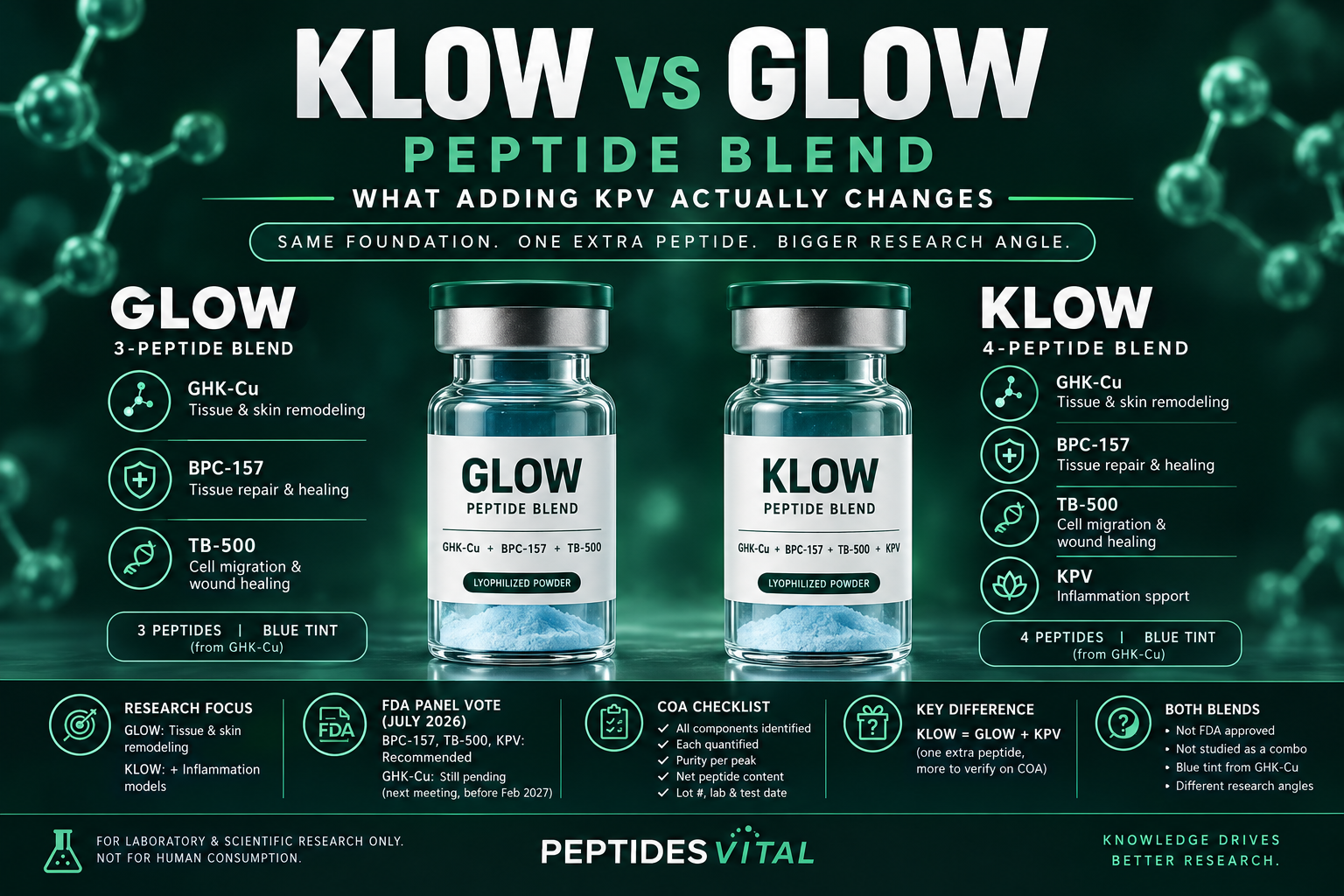
KLOW is GLOW plus one extra peptide. GLOW combines GHK-Cu, BPC-157 and TB-500 in one lyophilized vial. KLOW adds KPV, a three-amino-acid fragment of alpha-MSH, as a fourth component.
That single addition changes three things: the blend’s research focus, its regulatory picture after the July 2026 FDA panel vote, and how much you need to check on its certificate of analysis (COA). This guide covers all three. If you’re new to the three-peptide version, start with our GLOW blend explainer.
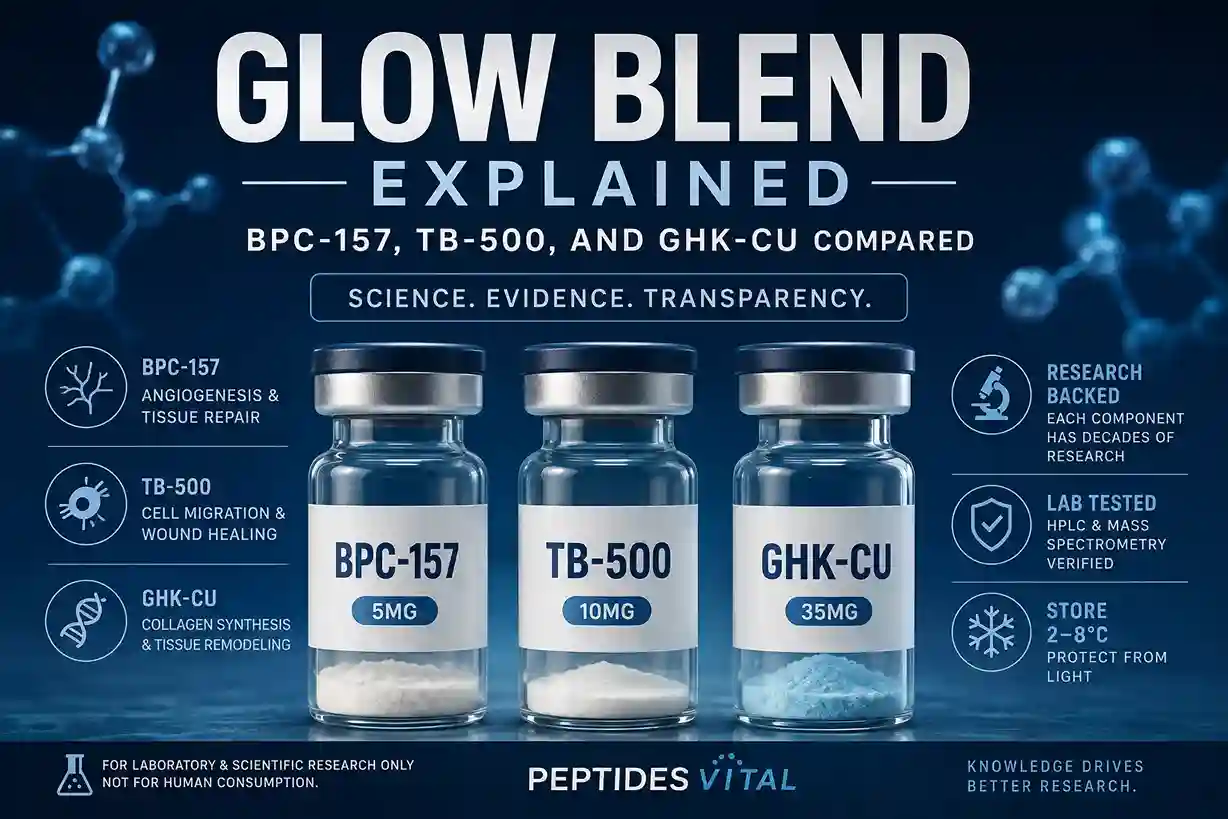
GLOW is a three-peptide research blend supplied as a single lyophilized powder. Each component has its own, separate body of preclinical literature:
The name is informal. It is a supplier naming convention, not a pharmacopeial or regulatory term, so the per-peptide split inside a GLOW vial varies from supplier to supplier.
KLOW keeps all three GLOW components and adds KPV as a fourth. The “K” is generally read as a nod to KPV. Like GLOW, it is sold as one lyophilized vial, and the amount of each peptide is set by the supplier.
Because KLOW carries four peptides instead of three, every quality question gets one step harder: four identities to confirm, four quantities to match against the label, and more chances for one component to be under-filled.
| GLOW | KLOW | |
|---|---|---|
| Components | GHK-Cu, BPC-157, TB-500 | GHK-Cu, BPC-157, TB-500, KPV |
| Number of peptides | 3 | 4 |
| Extra component | None | KPV (Lys-Pro-Val) |
| Main preclinical research themes | Tissue and skin remodeling models | Same, plus inflammation models |
| Components the FDA panel backed in July 2026 | BPC-157, TB-500 | BPC-157, TB-500, KPV |
| Component still awaiting panel review | GHK-Cu (injectable form) | GHK-Cu (injectable form) |
| Identities to confirm on the COA | 3 | 4 |
| Typical color | Blue tint (from GHK-Cu) | Blue tint (from GHK-Cu) |
Neither blend has been studied as a combination in published research that we are aware of. Each component’s literature stands on its own.
KPV is a tripeptide (lysine-proline-valine) that matches the last three amino acids of alpha-melanocyte-stimulating hormone (alpha-MSH). It is the smallest of the four components by far.
Most published KPV work is preclinical: cell studies and rodent models of gut and skin inflammation. That is the logic behind the blend. GLOW’s components are mostly studied in tissue-remodeling models, and KPV adds an inflammation-research angle to the same vial.
KPV also matters for timing. It was one of the six peptides the FDA’s compounding advisory panel voted to recommend in July 2026, which is a large part of why KLOW searches have climbed since.
Three of KLOW’s four components got a favorable vote in July 2026. The fourth, GHK-Cu, is still waiting for its turn.
| Component | 2026 status | Vote |
|---|---|---|
| BPC-157 | Panel recommended adding it to the 503A bulks list, July 23 | 8 yes, 6 no, 1 abstain |
| TB-500 | Panel recommended, July 23 | 8 yes, 6 no, 1 abstain |
| KPV | Panel recommended, July 23 | 8 yes, 6 no, 1 abstain |
| GHK-Cu (injectable) | On the agenda for the panel’s next meeting, due before the end of February 2027 | Not yet voted |
Three points the headlines often miss:
For the five peptides up next, including GHK-Cu, see the FDA’s next peptide review.
A single-peptide COA answers one question per test. A blend COA has to answer it three or four times. Before you trust a blend vial, confirm:
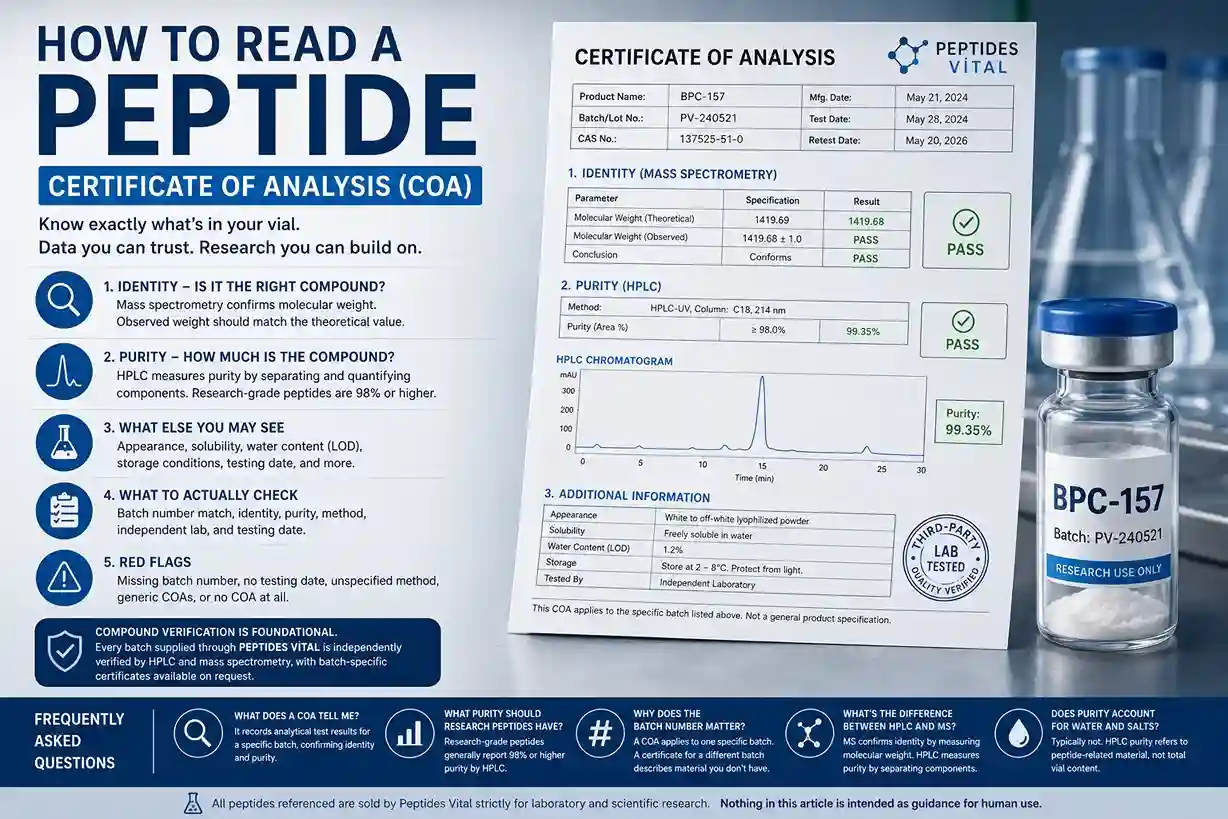
New to reading these reports? Start with how to read a peptide COA.
No. KLOW contains everything in GLOW (GHK-Cu, BPC-157, TB-500) plus a fourth peptide, KPV.
It is generally read as a reference to KPV, the peptide KLOW adds to the GLOW formula.
No. Neither blend, and none of its components, is an FDA-approved drug. The July 2026 panel vote was a non-binding recommendation about compounding, not an approval.
The blue tint comes from GHK-Cu, which is a copper complex. A faint blue or blue-green cake is expected in any blend that contains it.
Neither is better in general. They answer different research questions: KLOW suits work that includes an inflammation angle, GLOW suits work that does not. No published study compares the two blends head to head.
No. An FDA advisory panel voted 8 to 6 to recommend KPV for the 503A bulks list on July 23, 2026. The FDA has not yet acted on that recommendation.