- Free shipping on all orders over $200 (US) and $300 (International)
The phrase appears on essentially every research peptide product, and it’s easy to read past as boilerplate. It isn’t. It’s a regulatory classification with specific meaning, and understanding what it does and doesn’t cover is genuinely useful for anyone working with these compounds.
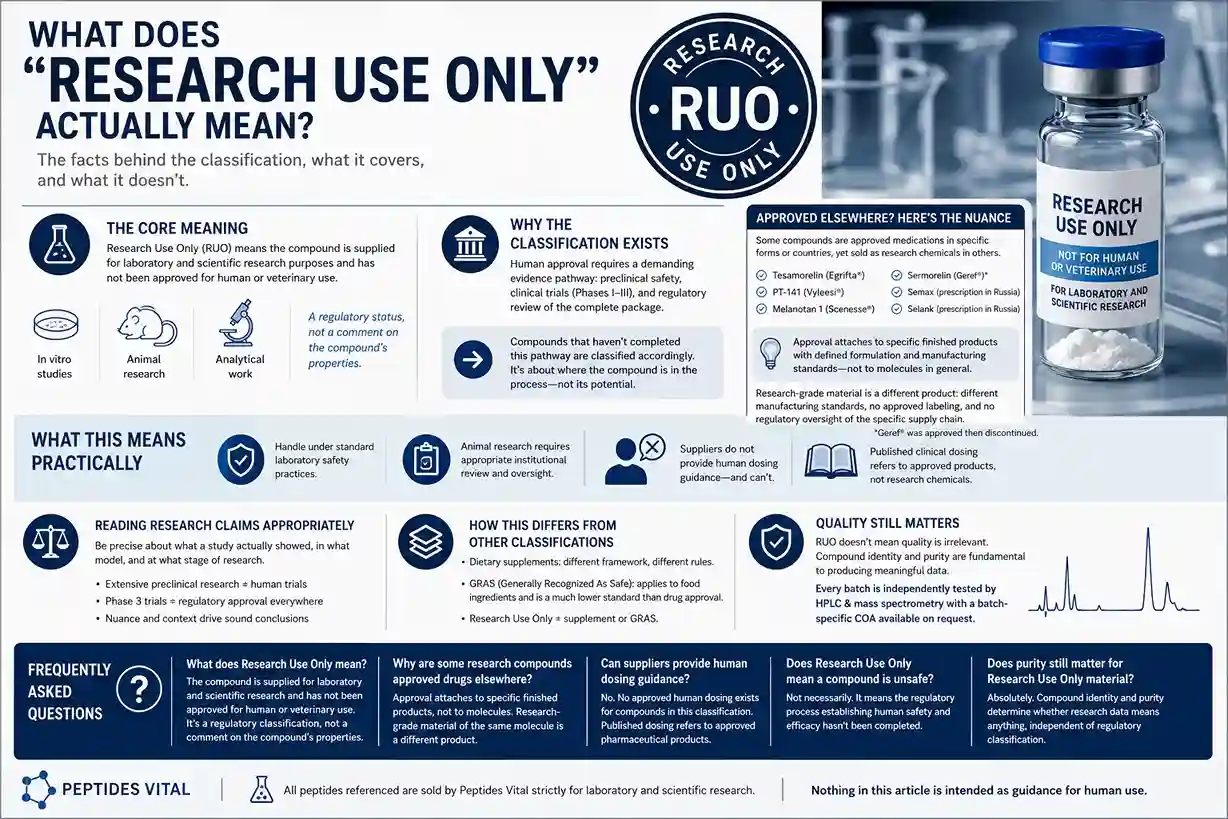
Research use only, often abbreviated RUO, means a compound is supplied for laboratory and scientific research purposes and has not been approved for human or veterinary use. This covers in vitro studies, animal research conducted under appropriate oversight, and analytical work.
The classification is a statement about regulatory status, not a comment on the compound’s properties. A research use only designation doesn’t mean a substance is unstudied, uninteresting, or necessarily unsafe. It means it hasn’t gone through the regulatory approval process required for human use in the jurisdiction where it’s sold.
Approving a substance for human use requires a specific and demanding evidence pathway: preclinical safety data, then clinical trials in phases establishing safety, dosing, and efficacy for a defined indication, then regulatory review of the complete package.
That process exists because determining whether a substance is safe and effective for people requires actually testing it in people, systematically, with monitoring and controls. Mechanistic plausibility and promising animal data are starting points, not substitutes.
Compounds that haven’t completed this pathway are classified accordingly. Some never entered it. Some are in progress. Some completed it in one country but not another. Some completed it and were later withdrawn for commercial rather than safety reasons.
This is where the classification gets genuinely nuanced, and understanding it prevents a common misreading.
Several compounds sold for research have approval histories. Tesamorelin is FDA-approved as Egrifta. PT-141 is approved as Vyleesi. Melanotan 1 is approved as Scenesse. Sermorelin was approved as Geref before discontinuation. Semax and Selank are approved prescription medications in Russia.
An approved pharmaceutical is a specific finished product: a defined formulation, manufactured under pharmaceutical quality standards, with an approved label specifying indication, dosing, and administration route. Research-grade material of the same molecule is not that product, even though the molecule is the same. Different manufacturing standards, different formulation, no approved labeling, no regulatory oversight of the specific supply chain.
So a compound can simultaneously be an approved medication in one form and a research chemical in another. That’s not a contradiction, it reflects that approval attaches to products rather than to molecules in the abstract.
For researchers, the classification carries several practical implications.
Research use only material should be handled under standard laboratory safety practices. Animal research requires appropriate institutional review and oversight, which is a legal and ethical requirement independent of a compound’s regulatory status.
Suppliers of research chemicals do not provide dosing guidance for human use, and that isn’t evasiveness. They aren’t in a position to, since no approved human dosing exists for a compound in this classification. Where published clinical dosing exists for an approved version of a molecule, that information describes the approved pharmaceutical product, not the research compound.
Understanding this classification also helps in evaluating claims. A compound with extensive preclinical research and no human trials, such as BPC-157, supports different conclusions than one with completed Phase 3 trials. Both may be legitimately interesting, but the evidence supports different levels of confidence.
Being precise about what a study actually showed, in what model, at what stage of research, is basic diligence. The research use only designation is a reminder that for these compounds, the regulatory process that would establish human safety and efficacy hasn’t been completed.
Research use only sits alongside several other classifications that are sometimes confused with it, and distinguishing them is useful.
Dietary supplements operate under a separate regulatory framework with different requirements, generally lower than pharmaceutical approval but involving specific rules around labeling and permitted claims. Compounds classified for research use are not supplements, and describing them as such misrepresents their status.
GRAS designation, meaning generally recognized as safe, is another classification that occasionally causes confusion. It applies to food ingredients and is a substantially lower bar than drug approval. A compound holding GRAS status has not thereby been approved as a medication, and conflating the two overstates what the designation establishes.
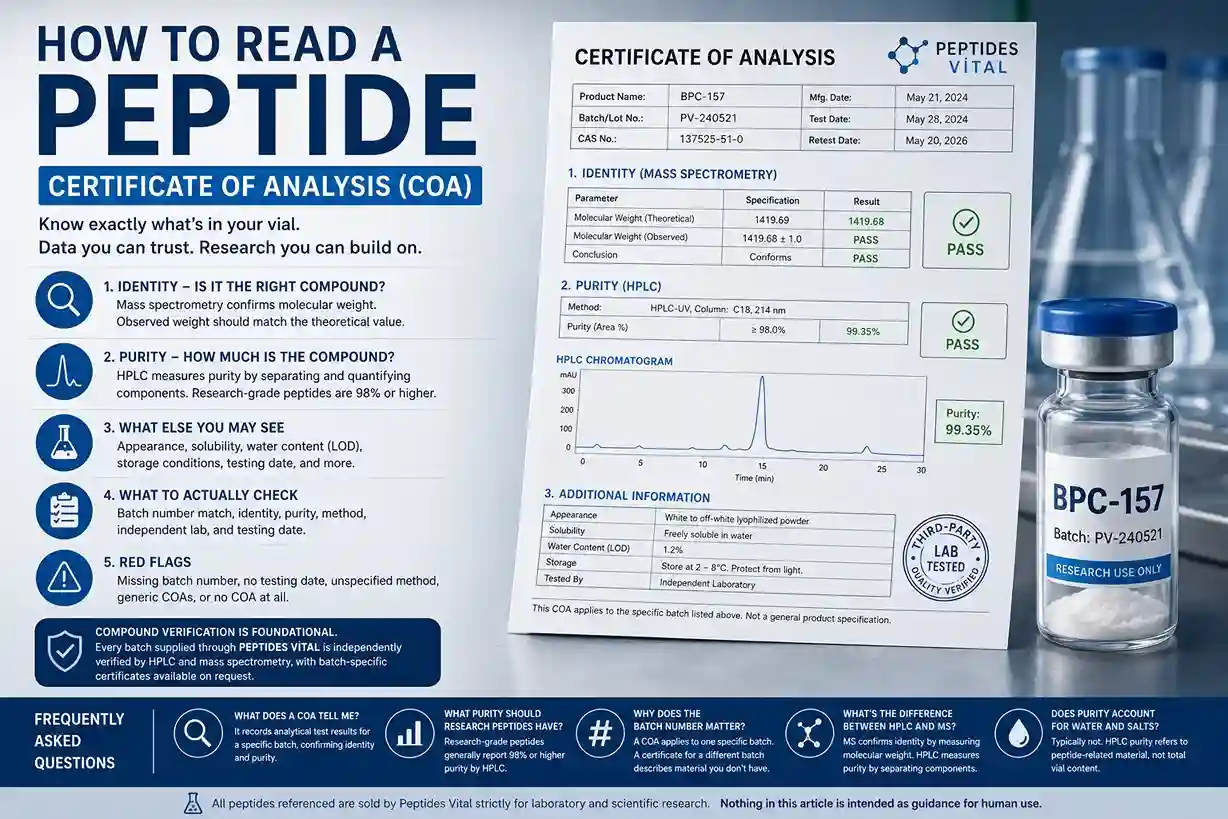
Research use only doesn’t mean quality is irrelevant. Compound identity and purity remain fundamental to producing meaningful data, which is why documented verification matters regardless of regulatory classification. Every batch supplied through Peptides Vital is independently tested by HPLC and mass spectrometry, with batch-specific certificates of analysis available on request.
What does research use only mean?
The compound is supplied for laboratory and scientific research and has not been approved for human or veterinary use. It’s a regulatory classification, not a comment on the compound’s properties.
Why are some research compounds approved drugs elsewhere?
Approval attaches to specific finished products with defined formulation and manufacturing standards, not to molecules generally. Research-grade material of the same molecule is a different product.
Can suppliers provide human dosing guidance?
No. No approved human dosing exists for compounds in this classification. Published clinical dosing figures describe approved pharmaceutical products, not research chemicals.
Does research use only mean a compound is unsafe?
Not necessarily. It means the regulatory process establishing human safety and efficacy hasn’t been completed, which is different from a finding that a compound is unsafe.
Does purity still matter for research use only material?
Absolutely. Compound identity and purity determine whether research data means anything, independent of regulatory classification.
All peptides referenced are sold by Peptides Vital strictly for laboratory and scientific research. Nothing in this article is intended as guidance for human use.