- Free shipping on all orders over $200 (US) and $300 (International)
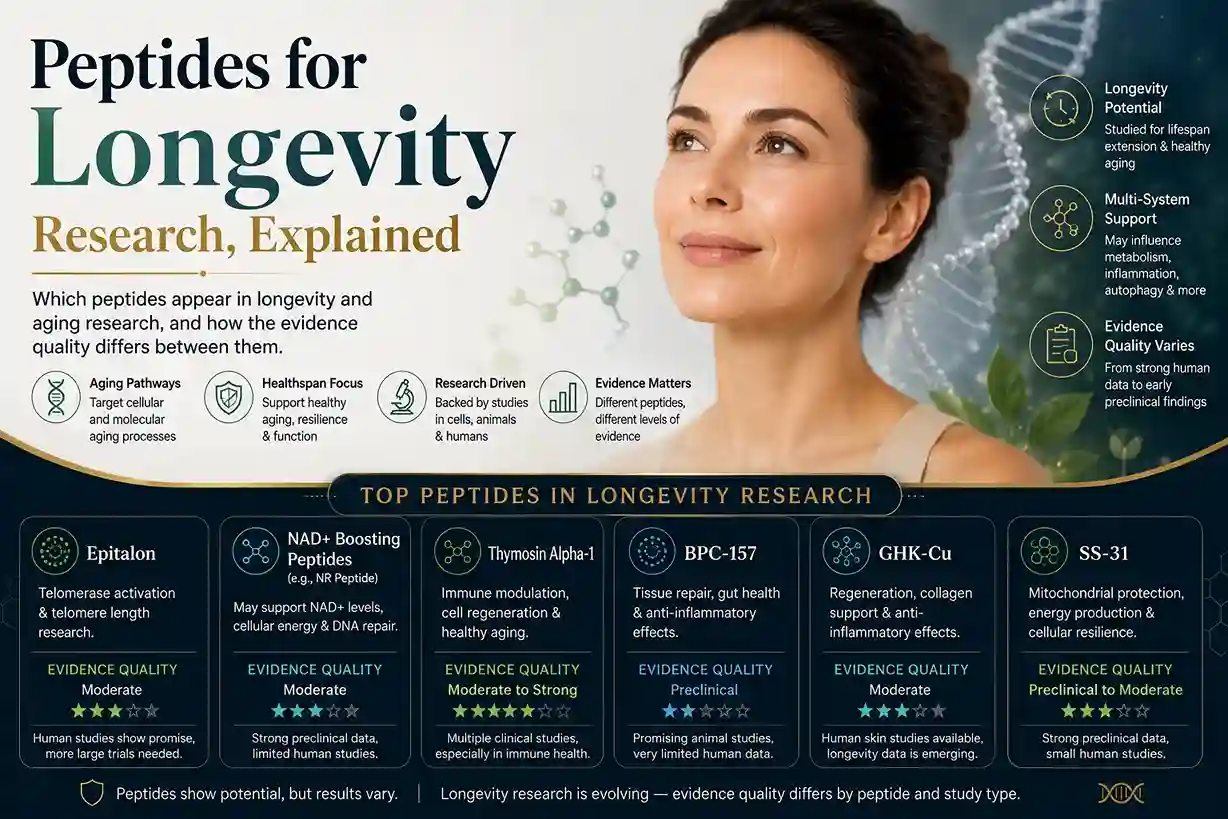
Longevity research attracts more speculation than most scientific fields, which makes it especially important to be clear about what the evidence actually shows for each compound. Several peptides appear in this space, approaching aging from genuinely different mechanistic angles, and their evidence bases vary widely in quality and independence.
NAD+ is not technically a peptide, it’s a dinucleotide, but it’s frequently studied and sold alongside research peptides because of overlapping interest in cellular energy and aging. It was first described in 1906 by biochemists Arthur Harden and William Young during fermentation research, making it one of the foundational discoveries in modern biochemistry. See the NAD+ product page.
Its role is as an electron carrier, accepting electrons to become NADH during metabolic reactions and donating them back during ATP production. That places it at the center of nearly every energy-producing pathway in the cell.
Modern longevity interest centers on NAD+ decline with age and its downstream effects on mitochondrial function and DNA repair, the latter through NAD+-dependent enzymes called sirtuins and PARPs. This has made NAD+ and its precursors among the most actively studied compounds in aging research over the past decade.
Epithalon is a synthetic tetrapeptide based on epithalamin, a bovine pineal gland extract. Its research is closely tied to Vladimir Khavinson’s program in Russia, focused primarily on telomerase activation. See the Epithalon product page.
Telomerase maintains telomeres, the protective chromosome end-caps that shorten with each cell division until cells enter senescence. A compound influencing telomerase sits at a mechanistically interesting point in cellular aging biology, which explains the research attention.
The honest caveat: this literature is concentrated among a small number of research groups and published substantially in Russian-language journals, with limited independent Western replication. That doesn’t make the findings wrong, but it means the evidence hasn’t been stress-tested through independent replication to the degree other compounds have. Treat it as an active research area rather than settled science.
Two compounds approach aging through mitochondrial function specifically. MOTS-c is notable for being encoded by mitochondrial DNA rather than nuclear DNA, one of only a handful of known mitochondrial-derived peptides. First described in 2015, it’s studied as a mitochondrial-to-nuclear signaling molecule, primarily through AMPK activation.
SS-31 takes a different approach, binding cardiolipin in the inner mitochondrial membrane. It has advanced considerably further through clinical development than most compounds here, studied as elamipretide by Stealth BioTherapeutics through Phase 2 and Phase 3 trials for Barth syndrome, primary mitochondrial myopathy, and dry age-related macular degeneration.
SS-31’s trial results have been mixed across indications, with some endpoints showing improvement and others not meeting primary targets. That’s worth stating as balanced context rather than treating registered trials as automatic validation.
Growth hormone declines with age, which has made GHRH analogs a recurring subject in aging research. Sermorelin has been examined for age-related growth hormone decline, building on data from its era as an approved pharmaceutical. Tesamorelin, which holds current FDA approval as Egrifta, has the deepest clinical trial base of any compound in this overview, though its approved indication is visceral fat reduction rather than aging.
A structural problem underlies all longevity research and is worth understanding before evaluating any specific compound.
Aging is not a single process with a single mechanism. Current frameworks describe multiple interacting hallmarks, including telomere attrition, mitochondrial dysfunction, cellular senescence, and impaired DNA repair, among others. Each compound in this overview addresses one or two of these at most.
This has direct implications for how findings should be read. A compound demonstrably affecting telomerase is influencing one hallmark, not aging as a whole. The same applies to mitochondrial function or NAD+ availability. Claims that jump from a specific mechanistic finding to broad longevity conclusions are making a leap the data does not support, and that leap is extremely common in how this research gets described outside the primary literature.
This is where an honest assessment matters most, because longevity research attracts claims that outrun the data.
Tesamorelin has genuine Phase 3 regulatory evidence, though for a specific indication rather than aging broadly. SS-31 has registered clinical trials with mixed results. NAD+ has extensive biochemical characterization dating to 1906 alongside a large but still-developing modern research base. MOTS-c has a compelling mechanism but a young evidence base, dating only to 2015. Epithalon has the most limited independent replication of the group.
Ranking these by mechanism interest produces a different order than ranking them by evidence strength, and being clear about which ranking you’re applying prevents a lot of confusion in this field.
NAD+ requires light and heat protection in addition to refrigeration, as it degrades under both. The peptides in this overview follow standard practice: reconstitution with bacteriostatic water and refrigerated storage at 2 to 8 degrees Celsius. All batches supplied through Peptides Vital are independently verified by HPLC and mass spectrometry.
Which longevity compound has the strongest evidence?
Tesamorelin has genuine Phase 3 regulatory data, though for visceral fat reduction rather than aging broadly. SS-31 has registered trials with mixed results across indications.
Is NAD+ a peptide?
No, it’s a dinucleotide. It’s studied alongside research peptides due to overlapping interest in cellular energy metabolism and aging.
How strong is the Epithalon evidence?
Limited in independent replication. The literature is concentrated among a small number of research groups, largely in Russian-language journals.
What makes MOTS-c different from other longevity compounds?
It’s encoded by mitochondrial DNA rather than nuclear DNA, positioning it as a signal carrying mitochondrial status information to the rest of the cell.
All peptides referenced are sold by Peptides Vital strictly for laboratory and scientific research. Nothing in this article is intended as guidance for human use.