- Free shipping on all orders over $200 (US) and $300 (International)

$94.00 – $374.00Price range: $94.00 through $374.00
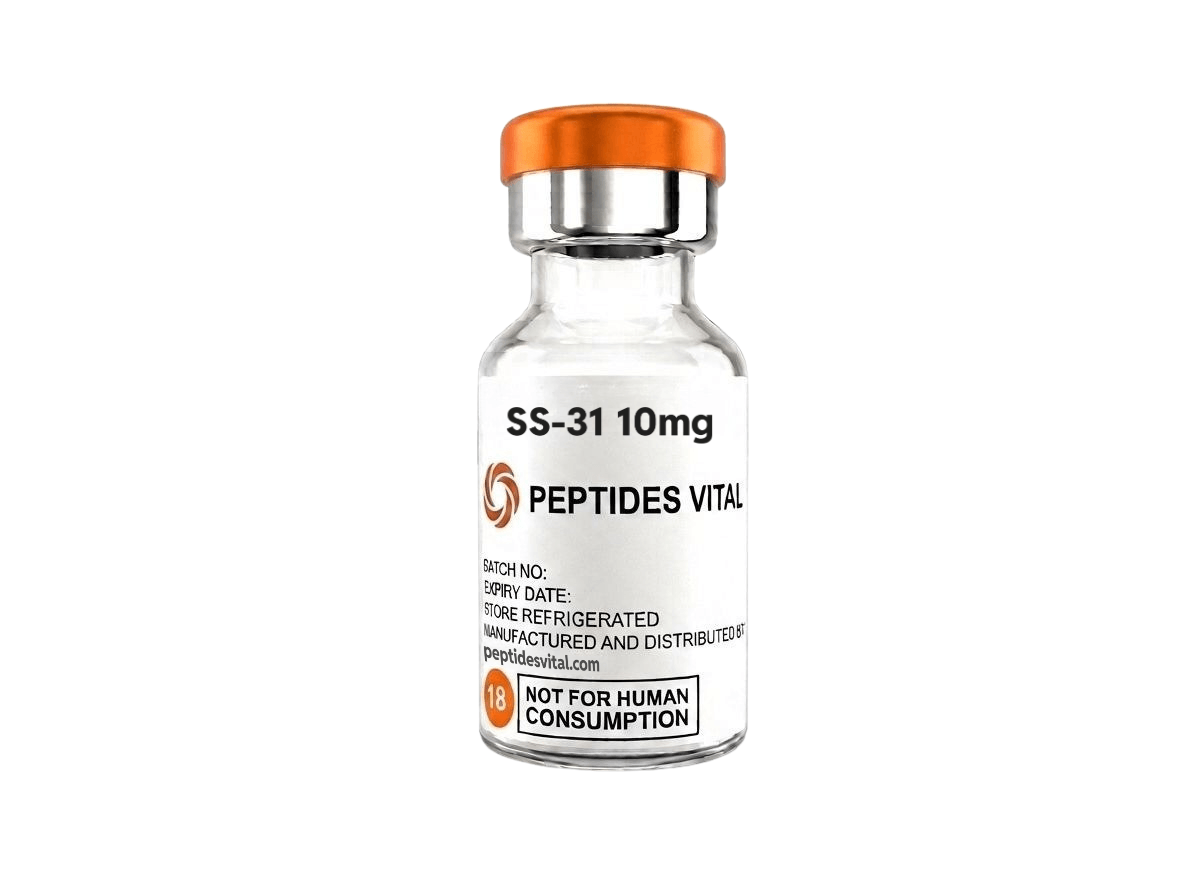
SS-31 is a synthetic mitochondria-targeted tetrapeptide with the sequence D-Arg-Dmt-Lys-Phe-NH2, where Dmt is 2′,6′-dimethyltyrosine. It binds cardiolipin, a phospholipid found almost only in the inner mitochondrial membrane. Developed under the name elamipretide by Stealth BioTherapeutics, it received FDA accelerated approval on September 19, 2025, as Forzinity for Barth syndrome, the first approved treatment for that rare mitochondrial disease. The molecular formula is C32H49N9O5, the molecular weight is 639.8 g/mol and the CAS number is 736992-21-5. Available in 10 mg and 50 mg options; each kit contains 10 vials of white to off-white lyophilized powder, verified by HPLC and mass spectrometry. For laboratory research use only. Not for human or veterinary use.
ℹ️ Note: 1 kit includes 10 vials
Free shipping on all orders over $200 (US) and $300 (International).
Every batch is HPLC & Mass Spectrometry verified. Full lab reports are available for every order within 30 days of purchase.
Your transactions are protected by our private, encrypted network. Supporting secure wire transfers and international invoicing.
SS-31 is a four-amino-acid peptide designed to reach the inside of mitochondria. Its name comes from Hazel Szeto and Peter Schiller, whose “Szeto-Schiller” peptides share an alternating pattern: positive charge, aromatic ring, positive charge, aromatic ring. In SS-31, D-arginine and lysine supply the positive charges, and Dmt and phenylalanine supply the aromatic rings. That pattern lets the peptide cross cell membranes and concentrate at the inner mitochondrial membrane.
There, SS-31 binds cardiolipin, the phospholipid that holds the inner membrane in its folded shape (cristae) and anchors the protein complexes that make ATP. Published studies report that SS-31 helps preserve cristae structure and inhibits cytochrome c’s peroxidase activity, a reaction that damages cardiolipin. The Dmt residue, a modified tyrosine, is the part of the molecule linked to scavenging reactive oxygen species.
SS-31 has an unusually deep clinical record for a research peptide. As elamipretide, it went through Phase 2 and Phase 3 trials in Barth syndrome, primary mitochondrial myopathy and dry age-related macular degeneration, and in 2025 the FDA approved it as Forzinity for Barth syndrome. The research-grade SS-31 sold here is not that drug. For related research compounds, see peptides for longevity research.
This product is strictly for research purposes only. Not approved for human or animal use.
| Property | Value |
|---|---|
| Also known as | Elamipretide, MTP-131, Bendavia |
| Sequence | D-Arg-Dmt-Lys-Phe-NH2 |
| Type | Tetrapeptide (4 amino acids), aromatic-cationic |
| Non-standard residues | D-arginine; Dmt (2′,6′-dimethyltyrosine) |
| Molecular formula | C32H49N9O5 |
| Molecular weight | 639.8 g/mol |
| CAS number | 736992-21-5 |
| Target | Cardiolipin, inner mitochondrial membrane |
| Property | Value |
|---|---|
| Options | 10 mg and 50 mg |
| Kit | 10 vials per kit |
| Form | White to off-white lyophilized powder |
| Solubility | Water-soluble |
| Testing | HPLC and mass spectrometry on every batch; lot COA available |
| Storage | Refrigerate at 2–8 °C (36–46 °F); −20 °C for long-term storage |
Preclinical research on SS-31 is broad. Studies have examined its effects on mitochondrial membrane potential, ATP production and oxidative stress in models of heart failure, kidney injury from interrupted blood flow, skeletal muscle and the brain. One frequently cited rat study reported that pretreatment protected cristae membranes during kidney ischemia and prevented mitochondrial swelling.
The clinical record is mixed, and worth reading honestly. Some trials of elamipretide missed their primary endpoints, including studies in primary mitochondrial myopathy. In Barth syndrome, the FDA granted accelerated approval in September 2025 based on improved knee-extensor muscle strength, an intermediate endpoint, and required a confirmatory trial to show that it translates into patient benefit.
That combination, broad preclinical data plus a real but limited clinical success, is what makes SS-31 a reference compound in mitochondrial research rather than a universally validated one. Every lot is verified by HPLC and mass spectrometry; because SS-31 contains two non-standard residues, the mass check is especially important. See how to read a peptide COA.
Mitochondrial dysfunction, through its binding to cardiolipin in the inner mitochondrial membrane. Research models include heart failure, kidney ischemia-reperfusion injury and age-related mitochondrial decline.
Yes. SS-31, elamipretide, MTP-131 and Bendavia are names for the same molecule.
Elamipretide received FDA accelerated approval on September 19, 2025, as Forzinity for Barth syndrome. Research-grade SS-31 is not that approved drug and is for laboratory use only.
Mixed results. Some trials missed their primary endpoints, while the Barth syndrome program showed improved muscle strength and led to accelerated approval, with a confirmatory trial required.
Szeto-Schiller, after Hazel Szeto and Peter Schiller, who developed this family of mitochondria-targeting peptides.
Refrigerated at 2–8 °C (36–46 °F), sealed, dry and away from light. For long-term storage, −20 °C. Available in 10 mg and 50 mg options, 10 vials per kit.
| Weight | 10mg, 50mg |
|---|
Jason Park –
First time ordering SS-31 from this vendor. CAS number (736992-21-5) matched perfectly. Vacuum seal was intact, and shipping was faster than expected. Will definitely be a repeat customer
Dr. Michelle Reynolds –
Excellent quality SS-31. I’ve tested peptides from several suppliers, and PeptidesVital ranks among the best. The product is clean, soluble, and consistent. Free shipping over $200 is a great perk
Dr. Anita Desai –
Very happy with my purchase. SS-31 reconstituted crystal clear and showed no signs of peptide aggregation. The price is fair for the quality offered. Will recommend to colleagues
Dr. Elena Vasquez –
SS-31 arrived promptly and in excellent condition. The lyophilized powder reconstituted beautifully with no residue. Our mitochondrial research depends on high-purity peptides, and this batch delivered. Highly recommend PeptidesVital
Dr. Sophia Chen –
International shipping was smooth and well-tracked. SS-31 arrived in perfect shape with clear labeling. The peptide performed exactly as expected in our assays. PeptidesVital is now my go-to supplier
Christopher Lane –
PeptidesVital consistently delivers top-notch products. SS-31 arrived well-packaged with documentation. Our lab has seen reproducible results across multiple trials. Definitely ordering in bulk next time
Brian Foster –
Reliable vendor with great customer support. Highly satisfied
Kevin Anderson –
Ordered SS-31 for a new research protocol. Very impressed with the purity and packaging. Customer service answered my questions about storage quickly. Five stars will order again