- Free shipping on all orders over $200 (US) and $300 (International)
Multi-peptide blends are common in research supply, and GLOW is among the most frequently referenced. It combines three compounds with independent research histories into a single formulation, which raises a reasonable question: what does combining them actually accomplish, and what has been studied?
Here is a component-by-component breakdown along with an honest account of where the evidence supports the combination and where it doesn’t.
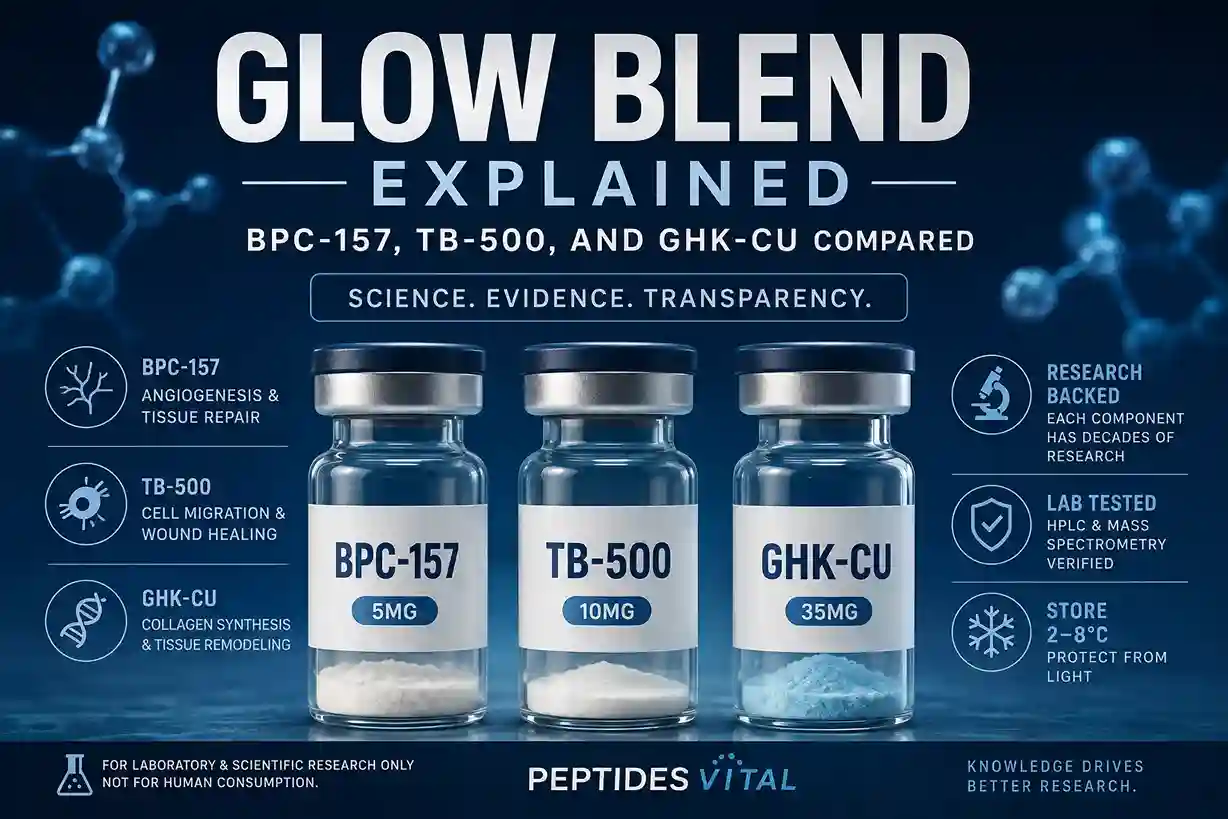
The standard 50mg kit contains BPC-157 (5mg), TB-500 (10mg), and GHK-Cu (35mg) in a 1:2:7 ratio. A higher-concentration 70mg option is also available, containing 10mg BPC-157, 10mg TB-500, and 50mg GHK-Cu. Full specifications are on the GLOW blend product page.
The powder carries a light blue tint, which comes from the copper content in GHK-Cu rather than any additive. That visual characteristic is a useful identifying feature.
BPC-157 is a synthetic pentadecapeptide, 15 amino acids, derived from a partial sequence of a protein found in human gastric juice. It was first characterized in the early 1990s. Its proposed mechanism centers on VEGFR2 activation, involved in angiogenesis, and nitric oxide signaling. See the BPC-157 product page for details.
Its research base is extensive but almost entirely preclinical, focused on gut lining repair, tendon and ligament healing, and blood vessel formation. Worth noting for regulatory context: the FDA added BPC-157 to its list of bulk drug substances presenting significant safety risks for compounding in 2023.
TB-500 is the synthetic form of a fragment of Thymosin Beta-4, a protein present in nearly all cell types, originally isolated from calf thymus tissue in 1981. Its defining mechanism is G-actin sequestration, which influences how quickly cells reorganize their internal structure to migrate toward a wound site. See the TB-500 product page.
The full-length Thymosin Beta-4 molecule has been through human clinical trials under the names RGN-259 and RGN-137. An important precision point: TB-500, the shorter fragment sold as a research compound, is not chemically identical to the full-length molecule used in those trials, though it contains the same core actin-binding region.
GHK-Cu is a copper-binding tripeptide identified in 1973 by Loren Pickart during human plasma research, where he observed higher concentrations in younger plasma than older. It occurs naturally in plasma, saliva, and urine. Its research focuses on collagen and elastin synthesis, matrix metalloproteinase regulation, and antioxidant activity. See the GHK-Cu product page.
At 35mg in the standard kit, GHK-Cu is the largest component by mass, making up 70 percent of the total formulation.
| BPC-157 | TB-500 | GHK-Cu | |
| Amount (50mg kit) | 5mg | 10mg | 35mg |
| Discovered | Early 1990s | 1981 | 1973 |
| Core mechanism | VEGFR2, nitric oxide | G-actin binding | Collagen synthesis, remodeling |
| Research emphasis | Gut, tendon repair | Cell migration, wound closure | Skin, collagen, hair follicle |
The rationale is mechanistic complementarity. Each compound is associated with a different stage of tissue repair rather than duplicating the same function.
Angiogenesis, cell migration, and collagen synthesis are sequential and interdependent processes in wound repair. Damaged tissue needs blood supply, cells need to physically migrate to the site, and structural proteins need to be produced and organized. Combining compounds studied for each of these addresses different points in that sequence.
That’s a coherent rationale. It’s also worth being clear about what kind of rationale it is: mechanistic reasoning drawn from each compound’s individual literature, not evidence from studying the combination.
This distinction matters enough to state directly rather than leaving implied.
Each of the three components has its own published research base, and those bases are real. BPC-157 has extensive animal literature. TB-500’s parent molecule has human clinical trial history. GHK-Cu has five decades of research behind it.
The GLOW combination itself has not been evaluated as a single formulation in published research. No study has tested whether these three compounds together produce effects different from what each produces individually, whether they interact, or whether the specific 1:2:7 ratio is optimal for anything.
Anyone assessing this formulation should understand they are working with a combination assembled from component evidence, not a studied formulation. That’s a legitimate research approach, but it’s different from what the individual component literature might suggest at a glance.
Two related formulations exist. The WOLVERINE blend is simpler, combining only BPC-157 and TB-500 at a 1:1 ratio without GHK-Cu. The KLOW blend is more complex, adding KPV, a tripeptide studied for anti-inflammatory effects in intestinal models, to GLOW’s three components.
The same evidence caveat applies to all three: each is assembled from component research rather than validated as a formulation.
GLOW is supplied as a lyophilized powder, water-soluble, with the characteristic light blue tint from its copper content. Store refrigerated at 2 to 8 degrees Celsius and protect from light, since the copper component is light-sensitive. Reconstitute with bacteriostatic water. Every batch supplied through Peptides Vital is independently verified by HPLC and mass spectrometry, with certificates of analysis available on request.
What’s in the GLOW blend?
BPC-157, TB-500, and GHK-Cu. The 50mg kit contains 5mg, 10mg, and 35mg respectively; a 70mg option contains 10mg, 10mg, and 50mg.
Has the GLOW blend been studied as a formulation?
No. Each component has independent research, but the combination itself has not been evaluated in published studies.
Why is the powder blue?
The copper(II) ion in GHK-Cu gives the blend its light blue tint. It’s a natural characteristic of the compound, not an additive.
How is GLOW different from WOLVERINE and KLOW?
WOLVERINE contains only BPC-157 and TB-500. GLOW adds GHK-Cu. KLOW adds both GHK-Cu and KPV.
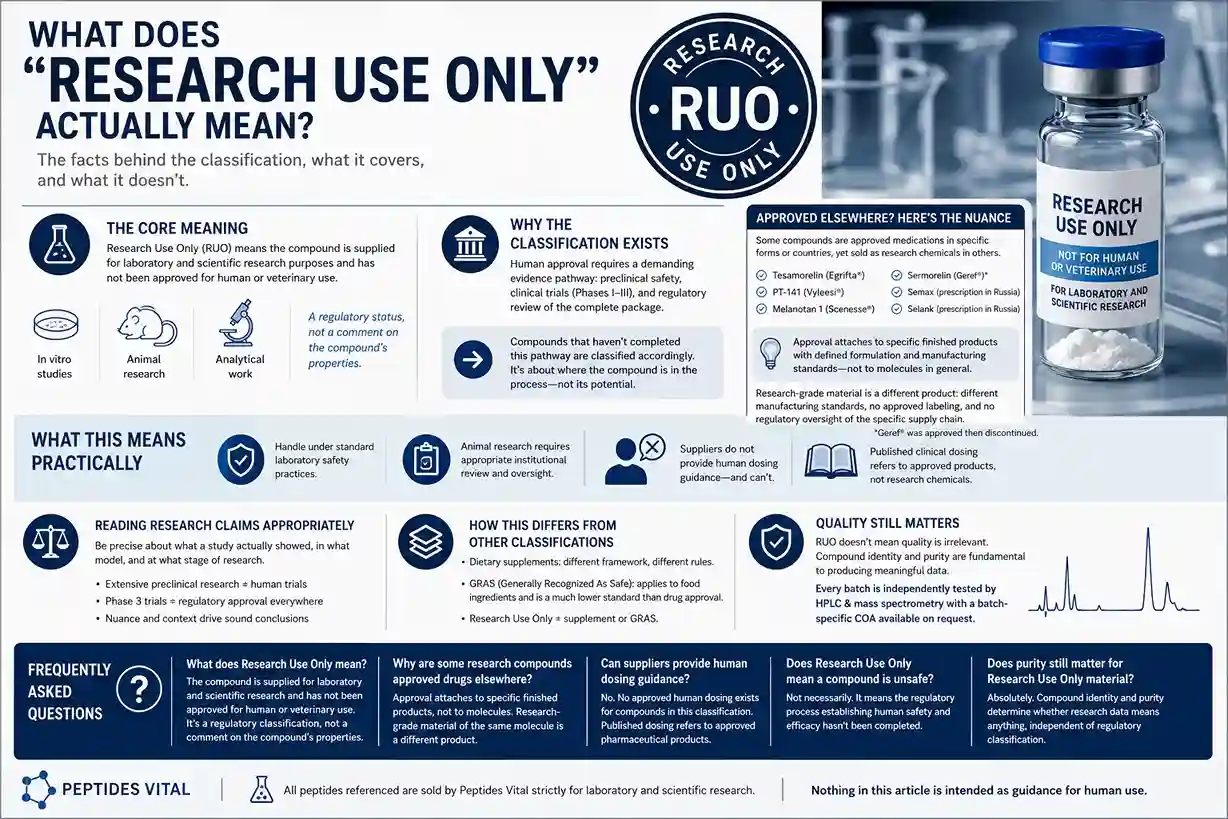
All peptides referenced are sold by Peptides Vital strictly for laboratory and scientific research. Nothing in this article is intended as guidance for human use.