- Free shipping on all orders over $200 (US) and $300 (International)

$100.00 – $165.00Price range: $100.00 through $165.00
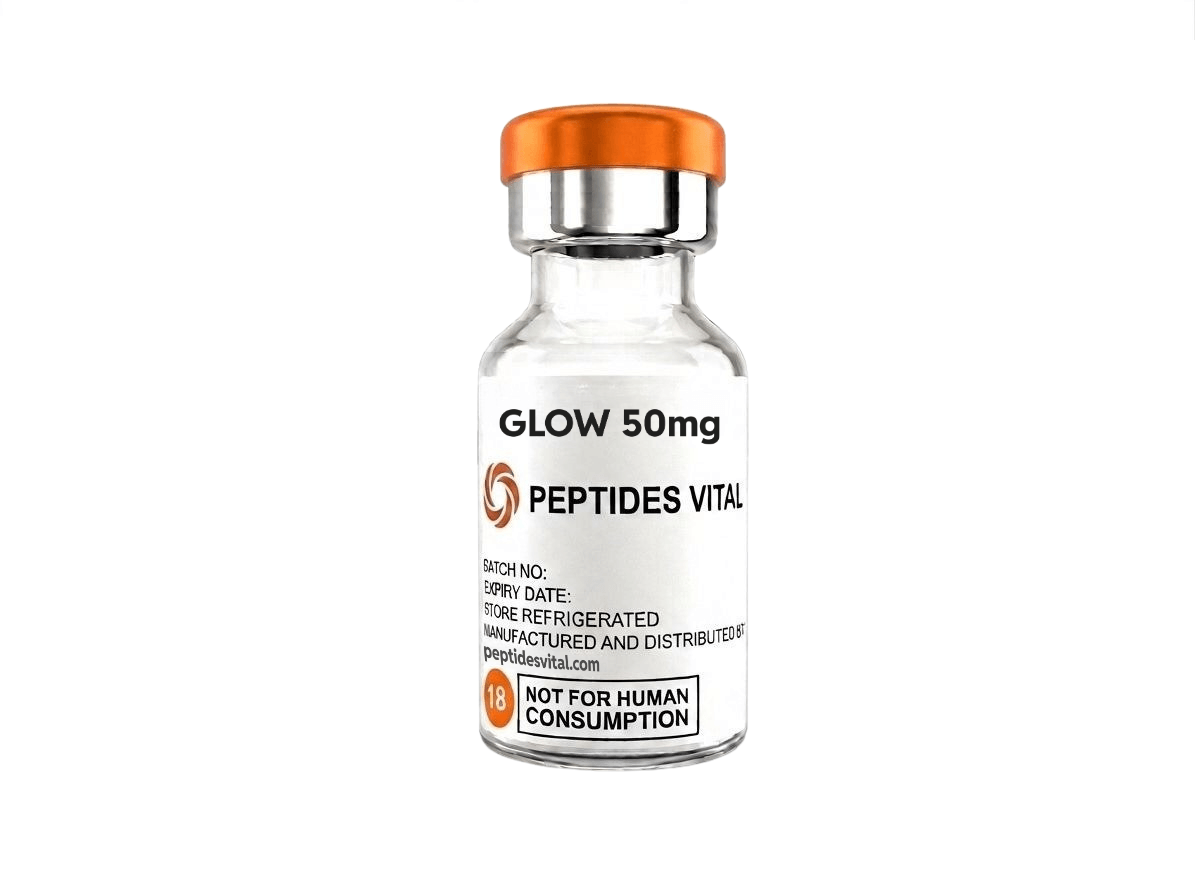
GLOW is a three-peptide research blend of BPC-157, TB-500 and GHK-Cu, supplied together as a lyophilized powder. The standard 50 mg option contains 5 mg BPC-157, 10 mg TB-500 and 35 mg GHK-Cu; the 70 mg option contains 10 mg BPC-157, 10 mg TB-500 and 50 mg GHK-Cu. BPC-157 is a synthetic 15-amino-acid peptide from a human gastric juice protein sequence, TB-500 is a synthetic peptide derived from thymosin beta-4, and GHK-Cu is a copper-bound tripeptide first isolated from human plasma by Dr. Loren Pickart in 1973. Each peptide has its own research literature; the blend has not been studied as a single formulation. The powder has a light blue tint from the copper. Each kit contains 10 vials, verified by HPLC and mass spectrometry. For laboratory research use only. Not for human or veterinary use.
ℹ️ Note: 1 kit includes 10 vials
Free shipping on all orders over $200 (US) and $300 (International).
Every batch is HPLC & Mass Spectrometry verified. Full lab reports are available for every order within 30 days of purchase.
Your transactions are protected by our private, encrypted network. Supporting secure wire transfers and international invoicing.
GLOW brings together three of the most widely studied research peptides in tissue-repair and skin-remodeling research. Each acts through a different proposed mechanism, which is the main reason they are studied side by side. GHK-Cu makes up the largest share of every GLOW vial. For the full background, read our GLOW blend explainer.
BPC-157 is a pentadecapeptide with the formula C62H98N16O22 and a molecular weight of about 1,419.5 g/mol. It has been studied largely in animal models of gut and soft-tissue repair, with proposed roles for VEGFR2 activation and nitric oxide signaling. TB-500 is derived from thymosin beta-4, an actin-binding protein studied for its role in cell migration and wound closure; see BPC-157 vs TB-500.
GHK-Cu is the tripeptide glycyl-L-histidyl-L-lysine bound to a copper(II) ion. It has a long research history in dermatology and wound care, where it is studied for collagen synthesis and tissue remodeling, and it is widely used in cosmetic science. See what is GHK-Cu and peptides for skin research.
The case for combining them comes from their separate, complementary research areas, not from a study of the blend. We say that plainly because it is what the literature supports.
This product is strictly for research purposes only. Not approved for human or animal use.
| Component | 50 mg option | 70 mg option | Structure | Molecular weight |
|---|---|---|---|---|
| BPC-157 | 5 mg | 10 mg | Gly-Glu-Pro-Pro-Pro-Gly-Lys-Pro-Ala-Asp-Asp-Ala-Gly-Leu-Val (15 aa) | 1419.5 g/mol |
| TB-500 | 10 mg | 10 mg | Synthetic thymosin beta-4 peptide | Confirmed on lot COA |
| GHK-Cu | 35 mg | 50 mg | Gly-His-Lys copper(II) complex (3 aa) | 340.4 g/mol (GHK peptide) |
| Property | Value |
|---|---|
| Ratio | 1:2:7 in the 50 mg option; 1:1:5 in the 70 mg option (BPC-157 : TB-500 : GHK-Cu) |
| Kit | 10 vials per kit |
| Form | Lyophilized powder with a light blue tint |
| Solubility | Water-soluble |
| Testing | HPLC and mass spectrometry on every batch; lot COA lists all three components |
| Storage | Refrigerate at 2–8 °C (36–46 °F); −20 °C for long-term storage |
Each GLOW component has its own body of research. BPC-157 work is mostly preclinical, centered on gut-lining and soft-tissue repair and on blood vessel formation. Thymosin beta-4 research focuses on actin binding and cell migration during wound closure, with some early human studies on the full-length protein. GHK-Cu has the longest history of the three: decades of skin, collagen and wound-remodeling studies since its discovery in human plasma, plus extensive cosmetic-science use.
In July 2026, the FDA’s compounding advisory panel recommended BPC-157 and TB-500 for the list of substances pharmacies may compound; the FDA has not yet acted on that. Injectable GHK-Cu is due before the panel by the end of February 2027, while non-injectable GHK-Cu has been allowed for compounding since 2023. See the FDA’s next peptide review. None of this changes the status of research materials.
Want to compare blends? The WOLVERINE blend has only BPC-157 and TB-500, and the KLOW blend adds KPV. Our KLOW vs GLOW guide compares the two in detail.
Three research peptides: BPC-157, TB-500 and GHK-Cu. The 50 mg option has 5 mg, 10 mg and 35 mg of each; the 70 mg option has 10 mg, 10 mg and 50 mg.
The 70 mg option doubles the BPC-157 (10 mg instead of 5 mg) and raises GHK-Cu from 35 mg to 50 mg. TB-500 stays at 10 mg in both.
No. Each peptide has its own published research, but the three-peptide combination has not been evaluated as one formulation.
The color comes from GHK-Cu, which is a copper complex. A light blue tint is expected.
KLOW contains everything in GLOW plus a fourth peptide, KPV, at 80 mg total.
Refrigerated at 2–8 °C (36–46 °F), sealed, dry and away from light. For long-term storage, −20 °C. The lot COA should confirm all three components; see how to read a peptide COA.
| QTY | Buy 1, Buy 12+ and save 20%, Buy 3 and save 10%, Buy 6 and save 15% |
|---|---|
| Weight | 50mg, 70mg |
Lara Kovalenko –
Ordering from Germany was hassle-free. The GLOW blend arrived in perfect condition, and I was kept updated on tracking every step of the way. PeptidesVital’s customer support is responsive and helpful. Excellent experience from start to finish.
Dr. Amanda Foster –
I was a bit skeptical about ordering internationally, but PeptidesVital exceeded my expectations. The GLOW blend arrived in less than two weeks to London. Purity seems excellent, and the price is fair for the quality. I’ve already placed my second order. Thank you!
Chen Martin –
Finding a reliable peptide supplier in Asia isn’t easy, but PeptidesVital delivered to Singapore without any issues. The GLOW blend’s quality is consistent with the COA they provide. Shipping was well-packaged, and the free international shipping over $300 saved me a lot. Very satisfied
James O’Connor –
International shipping to Ireland was smooth and surprisingly quick. The GLOW blend arrived well-packaged and intact. PeptidesVital has earned my trust — great quality and transparent about their 90% purity for research. Will definitely order again.
Dr. Marcus Allen –
As a research professional, I appreciate companies that are honest PeptidesVital delivers exactly what they promise. The GLOW blend reconstituted beautifully, and the quality is impressive. My go to supplier now
Claudia Zhang –
I’ve ordered from several peptide suppliers, but PeptidesVital stands out. The GLOW blend is consistent, and their free shipping threshold for international orders ($300) is fair. My package reached Vancouver in just over a two days