- Free shipping on all orders over $200 (US) and $300 (International)
A certificate of analysis is the document that tells you what is actually in a vial, as opposed to what a product label claims. For research work, that distinction matters, since data collected using a misidentified or degraded compound is data that can’t be trusted regardless of how carefully the rest of the study was run.
COAs can look intimidating if you haven’t read one before. Most of the content is straightforward once you know what each section is reporting.
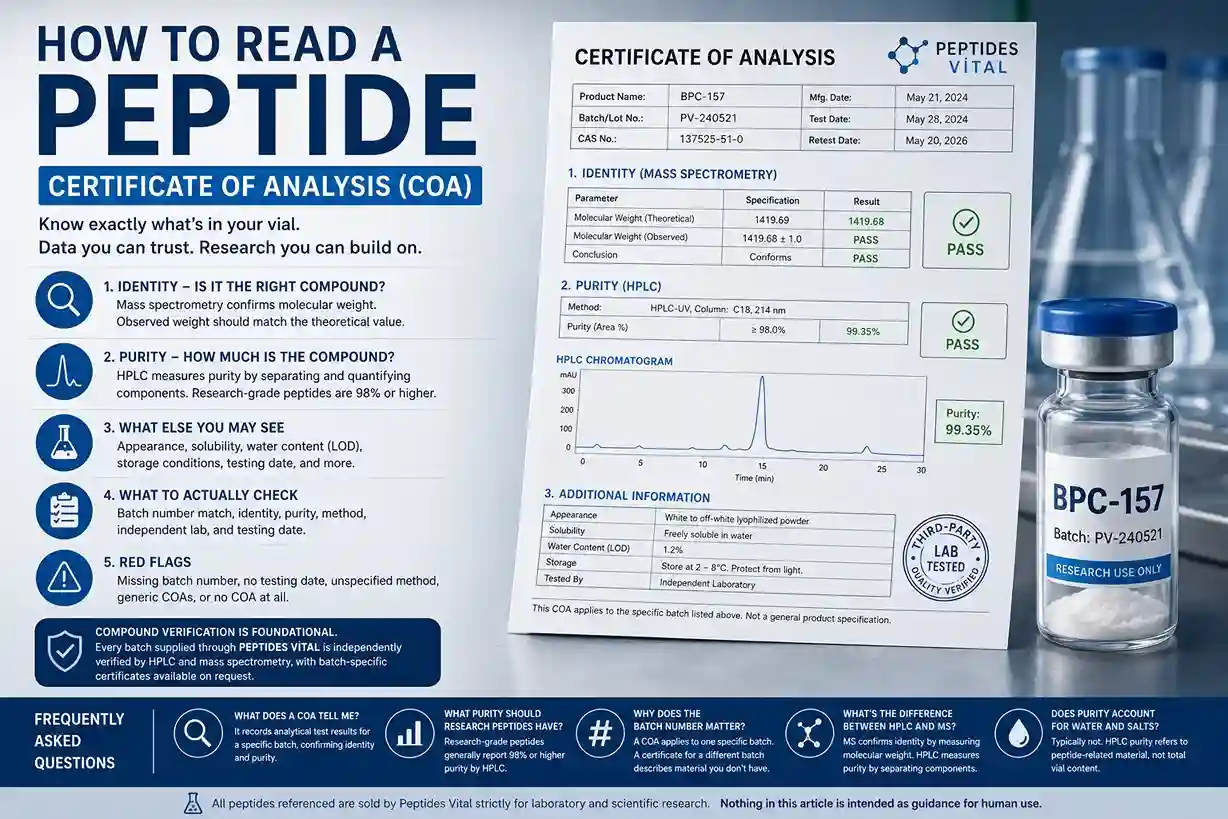
A certificate of analysis is a document produced by an analytical laboratory recording the results of tests performed on a specific batch of material. The key word is specific: a COA applies to one batch, identified by a batch or lot number, not to a product line generally.
This is why batch numbers matter. A COA for a different batch of the same product tells you about material you don’t have. Matching the batch number on your vial to the batch number on the certificate is the first thing to check.
The first question a COA answers is whether the material is what it claims to be, and this is typically established through mass spectrometry.
Mass spectrometry measures the molecular weight of a compound with high precision. Every peptide has a specific expected molecular weight determined by its amino acid sequence. If the measured weight matches the expected weight, that’s strong evidence the correct molecule is present.
On a COA, you’ll typically see both values: the theoretical or expected molecular weight, and the observed or measured value. These should match closely. A meaningful discrepancy indicates something other than the labeled compound.
The second question is what proportion of the material is the intended compound versus impurities, byproducts, or degradation products. This is usually established through HPLC, high-performance liquid chromatography.
HPLC separates the components of a mixture and measures how much of each is present. The result is typically expressed as a percentage, and research-grade peptides generally report 98 percent or higher.
Many COAs include the actual chromatogram, a graph showing peaks corresponding to detected components. The main peak represents the target compound, and its size relative to other peaks corresponds to purity. You don’t need to interpret the graph in detail, but its presence is a good sign, since it means the lab is showing its work rather than only reporting a number.
A purity figure alone doesn’t tell the whole story, and understanding what it does and doesn’t cover prevents overinterpretation.
HPLC purity refers to the proportion of peptide-related material that is the target peptide. It typically doesn’t account for non-peptide content such as residual water, salts, or counterions from synthesis. This means a vial labeled with a certain peptide mass may contain somewhat less actual peptide than the stated amount, depending on how it was manufactured and characterized.
This isn’t misconduct, it’s a known characteristic of how peptide purity is conventionally reported. It’s simply worth understanding when precise quantities matter to a research protocol.
COAs vary in comprehensiveness. Beyond identity and purity, you may encounter appearance, describing the physical form and color of the material; solubility information; water content, sometimes reported as loss on drying; and storage recommendations.
Some certificates include testing dates and the analyst or laboratory performing the work. Third-party testing, where analysis is performed by a laboratory independent of the manufacturer, carries more weight than in-house testing alone, since it removes the conflict of interest inherent in a supplier verifying its own material.
For practical purposes, a short checklist covers most of what matters.
Confirm the batch number matches your vial. Confirm the compound name and any identifiers like CAS number match what you ordered. Check that observed molecular weight aligns with the theoretical value. Check that purity meets your requirements, generally 98 percent or higher for research use. Note whether testing was performed by an independent laboratory. Check the testing date, since older certificates say less about current material condition if storage has been prolonged.
A few patterns suggest a certificate deserves closer scrutiny.
A COA with no batch number, or one that doesn’t match your vial, tells you nothing verifiable about your material. Purity reported without specifying the method used is less meaningful than a figure tied to a stated HPLC protocol. A certificate with no testing date leaves you unable to assess how current the analysis is.
Generic certificates that appear identical across different batches are worth questioning, since genuine batch testing produces batch-specific results with natural minor variation. And a supplier unwilling to provide a certificate at all, for material sold on the basis of documented purity, has answered the question in a different way.
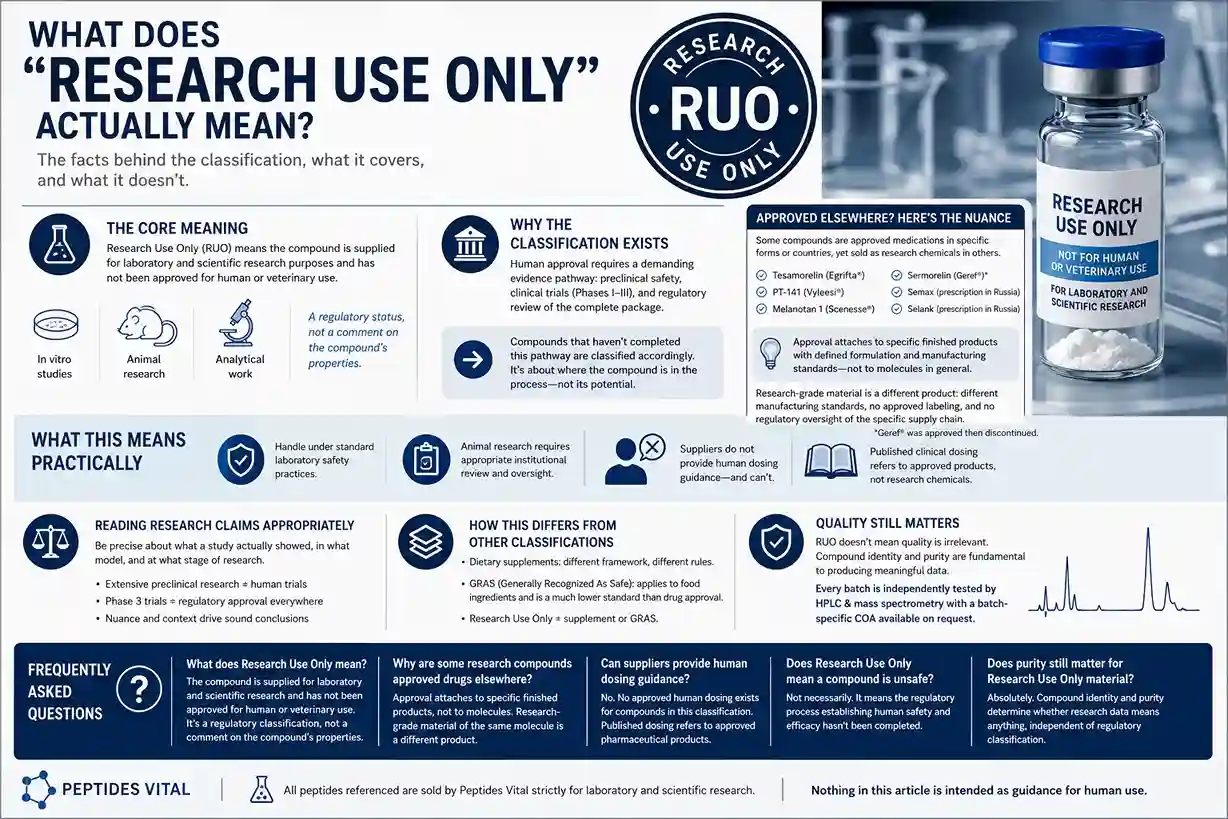
Compound verification is foundational rather than optional. A study using material that isn’t what it claims to be produces results that mean nothing, and the problem often isn’t detectable from the data itself, which is what makes it dangerous. Every batch supplied through Peptides Vital is independently verified by HPLC and mass spectrometry, with batch-specific certificates available on request. Documented verification at the point of purchase establishes the baseline; proper storage and handling maintain it from there.
What does a COA tell me?
It records analytical test results for a specific batch, confirming compound identity through mass spectrometry and purity through HPLC.
What purity should research peptides have?
Research-grade peptides generally report 98 percent or higher purity by HPLC.
Why does the batch number matter?
A COA applies to one specific batch. A certificate for a different batch describes material you don’t have.
What’s the difference between HPLC and mass spectrometry?
Mass spectrometry confirms identity by measuring molecular weight. HPLC measures purity by separating and quantifying components in the sample.
Does purity percentage account for water and salts?
Typically not. HPLC purity refers to peptide-related material, so total vial content may include residual water, salts, or counterions from synthesis.
All peptides referenced are sold by Peptides Vital strictly for laboratory and scientific research. Nothing in this article is intended as guidance for human use.