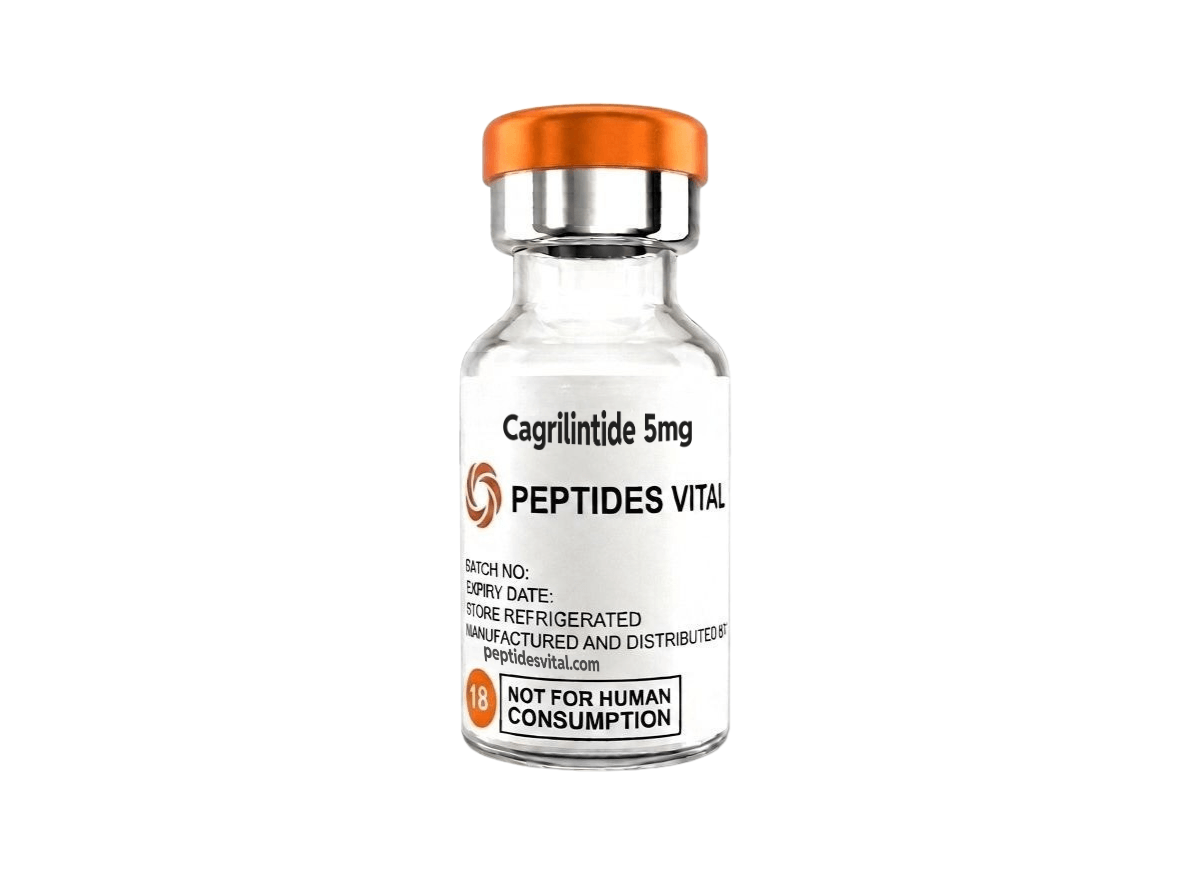
Cagrilintide is a synthetic analog of amylin, a 37-amino-acid peptide hormone naturally co-secreted with insulin from pancreatic beta cells. It was designed as a long-acting version of native amylin, with specific amino acid substitutions and an acylation, the attachment of a fatty acid chain, that slows clearance from solution.
Cagrilintide’s primary research interest comes from its role in combination weight-loss research. Amylin works as a satiety signal alongside insulin, slowing gastric emptying and reducing food intake through a mechanism distinct from GLP-1 receptor agonists like semaglutide. Novo Nordisk has studied cagrilintide combined with semaglutide, under the investigational name CagriSema, in Phase 3 trials, with published data showing meaningfully greater weight loss than semaglutide alone in trial populations, on the premise that combining an amylin agonist with a GLP-1 agonist targets complementary appetite-regulation pathways.
The compound has the molecular formula C194H312N54O59S2, molecular weight approximately 4,409 g/mol, CAS 1415456-99-3, classified as an acylated amylin receptor agonist. The fatty acid sidechain enables albumin binding and extends the molecule’s half-life substantially compared to native amylin, which breaks down within minutes in solution. This product is strictly for research purposes only.
PubChem Reference: View compound profile on NIH PubChem

Prof. Gregory S. Whitman –
A superior synthetic amylin analog. The specific amino acid substitutions reduce aggregation compared to native peptide. My postdocs noted reproducible results in replicate experiments highly
Dr. Fatima Z. El-Sayed –
Very effective in our in vivo pharmacokinetic trials. The long duration of action allowed for once-daily dosing in animal models. Shipping was prompt and lyophilized powder arrived intact
Prof. David K. Murakami –
Perfectly matched the published molecular weight of 4.3 kDa via MALDI-TOF. Solubility in alkaline buffer was excellent. Reliable supplier for long-acting peptide studies
Dr. Rebecca T. Lawson –
Exceptional purity and consistency across multiple batches. The fatty acid acylation delivers the expected extended half-life in our rodent models. Gold standard for amylin analog research in my lab
Dr. Anita K. Patel –
Good value for the price range ($110–$168). Activity in receptor binding assays matched literature values within 5%. Would appreciate slightly faster dry ice shipment, but overall excellent product
Prof. Lars E. Johansson –
Flawless performance in both cell-based and biochemical assays. The C194H312N62O50S7 composition was verified by our lab’s elemental analysis. Already placed a repeat order for our metabolic research cohort