- Free shipping on all orders over $200 (US) and $300 (International)

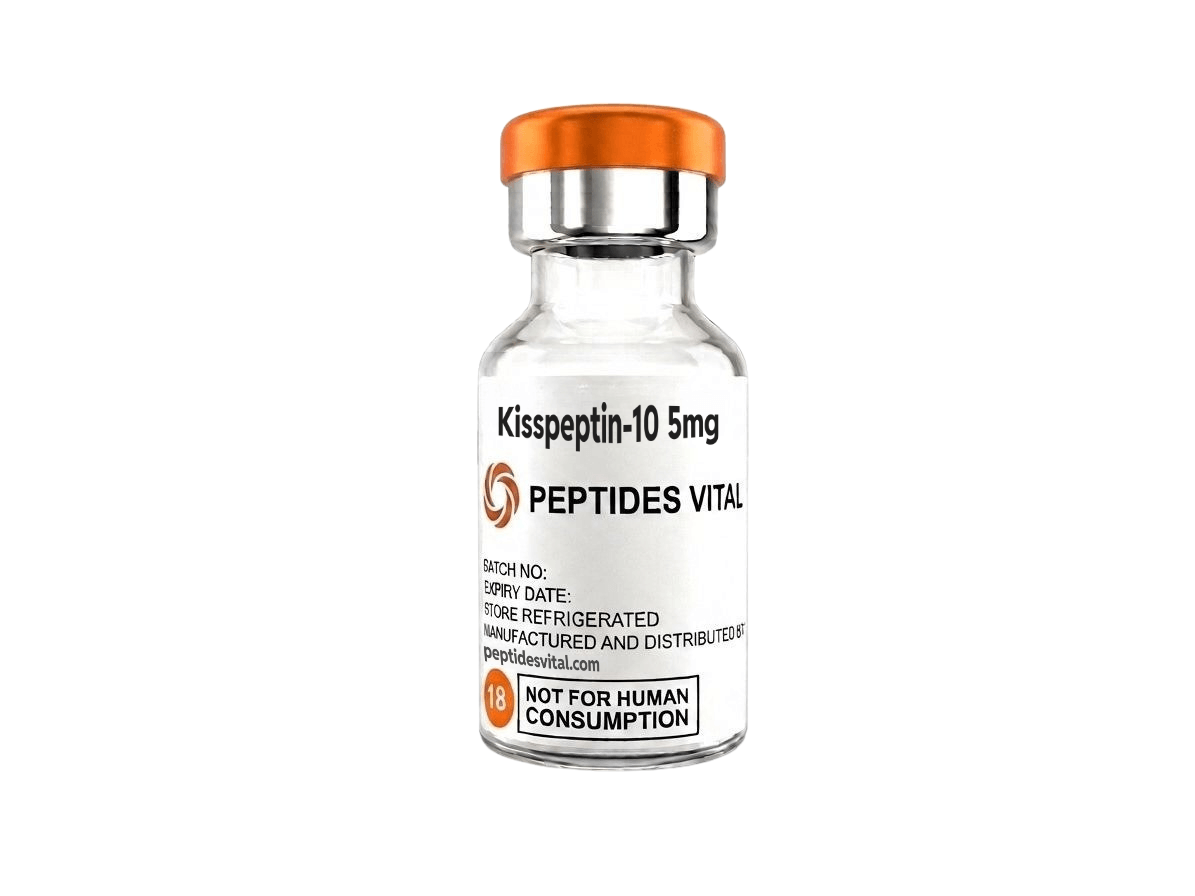
$56.00 – $112.00Price range: $56.00 through $112.00
Kisspeptin-10 is a decapeptide with the sequence Tyr-Asn-Trp-Asn-Ser-Phe-Gly-Leu-Arg-Phe-NH2, the shortest bioactive fragment of the larger kisspeptin-54 protein encoded by the KISS1 gene, first identified in 1996 at Pennsylvania State University, originally in the context of cancer metastasis research (KISS1 was initially studied as a metastasis-suppressor gene, which is where the “kiss” name comes from, a nod to Hershey’s Kisses chocolate, made in Hershey, Pennsylvania). Kisspeptin later became central to reproductive endocrinology research once its role in triggering GnRH (gonadotropin-releasing hormone) release was discovered. It has the molecular formula C63H83N17O14, molecular weight 1,302.45 g/mol, CAS 374675-21-5. Supplied as a white lyophilized powder with purity of 98% or higher by HPLC. This product is strictly for research purposes only.
ℹ️ Note: 1 kit includes 10 vials
Free shipping on all orders over $200 (US) and $300 (International).
Every batch is HPLC & Mass Spectrometry verified. Full lab reports are available for every order within 30 days of purchase.
Your transactions are protected by our private, encrypted network. Supporting secure wire transfers and international invoicing.
Kisspeptin-10 is a decapeptide, a chain of ten amino acids, sequence Tyr-Asn-Trp-Asn-Ser-Phe-Gly-Leu-Arg-Phe-NH2, the shortest bioactive fragment of the kisspeptin-54 protein encoded by the KISS1 gene. The gene was first identified in 1996 at Pennsylvania State University, originally in cancer research as a metastasis-suppressor gene, molecular formula C63H83N17O14, molecular weight 1,302.45 g/mol, CAS 374675-21-5.
Kisspeptin’s research significance shifted substantially after its role in reproductive endocrinology was discovered: the KISS1 gene product was found to be the natural ligand for the GPR54 receptor (now called the kisspeptin receptor), and kisspeptin signaling was identified as the key upstream trigger for GnRH release from the hypothalamus, the hormone that governs the entire reproductive hormonal cascade (LH, FSH, and downstream sex hormone production). This discovery repositioned kisspeptin from a cancer-research curiosity into one of the most studied peptides in reproductive and fertility research, including work on puberty onset, fertility regulation, and hypothalamic hormone signaling.
The C-terminal amide group (-NH2) on the final phenylalanine residue is a defining structural feature, distinguishing Kisspeptin-10 from truncated variants lacking this modification. It is supplied as a white lyophilized powder, highly soluble in bacteriostatic water, purity 98% or higher by HPLC. This product is strictly for research purposes only.
PubChem Reference: View compound profile on NIH PubChem
This product is strictly for research purposes only. Not approved for human or animal use.
Formula: C₆₃H₈₃N₁₇O₁₄
Weight: 1302.45 g/mol
CAS: 374675-21-5
Sequence: Tyr-Asn-Trp-Asn-Ser-Phe-Gly-Leu-Arg-Phe-NH₂
Form: White lyophilized powder
Purity: ≥98% (HPLC)
Solubility: Highly soluble in bacteriostatic water
Storage: Keep refrigerated 36‑46 °F (2‑8 °C)
Kisspeptin-10 is widely used as a research tool for studying the hypothalamic-pituitary-gonadal (HPG) axis, since it directly triggers GnRH release, making it useful for probing reproductive hormone signaling without needing to work with the larger, less stable kisspeptin-54 parent molecule. Published research has explored its role in puberty timing, fertility and ovulation research, and as an investigational approach to reproductive hormone disorders, building on the foundational discovery of the KISS1/GPR54 signaling pathway.
Reproductive endocrinology research, since it triggers GnRH release and sits upstream of the entire reproductive hormone cascade.
Kisspeptin signaling is essential for puberty onset and ovulation, making Kisspeptin-10 a key tool for studying fertility and reproductive hormone regulation.
The KISS1 gene was named after Hershey’s Kisses chocolate, discovered at Penn State, located in Hershey, Pennsylvania.
Bacteriostatic water, refrigerate 2–8°C.
5mg and 10mg kits, HPLC/MS verified.
| Weight | 5mg, 10mg |
|---|
Reviews
There are no reviews yet.