- Free shipping on all orders over $200 (US) and $300 (International)
Melanotan 1 and Melanotan 2 share a name, a research lineage, and a parent hormone. What they don’t share is a structure, a receptor profile, or a regulatory status, and those differences are substantial enough that treating them as two versions of the same thing leads to real confusion.
Both are analogs of alpha-melanocyte-stimulating hormone (alpha-MSH), a naturally occurring peptide involved in pigmentation and several other physiological processes. Beyond that shared starting point, they diverge in ways that matter for anyone evaluating which is relevant to a given research question.
Melanotan 1, also known as afamelanotide, is a linear 13-amino-acid analog of alpha-MSH, first synthesized in the 1980s by modifying the native sequence for greater chemical stability and enzymatic resistance. “Linear” here means the amino acid chain runs in a straight sequence without internal ring structures. Complete molecular data is available on the Melanotan 1 product page.
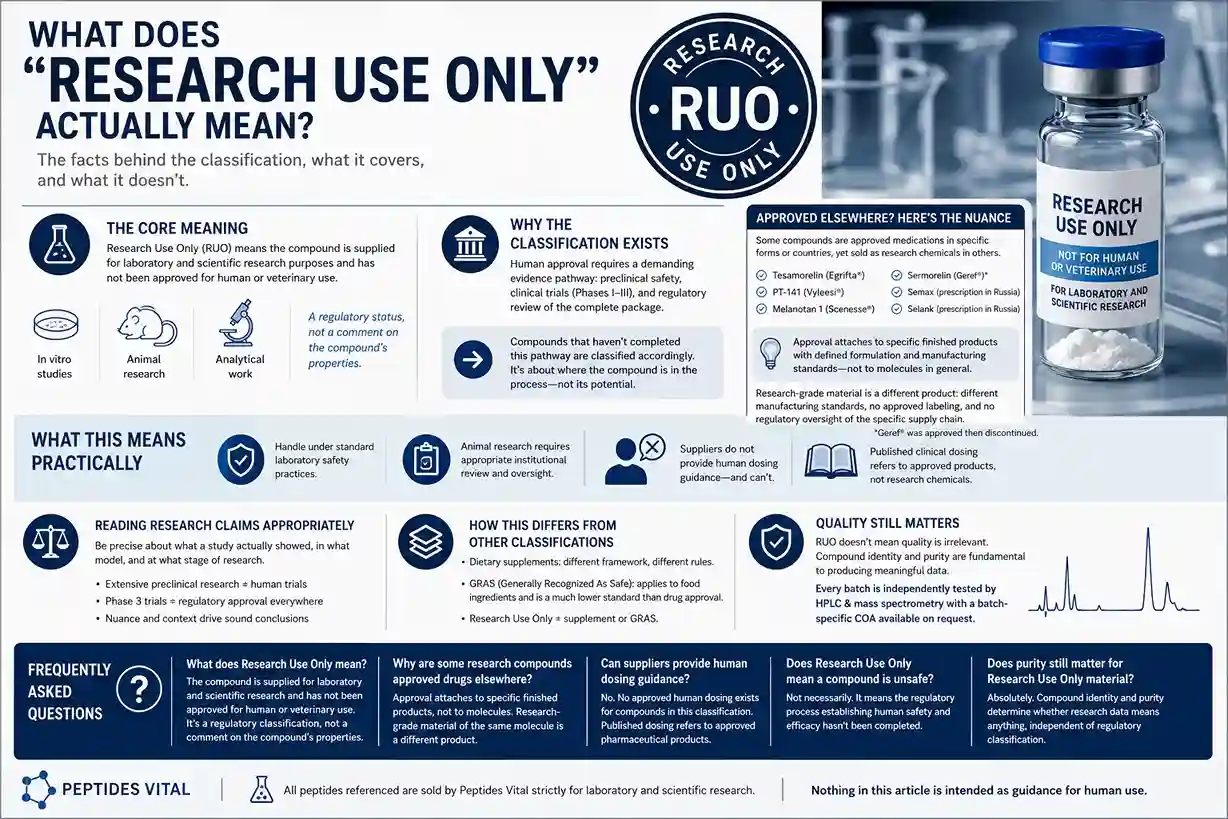
The most significant thing about Melanotan 1 is its regulatory standing. Its pharmaceutical form is FDA-approved under the brand name Scenesse, delivered as a subcutaneous implant for erythropoietic protoporphyria (EPP), a rare genetic disorder in which patients experience severe pain and skin damage from even minimal light exposure. That approval means Melanotan 1 has a genuine clinical trial history and published safety data, which is uncommon among compounds in this category.
Melanotan 2 is a cyclic heptapeptide, developed at the University of Arizona in the 1990s. Its defining structural feature is a lactam bridge, an internal chemical bond connecting two amino acid side chains that closes the molecule into a ring shape. That ring makes it more compact and more resistant to enzymatic breakdown than a linear equivalent. See the Melanotan 2 product page for full specifications.
The cyclic structure has a direct functional consequence: it gives Melanotan 2 structural compatibility with multiple melanocortin receptor subtypes rather than just one. This is the single most important distinction between the two compounds.
| Melanotan 1 | Melanotan 2 | |
| Structure | Linear, 13 amino acids | Cyclic (lactam bridge), 7 amino acids |
| Receptor activity | Selective for MC1R | MC1R, MC3R, MC4R, MC5R |
| Also known as | Afamelanotide | MT-2 |
| Regulatory status | FDA-approved as Scenesse | Not approved |
| Developed | 1980s | 1990s, University of Arizona |
| Notable derivative | — | PT-141 (bremelanotide) |
The melanocortin system consists of five known receptor subtypes, each associated with different physiological functions. MC1R is primarily involved in pigmentation. MC3R and MC4R are involved in energy homeostasis, appetite regulation, and sexual function. MC5R is associated with exocrine gland function.
Melanotan 1’s high selectivity for MC1R means its activity is concentrated on pigmentation-related pathways, which is precisely why it was viable as an approved treatment for a light-sensitivity disorder. A narrow receptor profile means a narrower and more predictable range of effects.
Melanotan 2’s non-selective activity means it engages several of these pathways simultaneously. That breadth makes it useful as a research tool for probing the melanocortin system as a whole, but it also means effects across multiple physiological systems occur together rather than in isolation.
This is where the story gets genuinely interesting from a drug development standpoint. During research on Melanotan 2 at the University of Arizona, investigators observed an effect on sexual arousal in study participants, unrelated to the pigmentation effects the compound was being studied for. That unexpected observation prompted a separate line of development. Researchers modified Melanotan 2’s structure to narrow its activity toward MC3R and MC4R while reducing the MC1R pigmentation activity, producing PT-141, later named bremelanotide. See the PT-141 product page for that compound’s profile.
PT-141 went on to receive FDA approval in 2019 under the brand name Vyleesi, based on two Phase 3 trials known as RECONNECT. So within this single family of compounds, two separate molecules reached full FDA approval for entirely different clinical indications, both tracing back to alpha-MSH research.
If the research question concerns pigmentation pathways specifically, or requires a compound with a documented clinical safety profile, Melanotan 1’s selectivity and approval history make it the closer match. If the question involves the melanocortin system more broadly, or comparative receptor pharmacology across subtypes, Melanotan 2’s non-selective profile is what makes it valuable as a research tool. Both compounds are supplied as lyophilized powders and are available through Peptides Vital, with every batch independently verified by HPLC and mass spectrometry.
Both are supplied as white to off-white lyophilized powders. Melanotan 1 dissolves readily in water. Melanotan 2 is soluble in both water and dilute acetic acid. Both should be refrigerated at 2 to 8 degrees Celsius after reconstitution with bacteriostatic water, with standard aliquoting practice to limit freeze-thaw cycles.
Is Melanotan 1 or Melanotan 2 more selective?
Melanotan 1 is far more selective, targeting primarily the MC1R receptor. Melanotan 2 activates MC1R, MC3R, MC4R, and MC5R.
Is either one FDA-approved?
Melanotan 1’s pharmaceutical form, afamelanotide (Scenesse), is FDA-approved for erythropoietic protoporphyria. Melanotan 2 holds no approval in any form.
How is Melanotan 2 related to PT-141?
PT-141 was structurally derived from Melanotan 2, modified to narrow receptor activity toward MC3R and MC4R while reducing MC1R pigmentation activity.
Why is Melanotan 2 cyclic and Melanotan 1 linear?
Melanotan 2 contains a lactam bridge connecting two amino acid side chains, closing it into a ring. This affects both its stability and its receptor binding profile.
Which has more clinical data behind it?
Melanotan 1, through the completed regulatory approval pathway for Scenesse. Melanotan 2 has been studied longer as a research compound but without a completed approval process.
All peptides referenced are sold by Peptides Vital strictly for laboratory and scientific research. Nothing in this article is intended as guidance for human use.