- Free shipping on all orders over $200 (US) and $300 (International)
PT-141 exists because of something researchers noticed while studying Melanotan 2 that had nothing to do with what they were looking for. It’s one of the more direct examples of an unexpected observation turning into a separate, eventually FDA-approved compound.
The two are structurally related but functionally distinct, and understanding the relationship clarifies why one ended up approved for a specific clinical indication while the other remains a research compound.
Melanotan 2 is a cyclic heptapeptide developed at the University of Arizona in the 1990s, an analog of alpha-melanocyte-stimulating hormone (alpha-MSH). Its structure is closed into a ring by a lactam bridge, an internal bond between amino acid side chains that makes the molecule more compact and resistant to enzymatic breakdown. Full data is on the Melanotan 2 product page.
It was originally studied for effects on skin pigmentation, which follows from alpha-MSH’s natural role. Melanotan 2 activates melanocortin receptors broadly: MC1R, MC3R, MC4R, and MC5R. That non-selectivity is a direct result of its cyclic shape.
During research on Melanotan 2, investigators observed an effect on sexual arousal in study participants that was unrelated to pigmentation. This wasn’t the research objective, it was an incidental finding.
Retrospectively, the mechanism makes sense. MC3R and MC4R, two of the receptors Melanotan 2 activates, are expressed in the hypothalamus and limbic system and are involved in centrally mediated arousal pathways. Melanotan 2 was engaging those receptors alongside the pigmentation-related MC1R, producing effects across multiple systems simultaneously.
That observation prompted a separate development program aimed at isolating the arousal-related activity from the pigmentation activity.
PT-141, later named bremelanotide, is the result of that program. It’s a synthetic cyclic heptapeptide derived from Melanotan 2 through targeted structural modification, narrowing receptor activity toward MC3R and MC4R while reducing the MC1R activity responsible for pigmentation effects. See the PT-141 product page for complete specifications.
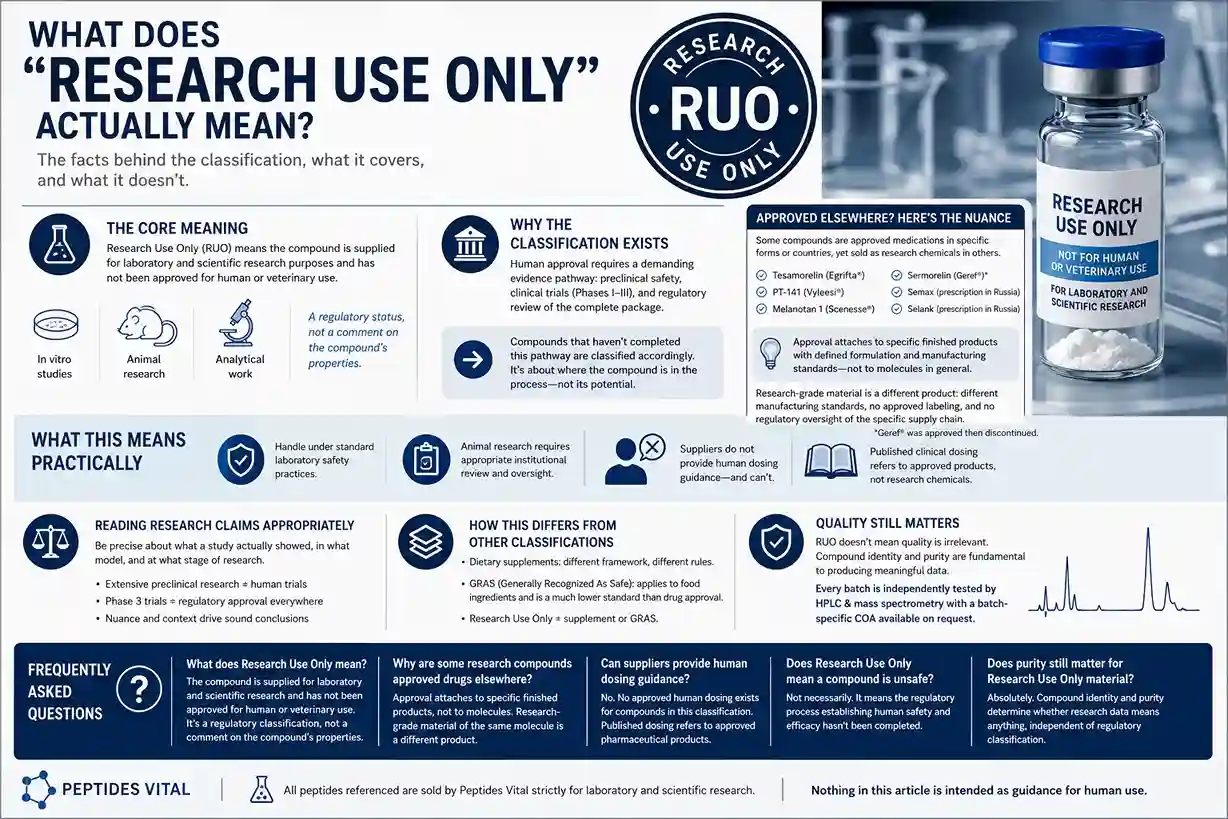
Palatin Technologies licensed and developed the compound, initially as an intranasal spray before shifting to a subcutaneous formulation. In June 2019, the FDA approved bremelanotide under the brand name Vyleesi for acquired, generalized hypoactive sexual desire disorder in premenopausal women, based on two Phase 3 trials known as RECONNECT.
| Melanotan 2 | PT-141 | |
| Relationship | Parent compound | Derived from Melanotan 2 |
| Receptor activity | MC1R, MC3R, MC4R, MC5R | Primarily MC3R and MC4R |
| Pigmentation activity | Present (MC1R) | Substantially reduced |
| Regulatory status | Not approved | FDA-approved as Vyleesi (2019) |
| Also known as | MT-2 | Bremelanotide |
| Clinical trial data | Limited | Phase 3 RECONNECT program |
Drug development generally moves toward narrower receptor targeting, and this case illustrates why clearly.
A compound that activates four receptor subtypes produces effects across four physiological systems. For a research tool investigating the melanocortin system broadly, that breadth is useful. For a therapeutic aimed at one specific indication, it’s a liability, because every unintended receptor engagement is a potential unwanted effect that has to be characterized, disclosed, and justified in a regulatory submission.
PT-141’s narrowed profile is what made a clinical development pathway viable. Reducing MC1R activity removed pigmentation effects from the equation, allowing the trials to focus on a single, well-defined endpoint.
Because bremelanotide is an approved medication, more pharmacological and safety data exists for PT-141 than for most compounds in this category.
Foundational human pharmacology work documented that melanocortin receptor agonism produced measurable physiological responses through a central nervous system mechanism, distinct from the peripheral vascular pathway used by PDE5 inhibitors. Published Phase 3 data reported transient increases in blood pressure as a notable finding, along with nausea among the more commonly reported effects.
Preclinical research using MC4R knockout mouse models helped establish the specific receptor pathways involved, providing the mechanistic foundation underlying how the compound is understood to work.
One aspect of PT-141 that distinguishes it from other approaches in its therapeutic area is where it acts.
PDE5 inhibitors, the drug class most people associate with sexual dysfunction treatment, work peripherally by affecting blood flow. PT-141 works centrally, through melanocortin receptors expressed in the hypothalamus and limbic system. These are fundamentally different mechanisms addressing different aspects of the same broad clinical area.
This distinction is part of what made bremelanotide viable as a separate therapeutic rather than a redundant one. A centrally acting compound addresses a different component of the physiology than a peripherally acting one, which is why the two drug classes were developed and approved for different indications rather than competing directly.
If the research question involves the melanocortin system broadly, or comparative receptor pharmacology across subtypes, Melanotan 2’s non-selective profile is what makes it valuable as a tool compound. If it concerns MC3R and MC4R activity specifically, or benefits from a compound with published clinical trial data behind it, PT-141 is the more directly applicable choice. For the third member of this family, see Melanotan 1, which sits at the opposite end of the selectivity spectrum with a narrow MC1R focus.
Both are supplied as white to off-white lyophilized powders. Melanotan 2 is soluble in water and dilute acetic acid; PT-141 dissolves readily in water. Both should be refrigerated at 2 to 8 degrees Celsius after reconstitution with bacteriostatic water. Batches supplied through Peptides Vital are independently verified by HPLC and mass spectrometry.
Was PT-141 made from Melanotan 2?
Yes. PT-141 was derived from Melanotan 2 through structural modification that narrowed receptor activity toward MC3R and MC4R.
Does PT-141 cause skin pigmentation like Melanotan 2?
Its MC1R activity, the receptor responsible for pigmentation, was substantially reduced during development, which was a primary objective of creating it.
Is PT-141 FDA-approved?
Yes, as bremelanotide under the brand name Vyleesi, approved in June 2019 for a specific clinical indication.
Why was Melanotan 2 never approved?
Its broad, non-selective receptor activity produces effects across multiple physiological systems, which complicates a focused clinical development pathway.
How was the arousal effect discovered?
It was observed incidentally during research on Melanotan 2’s pigmentation effects, and that unexpected finding prompted a separate development program.
All peptides referenced are sold by Peptides Vital strictly for laboratory and scientific research. Nothing in this article is intended as guidance for human use.