- Free shipping on all orders over $200 (US) and $300 (International)
Kisspeptin-10 has one of the more unusual origin stories in peptide research. It was discovered in a cancer laboratory, named after a chocolate bar, and only later turned out to be a central regulator of human reproduction. That trajectory explains a lot about why it’s studied the way it is today.
Kisspeptin-10 is a decapeptide, a chain of ten amino acids, and the shortest bioactive fragment of a larger protein called kisspeptin-54, which is encoded by the KISS1 gene. Complete molecular data is available on the Kisspeptin-10 product page.
A structural detail worth noting: the molecule ends with a C-terminal amide group on its final phenylalanine residue. This isn’t cosmetic, it distinguishes Kisspeptin-10 from truncated variants lacking that modification and is relevant when verifying you have the correct compound.
The KISS1 gene was identified in 1996 at Pennsylvania State University, and the name comes from an unlikely source: Hershey’s Kisses. The research was conducted in Hershey, Pennsylvania, home of the chocolate company, and the naming was a nod to the location.
More significantly, the gene wasn’t discovered in reproductive research at all. It was originally identified as a metastasis-suppressor gene, studied in the context of cancer, specifically how tumors spread. For several years, that was the entire research framing.
The compound’s significance changed substantially when researchers established that the KISS1 gene product was the natural ligand for a receptor then called GPR54, now known as the kisspeptin receptor.
That finding connected kisspeptin to gonadotropin-releasing hormone, or GnRH. Kisspeptin signaling was identified as the upstream trigger for GnRH release from the hypothalamus, and GnRH governs the entire downstream reproductive hormonal cascade: luteinizing hormone, follicle-stimulating hormone, and the sex hormone production those regulate.
In other words, kisspeptin sits above the reproductive axis rather than within it. That position is what makes it valuable as a research tool, because affecting kisspeptin signaling affects the whole cascade rather than one isolated component.
The primary research application is studying the hypothalamic-pituitary-gonadal axis, commonly abbreviated as the HPG axis. Because Kisspeptin-10 directly triggers GnRH release, researchers can use it to probe how the reproductive hormone system responds under controlled conditions.
Specific research areas include puberty timing, since kisspeptin signaling is essential for puberty onset and disruptions to it are associated with delayed or absent pubertal development. Fertility and ovulation research is another major area, along with investigation of reproductive hormone disorders more broadly.
There’s also a practical reason Kisspeptin-10 is used rather than the full-length kisspeptin-54: as the shortest bioactive fragment, it’s more stable and easier to work with while retaining the receptor-binding activity that matters for the research question.
Researchers studying hormone systems often face a choice between intervening at different points in a cascade. Working downstream, closer to the final hormone, gives more direct control over one output. Working upstream gives insight into how the system regulates itself.
Kisspeptin-10’s position makes it useful for the second type of question. If a study needs to understand how the reproductive axis is triggered, modulated, or fed back on, intervening at the kisspeptin level engages that regulatory machinery rather than bypassing it. That’s a different kind of information than simply supplying a downstream hormone directly.
The receptor kisspeptin binds to was originally designated GPR54, one of many orphan receptors, meaning receptors identified structurally before anyone knew what natural molecule activated them.
Establishing that kisspeptin was GPR54’s natural ligand was significant on two levels. It explained what the receptor was for, and it simultaneously revealed that kisspeptin had a role far beyond the cancer context it was originally studied in. The receptor has since been renamed the kisspeptin receptor to reflect that relationship.
This kind of pairing, matching an orphan receptor to its natural ligand, is a recurring pattern in endocrinology. It happened with the ghrelin receptor as well, which was characterized through synthetic secretagogues years before ghrelin itself was identified.
Kisspeptin-54, the full protein, and Kisspeptin-10, the fragment, both activate the same receptor. The choice to work with the shorter version comes down to practical research considerations.
Shorter peptides are generally more stable, easier to synthesize consistently, and simpler to characterize analytically. Since Kisspeptin-10 retains the receptor-binding activity that matters for most research questions, working with the larger parent molecule adds complexity without a corresponding benefit for most study designs.
Kisspeptin-10 is supplied as a white lyophilized powder, highly soluble in bacteriostatic water. Store refrigerated at 2 to 8 degrees Celsius once reconstituted, with unreconstituted vials kept cool and dry. Standard practice applies for aliquoting into working volumes and limiting freeze-thaw cycles. Batches supplied through Peptides Vital carry documented purity of 98 percent or higher by HPLC.
What is Kisspeptin-10 used for in research?
Primarily reproductive endocrinology, since it triggers GnRH release and sits upstream of the entire reproductive hormone cascade, including research on puberty timing, fertility, and ovulation.
Why is it called kisspeptin?
The KISS1 gene was named after Hershey’s Kisses, as the research was conducted at Penn State in Hershey, Pennsylvania.
How is Kisspeptin-10 different from kisspeptin-54?
Kisspeptin-10 is the shortest bioactive fragment of the larger kisspeptin-54 protein, retaining receptor-binding activity while being more stable and practical to work with.
Was kisspeptin originally studied for reproduction?
No. The KISS1 gene was first identified in 1996 as a metastasis-suppressor gene in cancer research. Its reproductive role was established later.
What is the HPG axis?
The hypothalamic-pituitary-gonadal axis, the hormonal system governing reproduction, which kisspeptin signaling sits upstream of.
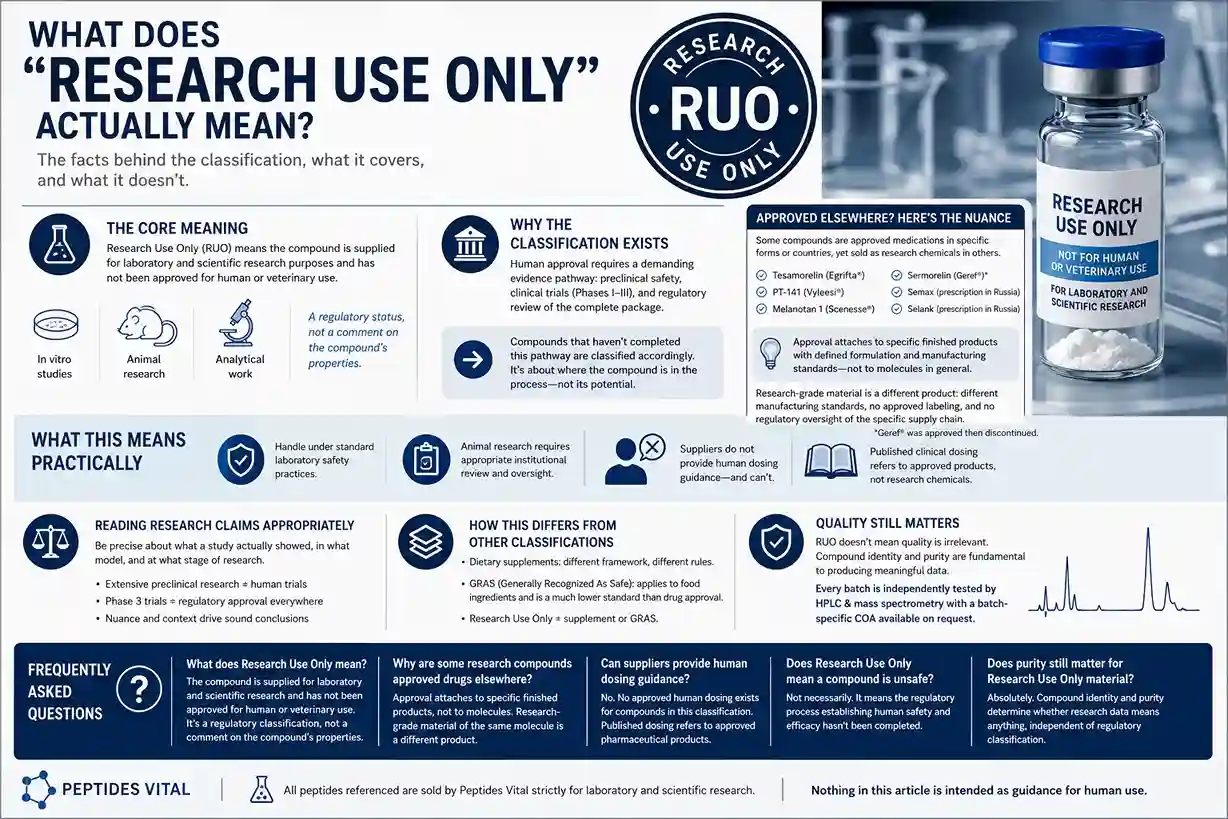
All peptides referenced are sold by Peptides Vital strictly for laboratory and scientific research. Nothing in this article is intended as guidance for human use.