- Free shipping on all orders over $200 (US) and $300 (International)
Semax and Selank are frequently mentioned in the same conversation, and there’s a genuine reason for that beyond coincidence. They came out of the same Russian research institution, they were built using the same structural design principle, and they’re both approved prescription medications in Russia despite being largely unknown in Western clinical practice.
What gets lost in that shared background is how differently they’re actually studied. One is a cognitive and neuroprotective compound. The other is an anxiolytic. Treating them as interchangeable because they look similar on paper is a common mistake worth clearing up.
Both peptides were developed at Russia’s Institute of Molecular Genetics in Moscow. Both were built using the same stabilization strategy: taking a naturally occurring biological fragment and extending it with a Pro-Gly-Pro tripeptide tail. That tail is a well-established structural motif in peptide chemistry, used specifically to resist cleavage by prolyl endopeptidases, enzymes that would otherwise break the molecule down quickly.
That’s genuinely where the similarity ends. The parent fragments each was built from come from entirely different biological systems, and that determines everything about how they’re researched.
Semax is a heptapeptide built from the 4 to 10 fragment of adrenocorticotropic hormone (ACTH), with the Pro-Gly-Pro tail added for stability. It has one of the more established research histories among synthetic neuropeptides, formally approved in Russia as a prescription treatment for stroke, cognitive impairment, and optic nerve disorders, and listed on the Russian List of Vital and Essential Drugs. Full molecular details are on the Semax product page.
Its studied mechanism involves melanocortin receptor activity leading to CREB-mediated upregulation of brain-derived neurotrophic factor (BDNF) and nerve growth factor (NGF) in the hippocampus. Research has also examined its effects on dopaminergic and serotonergic signaling and neuroprotection during ischemic injury.
Selank is built from tuftsin, a naturally occurring tetrapeptide that is itself a fragment of the immunoglobulin G heavy chain, again extended with the Pro-Gly-Pro tail. It’s approved in Russia as a prescription anxiolytic. See the Selank product page for its complete profile.
Its mechanism involves modulation of GABAergic transmission, enkephalinase inhibition, and changes in BDNF expression. That last point is the one real mechanistic overlap with Semax, though the two are studied toward different endpoints. Russian research has reported reduced anxiety-like behavior in animal models without the sedative or cognitive-impairing effects typically associated with benzodiazepine-class compounds, which is the finding that generates most of the interest in it.
| Semax | Selank | |
| Parent molecule | ACTH (4-10) fragment | Tuftsin (IgG fragment) |
| Research focus | Cognition, neuroprotection, stroke | Anxiety, stress response |
| Key mechanism | BDNF/NGF upregulation, melanocortin receptors | GABAergic modulation, enkephalinase inhibition |
| Russian approval | Stroke, cognitive impairment, optic nerve | Anxiety disorder |
| Secondary research angle | Antioxidant, anti-inflammatory activity | Immune modulation |
Most pharmacological data on both compounds comes from Russian clinical and preclinical research, which is worth stating upfront since it affects how accessible and independently replicated that evidence is.
For Semax, one randomized placebo-controlled trial in acute ischemic stroke patients reported measurable improvements in neurological recovery scores when administered intranasally within hours of symptom onset. Animal studies have reported reduced infarct size and improved functional recovery following ischemic events. Separate research has examined chronic stress models, where Semax appeared to preserve hippocampal neurogenesis and prevent stress-related reductions in BDNF expression.
For Selank, preclinical studies have reported anxiolytic-like effects in stress and conflict-based behavioral models, along with changes in peripheral immune markers that suggest an immunomodulatory role running alongside the anxiolytic activity. Published research has also examined BDNF expression and monoamine turnover, which partially overlaps with Semax’s mechanism.
Both compounds are supplied as lyophilized powders and share similar handling requirements, which simplifies things for labs working with both. Each should be kept in a cool, dry place prior to reconstitution and refrigerated at 2 to 8 degrees Celsius once dissolved in bacteriostatic water.
Standard laboratory practice applies for preserving stability: proper labeling, aliquoting into smaller working volumes rather than repeatedly drawing from a single vial, and minimizing freeze-thaw cycles. Peptides in this class are sensitive to repeated temperature swings, and degradation directly affects the reliability of any data collected afterward.
The decision usually comes down to the research endpoint rather than any measure of which compound is stronger.
If the question involves memory, learning, neuroprotection, stroke recovery, or BDNF signaling in a cognitive context, Semax’s literature base is the more direct match. If it involves anxiety-like behavior, stress response, GABAergic activity, or the intersection of immune function and stress, Selank’s literature is more applicable.
Some researchers examining the overlap between chronic stress and cognitive function work with both, since they share the BDNF-related mechanism despite different primary applications. Both are supplied as lyophilized powders requiring reconstitution with bacteriostatic water, and both are available through Peptides Vital with batch-specific HPLC and mass spectrometry verification.
Are Semax and Selank chemically related?
Not directly. Both are heptapeptides sharing the same stabilizing Pro-Gly-Pro tail, but they’re built from completely different parent molecules, ACTH for Semax, tuftsin for Selank.
Is one more potent than the other?
They aren’t comparable that way. They’re studied toward different endpoints entirely, cognition and neuroprotection versus anxiety and stress response.
Can Semax and Selank be researched together?
Some researchers do study them together given their shared BDNF-related mechanism, though no published trial has evaluated them in combination.
Are both approved as medications anywhere?
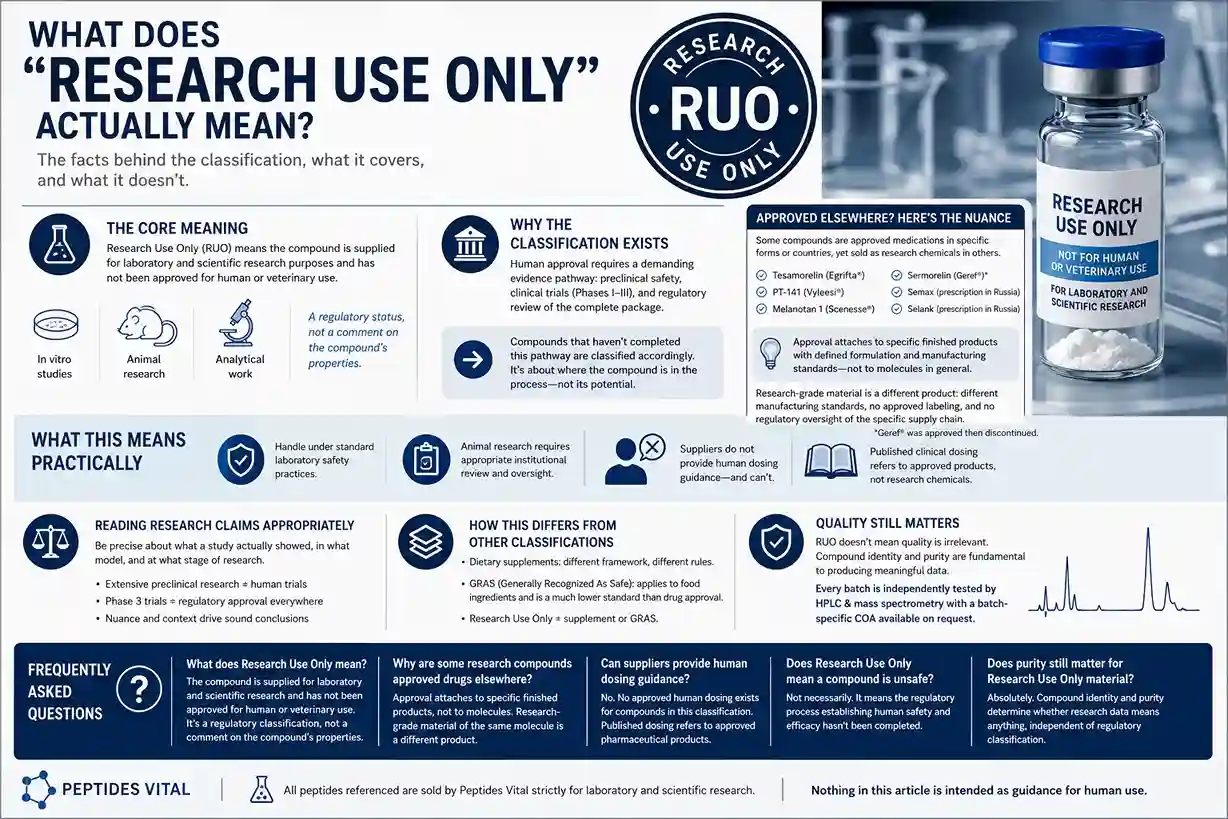
Yes, both are approved prescription drugs in Russia. Neither holds FDA approval in the United States.
Does Selank cause sedation like benzodiazepines?
Published Russian research reports anxiolytic effects without the sedation or cognitive impairment associated with benzodiazepines, though Western safety data remains limited.
All peptides referenced are sold by Peptides Vital strictly for laboratory and scientific research. Nothing in this article is intended as guidance for human use.