- Free shipping on all orders over $200 (US) and $300 (International)
GHRP-2 and GHRP-6 are among the earliest growth hormone secretagogues ever developed, and they remain two of the most frequently searched compounds in this category. Both are hexapeptides. Both act on the same receptor. Both were created before anyone knew that receptor’s natural hormone even existed.
That last detail is what makes this comparison genuinely interesting, and it’s also why the two behave differently despite targeting the same target.
GHRP-6 was synthesized in the 1980s, making it one of the first synthetic growth hormone-releasing peptides ever produced. At the time, researchers knew it caused growth hormone release, but the receptor it acted on hadn’t been formally characterized.
That receptor, now called the growth hormone secretagogue receptor (GHS-R1a), was later found to be the natural target of ghrelin, the stomach-derived hormone discovered in 1999. GHRP-6’s development therefore predates the discovery of the hormone system it works through by more than a decade, which gives it real historical significance in endocrinology beyond its practical research use.
GHRP-2, also known by its International Nonproprietary Name pralmorelin, followed in the early 1990s as part of the same broader effort to develop synthetic secretagogues, refined for different performance characteristics.
GHRP-6 is a hexapeptide, a chain of six amino acids, containing D-amino acids, mirror-image versions of the naturally occurring forms, which increase resistance to enzymatic breakdown. It’s classified as a growth hormone secretagogue and ghrelin mimetic. Full molecular data is on the GHRP-6 product page.
GHRP-2 is also a hexapeptide with an amidated C-terminus and D-amino acid substitutions. It contains D-2-naphthylalanine, an unnatural amino acid that contributes to its binding profile. See the GHRP-2 product page for complete specifications.
| GHRP-6 | GHRP-2 | |
| Developed | 1980s | Early 1990s |
| Also known as | — | Pralmorelin |
| GH release potency | Lower of the two | Higher of the two |
| Appetite stimulation | Pronounced | Milder |
| Receptor target | GHS-R1a (ghrelin receptor) | GHS-R1a (ghrelin receptor) |
| Research significance | First to demonstrate GHS-R1a activity | More potent secretagogue research |
This is the single most-cited distinction between the two compounds in published pharmacology, and it has real implications for study design.
Because both peptides mimic ghrelin, and ghrelin is centrally involved in hunger signaling, both produce some degree of appetite stimulation. GHRP-6’s effect here is notably more pronounced. Depending on what a study is measuring, that’s either a useful feature or a confounding variable that muddies the data.
If a research protocol is specifically examining appetite regulation or ghrelin-mediated feeding behavior, GHRP-6’s stronger effect is the point. If the protocol is isolating growth hormone release and appetite changes would interfere with interpreting results, GHRP-2’s milder profile makes it the cleaner choice, and it’s generally reported as the more potent GH secretagogue of the two anyway.
Neither GHRP-2 nor GHRP-6 is the most receptor-selective option available. Ipamorelin, described in the research literature in the mid-1990s, was developed specifically to improve on these earlier compounds. Its structure incorporates non-standard amino acids that give it unusually high selectivity for the ghrelin receptor, producing GH release with minimal impact on cortisol, prolactin, or appetite. See the Ipamorelin product page for details.
That selectivity is why Ipamorelin has become the standard choice for combination research protocols, most commonly paired with a GHRH analog like CJC-1295 in the CJC-1295/Ipamorelin blend. The two compounds act on different receptors, GHRH and ghrelin, which allows researchers to study additive release through mechanistically independent pathways.
The progression from GHRP-6 to GHRP-2 to Ipamorelin tells a clear story about what researchers came to prioritize in this compound class.
Early secretagogues proved the concept: small synthetic peptides could reliably trigger growth hormone release. But activating the ghrelin receptor doesn’t happen in isolation. That receptor sits within a broader signaling network, and stimulating it can produce parallel effects on cortisol, prolactin, and hunger signaling alongside the intended GH response.
For a study measuring growth hormone specifically, those parallel effects are noise. Cortisol elevation in particular can complicate interpretation, since cortisol influences many of the same downstream metabolic markers researchers might be tracking. Each successive generation of secretagogue was refined to narrow that response window, which is why selectivity, rather than raw potency, became the metric that mattered most.
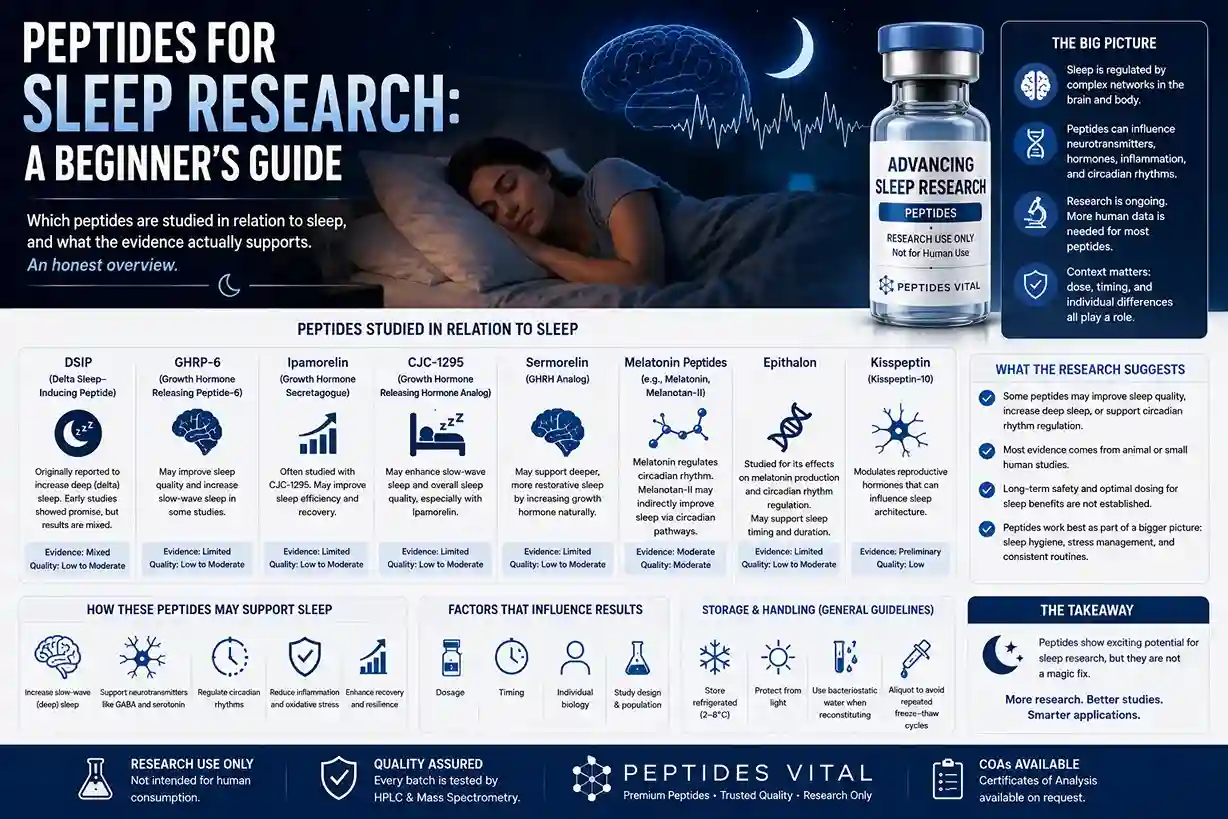
Both compounds are supplied as lyophilized powders that dissolve readily in water. Standard practice is reconstitution with bacteriostatic water, followed by refrigerated storage at 2 to 8 degrees Celsius. Unreconstituted vials should be kept cool and dry.
As with any peptide in this class, aliquoting into working volumes and limiting freeze-thaw cycles helps preserve integrity across a study period. Degraded material produces unreliable data, and that degradation isn’t always visually obvious, which is why documented purity at the point of purchase matters as a starting baseline.
For research isolating growth hormone release with fewer secondary effects, GHRP-2 is the stronger of the two older compounds, and Ipamorelin is cleaner still. For research where appetite signaling is part of the question rather than a nuisance variable, GHRP-6’s more pronounced ghrelin-mimetic activity is the relevant property. All three are available as research compounds through Peptides Vital, each batch verified by HPLC and mass spectrometry with certificates of analysis available on request.
Which is more potent, GHRP-2 or GHRP-6?
GHRP-2 is generally reported as the more potent growth hormone secretagogue of the two.
Which causes more appetite stimulation?
GHRP-6, due to its more pronounced ghrelin-receptor mimetic activity. GHRP-2’s effect on appetite is milder.
Do GHRP-2 and GHRP-6 act on the same receptor?
Yes, both act on the GHS-R1a receptor, the same receptor ghrelin naturally targets.
How do they compare to Ipamorelin?
Ipamorelin was developed later for greater receptor selectivity, producing GH release with substantially less impact on cortisol, prolactin, and appetite than either GHRP.
What does pralmorelin mean?
It’s the International Nonproprietary Name for GHRP-2, used interchangeably in pharmacology literature.
All peptides referenced are sold by Peptides Vital strictly for laboratory and scientific research. Nothing in this article is intended as guidance for human use.