- Free shipping on all orders over $200 (US) and $300 (International)
Ipamorelin and GHRP-6 both act on the same receptor and both trigger growth hormone release. On that basis alone they look like near-equivalents. In practice, they’re separated by about a decade of development and one property that changes almost everything about how each is used in research: receptor selectivity.
Understanding that gap explains why Ipamorelin became the default choice for combination protocols while GHRP-6 remains studied mostly for different reasons entirely.
Both compounds act on the growth hormone secretagogue receptor, GHS-R1a, which is the same receptor ghrelin naturally binds to. Ghrelin is the stomach-derived hormone discovered in 1999, sometimes described as the hunger hormone because of its role in appetite signaling.
That connection is important. Any compound activating this receptor is stepping into a signaling network that governs more than growth hormone release alone. Appetite, cortisol, and prolactin are all connected to activity at or around this pathway, and how much a given compound engages those adjacent responses is precisely what separates one secretagogue from another.
GHRP-6 is a hexapeptide synthesized in the 1980s, one of the earliest synthetic growth hormone-releasing peptides ever produced. It holds real historical significance: it was among the first compounds to demonstrate that small synthetic peptides could interact with GHS-R1a, years before ghrelin itself was identified. See the GHRP-6 product page for its full molecular profile.
Because it was developed before the receptor’s natural hormone was even known, GHRP-6 wasn’t designed around a selectivity target. It activates the receptor effectively, and it also produces a notably pronounced appetite response as a direct consequence of its ghrelin-mimetic activity.
Ipamorelin is a pentapeptide first described in the research literature in the mid-1990s. It was developed specifically to improve on earlier secretagogues like GHRP-6, and its structure reflects that intent. It contains two non-standard amino acids, aminoisobutyric acid (Aib) at the N-terminus and D-2-naphthylalanine in the third position, both engineered to sharpen receptor selectivity. Full details are on the Ipamorelin product page.
Published pharmacology consistently reports that Ipamorelin stimulates growth hormone release with minimal impact on cortisol, prolactin, or appetite. That cleaner profile is its defining characteristic and the entire reason it exists.
| GHRP-6 | Ipamorelin | |
| Developed | 1980s | Mid-1990s |
| Structure | Hexapeptide (6 amino acids) | Pentapeptide (5 amino acids) |
| Receptor selectivity | Lower | High |
| Appetite stimulation | Pronounced | Minimal |
| Cortisol and prolactin | More affected | Minimally affected |
| Common use in combinations | Less common | Standard choice |
This isn’t an abstract distinction. It has direct consequences for whether a research protocol produces interpretable data.
Consider a study measuring growth hormone response and downstream metabolic markers. If the compound used also elevates cortisol, that becomes a confounding variable, because cortisol independently influences many of the same metabolic markers being tracked. Separating what the growth hormone did from what the cortisol did becomes considerably harder, and in some designs, effectively impossible.
The same logic applies to appetite. If a protocol involves any measurement affected by food intake, a compound that substantially increases hunger introduces a variable that has to be controlled for or accounted for in analysis.
Ipamorelin’s narrower response window means fewer of these adjacent variables to manage. That’s not a claim about potency, it’s a claim about experimental cleanliness.
Cortisol and prolactin come up constantly in discussions of growth hormone secretagogues, and it helps to understand why they are grouped together as concerns.
Both are pituitary-related hormones, and both can be influenced by compounds acting on the growth hormone axis. Cortisol is the primary stress hormone, involved in glucose regulation, inflammatory response, and a wide range of metabolic processes. Prolactin is best known for its role in lactation but also affects reproductive and metabolic function.
Earlier-generation secretagogues tended to produce measurable increases in both alongside growth hormone release. Published research on Ipamorelin consistently reports minimal effect on either, and this specific finding is what established its reputation in the literature. For researchers, that translates to fewer parallel hormonal changes to account for when interpreting results.
None of this makes GHRP-6 obsolete. If a research question specifically concerns appetite regulation, ghrelin-mediated feeding behavior, or the broader physiology of the ghrelin system, GHRP-6’s more pronounced effect is the feature rather than the flaw. Researchers studying appetite signaling have a legitimate reason to prefer it. Its historical role in characterizing the GHS-R1a receptor also makes it a reference compound in pharmacology literature. For a comparison with the intermediate option, see GHRP-2, which sits between the two in both potency and appetite response.
Ipamorelin’s selectivity is why it became the standard ghrelin-receptor component in combination protocols. Pairing it with a GHRH analog engages two mechanistically independent pathways at once, and the cleaner secondary profile means the combination doesn’t compound unwanted responses. The CJC-1295 and Ipamorelin blend is the most common form of this pairing, combining both at a 1:1 ratio.
Both are supplied as lyophilized powders that dissolve readily in water, typically reconstituted with bacteriostatic water. Refrigerate at 2 to 8 degrees Celsius once reconstituted, keeping unreconstituted vials cool and dry.
Standard practice applies to both: aliquot into working volumes and limit freeze-thaw cycles, since degradation affects data reliability without necessarily being visible on inspection. Every batch supplied by Peptides Vital is independently verified by HPLC and mass spectrometry, with certificates of analysis available on request.
Is Ipamorelin stronger than GHRP-6?
Not necessarily stronger, but more selective. Ipamorelin produces growth hormone release with substantially less effect on cortisol, prolactin, and appetite.
Does Ipamorelin cause appetite stimulation?
Minimally, which is one of its defining research characteristics compared to GHRP-6, where appetite stimulation is pronounced.
Do they act on the same receptor?
Yes, both act on GHS-R1a, the ghrelin receptor. The difference lies in how narrowly each engages the surrounding signaling network.
Why is Ipamorelin used in blends rather than GHRP-6?
Its cleaner secondary profile means combining it with a GHRH analog doesn’t compound unwanted cortisol, prolactin, or appetite responses.
Is GHRP-6 still used in research?
Yes, particularly where appetite signaling or ghrelin system physiology is the actual research subject rather than a variable to minimize.
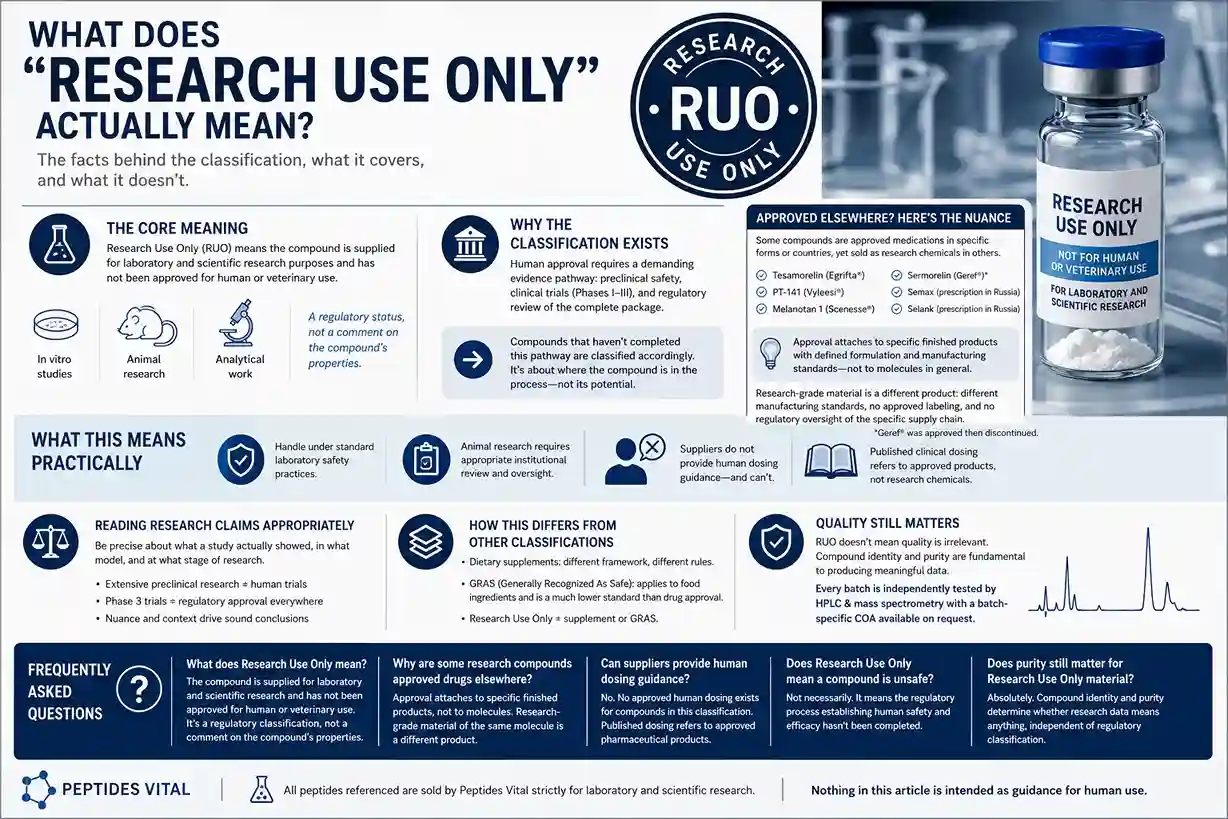
All peptides referenced are sold by Peptides Vital strictly for laboratory and scientific research. Nothing in this article is intended as guidance for human use.