- Free shipping on all orders over $200 (US) and $300 (International)
Sermorelin and Tesamorelin belong to the same functional class: both are analogs of growth hormone-releasing hormone (GHRH), the hypothalamic peptide that signals the pituitary gland to release growth hormone. Both also have something most research peptides lack entirely, a documented pharmaceutical history including FDA approval.
That shared regulatory pedigree makes them unusually well-characterized compared to the wider research peptide category. But their structures, approved uses, and depth of available clinical data differ considerably.
Natural GHRH is a 44-amino-acid peptide produced in the hypothalamus. It binds to receptors on the pituitary gland, prompting release of growth hormone in a pulsatile pattern. The challenge with using natural GHRH directly is that it breaks down rapidly, cleared by enzymes within minutes, which limits its practical usefulness.
Every GHRH analog is essentially an attempt to solve that problem, either by trimming the molecule to its essential active region, modifying it to resist enzymatic breakdown, or both. Sermorelin and Tesamorelin represent two different approaches to that same goal.
Sermorelin consists of the first 29 amino acids of natural GHRH, sometimes designated GRF(1-29)NH2. Those 29 residues represent the shortest sequence that retains the complete receptor-binding region, so it’s the natural molecule trimmed down rather than chemically altered. Full details are on the Sermorelin product page.
Sermorelin was FDA-approved in the 1990s under the brand name Geref, used primarily for diagnosing growth hormone deficiency, before the branded product was discontinued from commercial manufacture. That approval-era research produced published data on pulsatile growth hormone release, IGF-1 response, and its diagnostic application in both pediatric and adult populations. More recent research has examined effects on sleep architecture and age-related growth hormone decline.
Tesamorelin takes the opposite approach. Rather than trimming the molecule, it retains all 44 amino acids of natural GHRH and adds a chemical modification: a trans-3-hexenoic acid group attached to the tyrosine at position 1, specifically to increase resistance to enzymatic breakdown. See the Tesamorelin product page for complete data.
Tesamorelin holds current FDA approval under the brand name Egrifta, granted in 2010 for reducing excess visceral adipose tissue in patients with HIV-associated lipodystrophy. That approval was based on multiple randomized, placebo-controlled Phase 3 trials, and unlike Sermorelin’s discontinued Geref, Egrifta remains an actively marketed pharmaceutical.
| Sermorelin | Tesamorelin | |
| Length | 29 amino acids | 44 amino acids |
| Approach | Truncated natural GHRH | Full GHRH plus stabilizing modification |
| Brand name | Geref (discontinued) | Egrifta (active) |
| Approval status | Formerly approved | Currently FDA-approved |
| Approved indication | GH deficiency diagnosis | Visceral fat reduction, HIV lipodystrophy |
| Trial depth | Moderate, from approval era | Extensive, multiple Phase 3 programs |
Tesamorelin, by a meaningful margin, and the reason is structural rather than scientific merit.
Because Egrifta remains an actively approved and marketed drug, Tesamorelin’s evidence base has continued to grow. Phase 3 trials reported statistically significant reductions in visceral adipose tissue over 26-week treatment periods, alongside sustained IGF-1 elevation. Research since approval has extended into cognitive function and hepatic fat in non-alcoholic fatty liver disease, building on the safety and mechanistic foundation established during the original registration studies.
Sermorelin’s clinical data is genuine but comes from an earlier era and a product that was subsequently withdrawn from commercial production. The foundational pharmacology is well-documented, but the literature hasn’t expanded at the same pace, since there’s no active pharmaceutical program driving new studies.
Neither Sermorelin nor Tesamorelin incorporates the extended half-life technology used in CJC-1295’s DAC version, which binds serum albumin to remain active for roughly a week. If a research question specifically concerns sustained GHRH receptor activation over days rather than shorter pulsatile release, CJC-1295 is worth comparing directly. See the CJC-1295 product page, or the CJC-1295/Ipamorelin blend for research combining a GHRH analog with a ghrelin receptor agonist.
One distinction worth understanding is why researchers work with GHRH analogs at all rather than growth hormone directly.
Synthetic human growth hormone supplies the hormone itself, bypassing the body’s own regulatory machinery entirely. GHRH analogs work one step upstream, prompting the pituitary to release its own growth hormone. That difference matters because the pituitary retains its natural feedback controls, meaning release still follows the body’s existing regulatory pattern rather than overriding it.
For research purposes, this makes GHRH analogs useful for studying the regulatory axis itself, how the signal is generated, modulated, and fed back, rather than simply observing the downstream effects of elevated growth hormone. Both Sermorelin and Tesamorelin sit in this upstream category.
Both compounds are supplied as lyophilized white to off-white powders, soluble in water, and both require refrigeration after reconstitution with bacteriostatic water. Unreconstituted vials should be kept cool and dry.
Tesamorelin’s larger molecular size, 44 amino acids versus Sermorelin’s 29, doesn’t meaningfully change handling requirements, but standard practice applies to both: aliquot into working volumes rather than repeatedly drawing from a single vial, and limit freeze-thaw cycles, which degrade peptide integrity over time in ways that aren’t always visually apparent.
For research where the deepest and most current clinical evidence base matters, Tesamorelin is the better-documented compound. For research examining GHRH in a form structurally closest to the natural hormone, Sermorelin’s unmodified 29-amino-acid fragment is the more direct analog. Both are supplied as lyophilized powders requiring refrigeration after reconstitution, and both are available through Peptides Vital with batch-specific purity verification by HPLC and mass spectrometry.
Is Tesamorelin stronger than Sermorelin?
They aren’t directly comparable in potency since they were developed and studied for different indications. Tesamorelin does have a larger and more current clinical evidence base.
Are either currently FDA-approved?
Tesamorelin is, marketed as Egrifta. Sermorelin’s approved product, Geref, was discontinued from commercial manufacture.
Which is structurally closer to natural GHRH?
Sermorelin, since it’s an unmodified fragment of the natural sequence. Tesamorelin retains full length but adds a chemical modification for stability.
What was Sermorelin originally approved for?
Diagnosing growth hormone deficiency, under the brand name Geref.
Why does Tesamorelin have a longer amino acid chain?
It retains all 44 amino acids of natural GHRH rather than being truncated to the minimal active region as Sermorelin is.
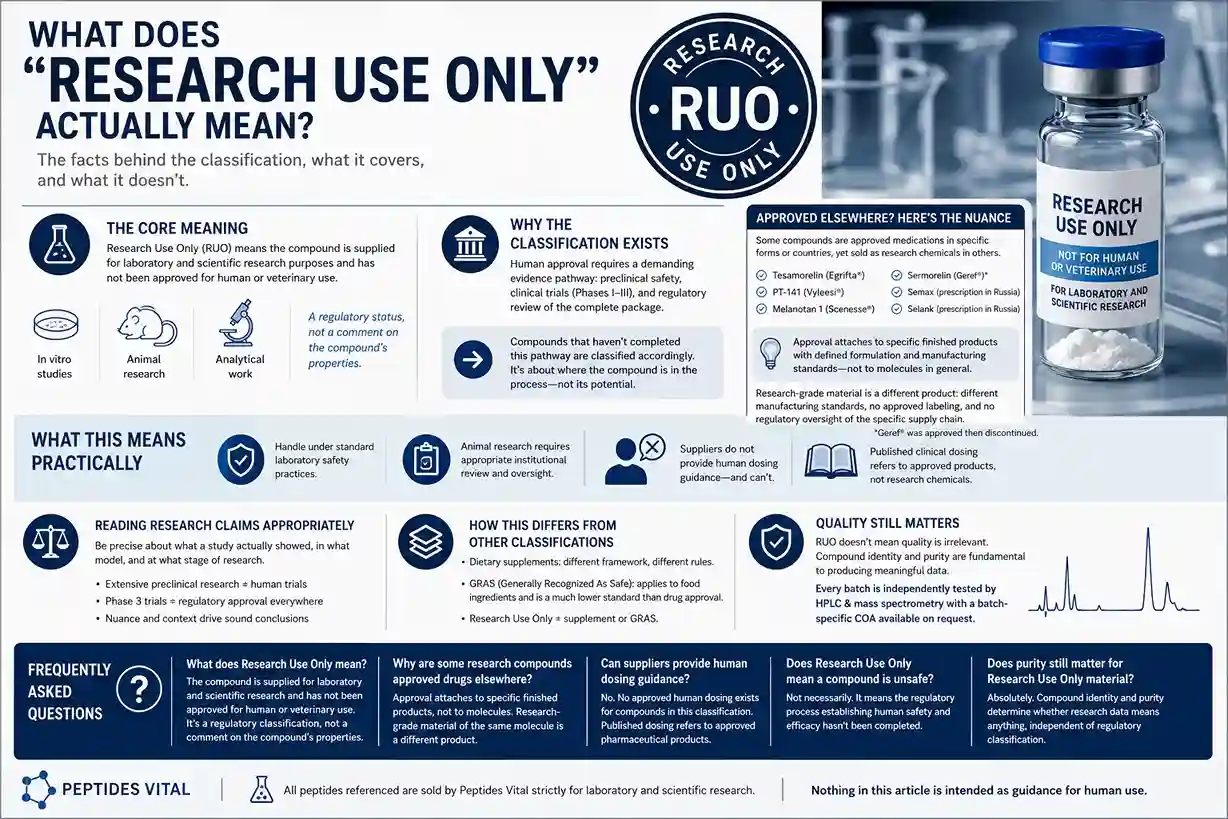
All peptides referenced are sold by Peptides Vital strictly for laboratory and scientific research. Nothing in this article is intended as guidance for human use.