- Free shipping on all orders over $200 (US) and $300 (International)
BPC-157 and TB-500 come up together constantly in peptide research discussions, and for understandable reasons. Both are studied for tissue repair. Both are sold as research compounds. They’re common enough as a pairing that they’re even offered as a pre-combined blend. That familiarity leads a lot of people to assume they’re interchangeable, or that one is simply a stronger version of the other.
Neither assumption holds up. These are structurally unrelated molecules that were discovered decades apart, in completely different biological contexts, and they act through mechanisms that have almost nothing in common. Understanding that difference is what makes the comparison useful, because it explains why researchers study them together rather than choosing between them.
BPC-157, short for Body Protection Compound-157, is a synthetic pentadecapeptide, meaning a chain of 15 amino acids. Its sequence was derived from a partial segment of a larger protein identified in human gastric juice, which is where the compound’s research story begins. Researchers studying protective factors in the stomach lining in the early 1990s isolated and characterized this fragment, and interest expanded from there into wider tissue-repair applications. Complete molecular data is on the BPC-157 product page.
Its proposed mechanism centers on two pathways. The first is activation of VEGFR2, a receptor involved in angiogenesis, the process of forming new blood vessels. The second is nitric oxide signaling, which affects blood flow and vascular function. Both of these are directly relevant to wound healing, since damaged tissue can’t repair effectively without adequate blood supply reaching it.
One practical detail worth knowing: BPC-157 remains stable across a wide pH range, including acidic conditions. That’s unusual for a peptide of its size and is a direct consequence of its gastric origin. It’s also worth noting for anyone tracking this compound’s regulatory status that the FDA added BPC-157 to its list of bulk drug substances presenting significant safety risks for compounding in 2023.
TB-500 is the synthetic form of a fragment of Thymosin Beta-4, a naturally occurring protein present in nearly every cell type in the body. Thymosin Beta-4 was first isolated from calf thymus tissue in 1981, and its complete amino acid sequence was published shortly afterward. TB-500 corresponds specifically to the active actin-binding region of that larger 43-amino-acid molecule. See the TB-500 product page for full specifications.
Its mechanism is entirely different from BPC-157’s. TB-500’s defining biochemical role is sequestering G-actin, the unpolymerized form of actin, which is one of the most abundant structural proteins in the body. By binding G-actin, the peptide influences how quickly cells can reorganize their internal skeleton, and that reorganization is what allows cells to physically migrate toward a wound site. Where BPC-157’s research focus involves getting blood supply to damaged tissue, TB-500’s involves getting cells to move there.
| BPC-157 | TB-500 | |
| Origin | Human gastric juice protein fragment | Thymosin Beta-4, calf thymus (1981) |
| Size | 15 amino acids | Fragment of a 43-amino-acid protein |
| Core mechanism | VEGFR2 activation, nitric oxide signaling | G-actin binding, cell migration |
| Research emphasis | Gut lining repair, angiogenesis, tendon | Wound closure, corneal repair, cardiac tissue |
| Human trial data | Minimal, largely preclinical | Some, via full-length molecule |
| Notable regulatory note | FDA compounding risk list, 2023 | Studied clinically as RGN-259, RGN-137 |
BPC-157’s literature leans heavily toward gastrointestinal healing, which follows logically from where it was discovered. Much of the early published work examined gut lining repair and bowel-related injury models in animals. From there, research expanded into tendon and ligament healing, which is where most current interest sits.
TB-500’s literature centers on the cell-migration side of wound repair. Published rodent studies of full-thickness skin wounds have reported meaningfully faster re-epithelialization compared to controls, alongside improved wound contraction. Thymosin Beta-4 has also been studied for corneal repair, cardiac tissue after injury, and hematopoietic stem cell regulation through a related fragment called Ac-SDKP.
This is where an honest answer matters more than a marketing one. TB-500 has the deeper regulatory paper trail, but with an important caveat attached.
The full-length Thymosin Beta-4 molecule has been through human clinical trials under the names RGN-259 for dry eye disease and RGN-137 for chronic wounds, with some studies reporting accelerated healing in conditions like venous stasis and pressure ulcers. However, TB-500, the shorter synthetic fragment sold as a research chemical, is not chemically identical to the full-length molecule used in those trials. It shares the same core actin-binding region believed to drive much of the activity, but systemic use of the fragment specifically has not been evaluated in completed randomized controlled trials.
BPC-157’s situation is more straightforward: comprehensive human clinical trial data is limited. The substantial majority of published evidence comes from animal models. That doesn’t make the research uninteresting, the animal literature is genuinely extensive, but it does mean claims should be framed as preclinical findings rather than established human outcomes.
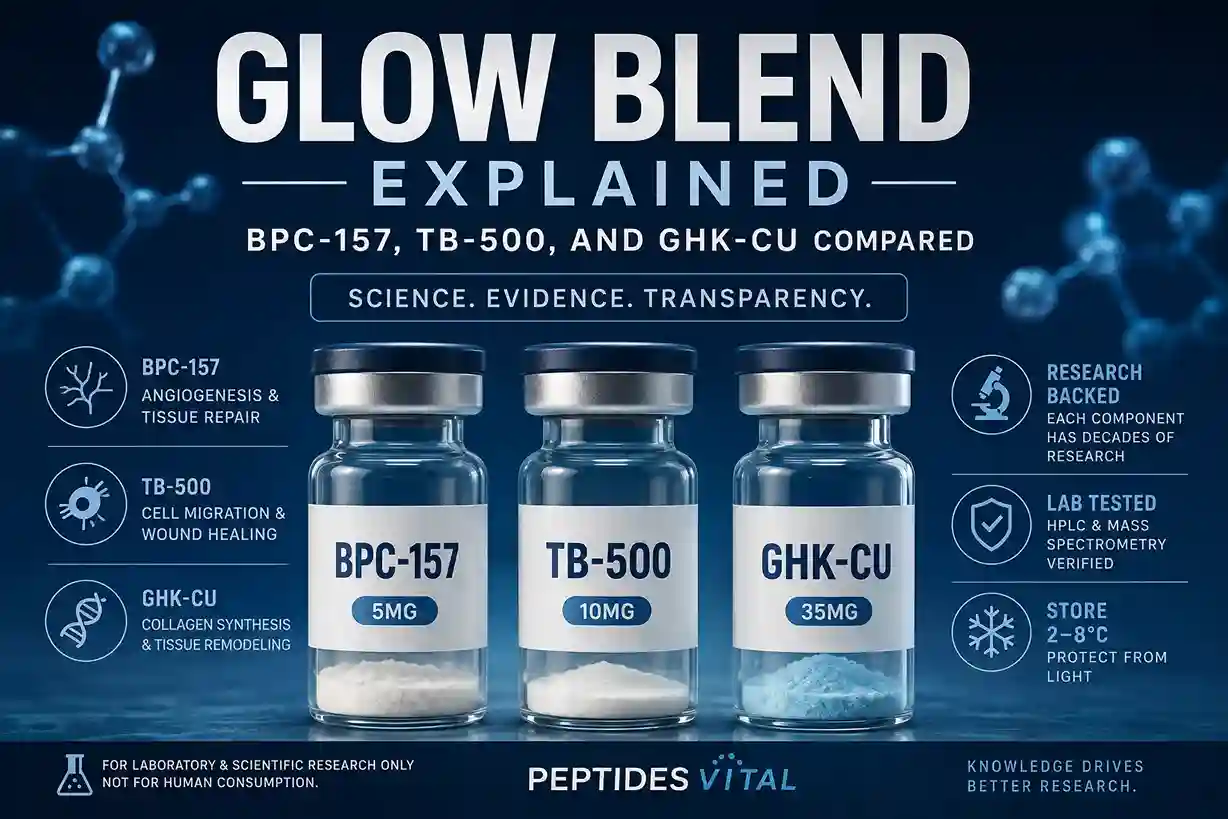
Because their mechanisms don’t overlap, they address different stages of the same process. Angiogenesis and cell migration are complementary steps in tissue repair, not competing approaches to it. That’s the reasoning behind the WOLVERINE blend, which combines both at a 1:1 ratio, and it’s why they also appear together in the GLOW blend alongside GHK-Cu, and in the KLOW blend with GHK-Cu and KPV.
One point of transparency worth stating plainly: none of these combinations has been evaluated as a single formulation in published research. The rationale for combining them is mechanistic, drawn from what each peptide does individually, rather than trial data on the blend itself. That’s a meaningful distinction when assessing what the evidence actually supports.
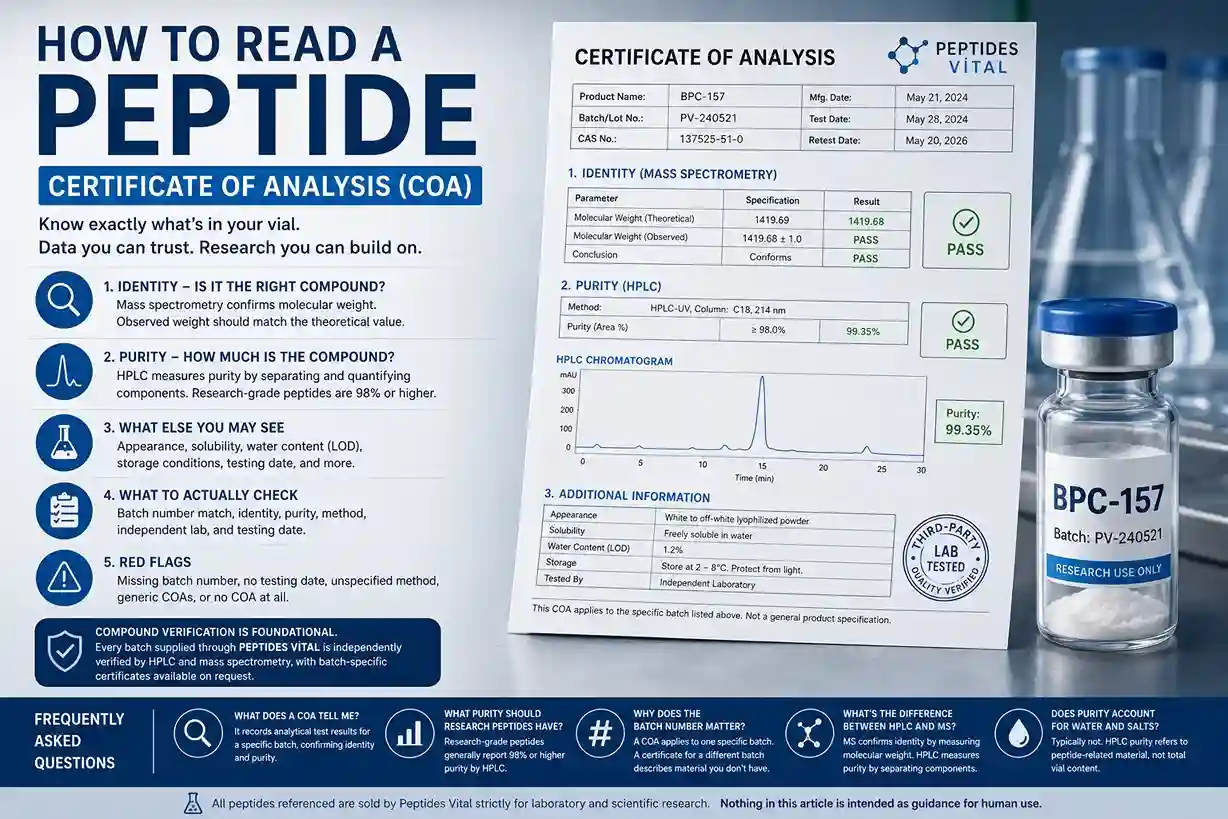
If a research question involves gastrointestinal models, vascular formation, or tendon and ligament repair, BPC-157’s literature is the closer fit. If it involves wound closure kinetics, cell migration, or corneal and cardiac tissue, TB-500’s body of work is more directly applicable. Researchers studying the repair process as a whole often work with both. Whichever direction the research takes, verified purity matters as much as compound selection, every batch supplied by Peptides Vital is independently tested by HPLC and mass spectrometry, with certificates of analysis available on request.
Is BPC-157 or TB-500 better researched?
TB-500 has more human trial history, but through its full-length parent molecule (Thymosin Beta-4) rather than the shorter fragment sold as a research chemical. BPC-157’s evidence is almost entirely preclinical, though its animal literature is extensive.
Do BPC-157 and TB-500 work the same way?
No. BPC-157 acts through VEGFR2 and nitric oxide pathways affecting blood vessel formation. TB-500 acts through G-actin binding, which affects cell migration. They’re mechanistically distinct.
Can BPC-157 and TB-500 be studied together?
Yes, and they frequently are. Their mechanisms are considered complementary rather than redundant, which is the basis for the WOLVERINE, GLOW, and KLOW blends.
Which blends contain both peptides?
WOLVERINE combines just BPC-157 and TB-500. GLOW adds GHK-Cu. KLOW adds both GHK-Cu and KPV.
Is either peptide FDA approved?
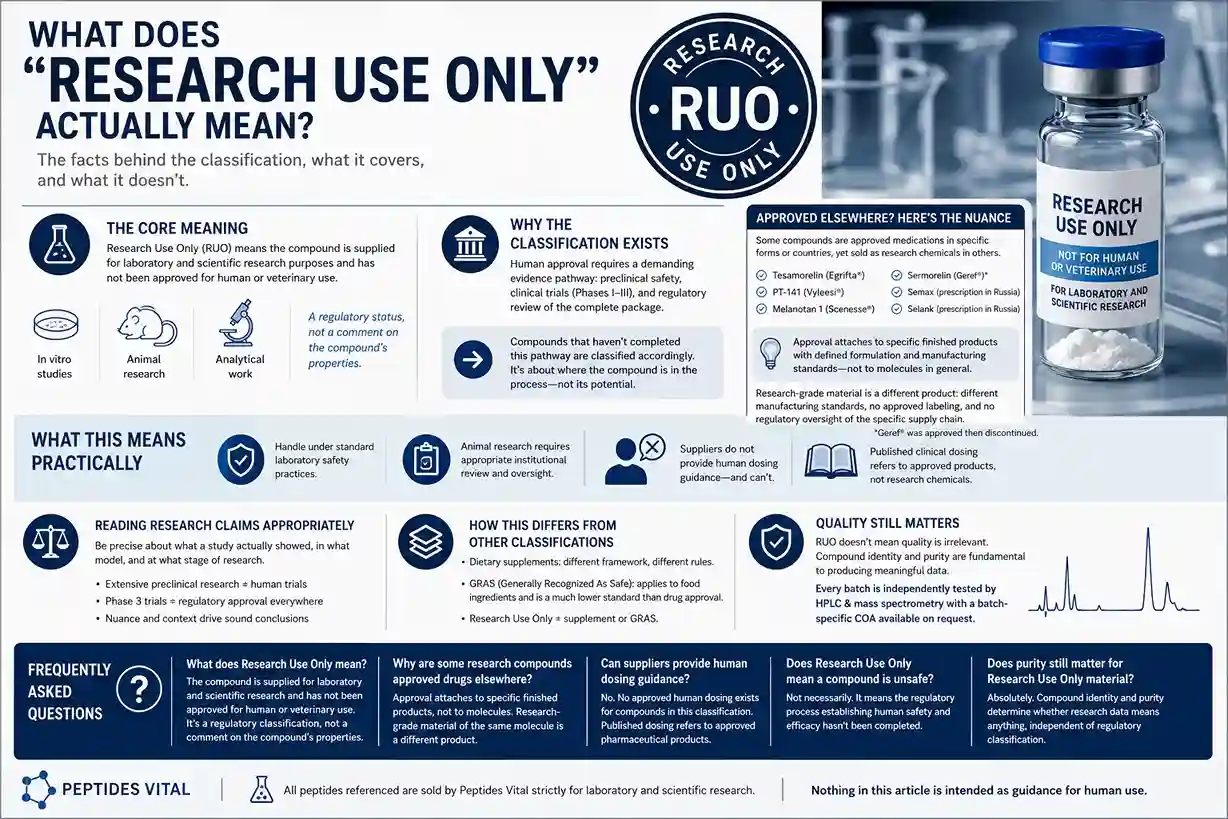
Neither is approved for human use. Both are sold strictly for laboratory and scientific research.
All peptides referenced are sold by Peptides Vital strictly for laboratory and scientific research. Nothing in this article is intended as guidance for human use.