- Free shipping on all orders over $200 (US) and $300 (International)
GHK-Cu is unusual among research peptides in several ways. It’s tiny, just three amino acids. It contains a metal ion as part of its core structure. It turns up naturally in human blood. And its research history stretches back over five decades, considerably longer than most compounds in this category.
If you’ve encountered it as an ingredient in skincare research or as a component in peptide blends and want to understand what it actually is, here’s a straightforward explanation.
GHK-Cu is a copper-binding tripeptide made of three amino acids, glycine, histidine, and lysine, bound to a copper(II) ion. The name is literal: G, H, and K are the single-letter codes for those three amino acids, and Cu is the chemical symbol for copper. Complete molecular data is on the GHK-Cu product page.
The copper ion is coordinated to the peptide through nitrogen atoms in the glycine and histidine residues. That copper content is what gives the compound its distinctive blue color in crystalline form, an immediately recognizable characteristic that sets it apart visually from the white and off-white powders typical of other research peptides.
GHK-Cu was identified in 1973 by researcher Loren Pickart during studies of human blood plasma. His observation was specific and became the foundation for decades of subsequent work: the complex appeared at higher concentrations in plasma from younger donors than from older ones.
That age-related difference is what made it interesting. A naturally occurring molecule that declines measurably with age, and is involved in tissue-related processes, is an obvious candidate for research into repair and aging. Pickart’s finding launched a research program that continues today.
GHK-Cu is classified as a metallopeptide, meaning it incorporates a metal ion as an integral part of its structure rather than merely interacting with one incidentally. The copper isn’t an additive or a contaminant, it’s part of what the molecule is.
This matters because the copper participates directly in the compound’s biological activity. Copper is a cofactor for several enzymes involved in tissue remodeling and collagen crosslinking, and GHK-Cu’s proposed function includes acting as a delivery mechanism for copper to specific tissues, alongside its own peptide-mediated signaling activity.
GHK-Cu is present in trace amounts in human plasma, saliva, and urine. This natural occurrence is a meaningful part of its research profile, since it means researchers are studying a molecule the body already produces rather than an entirely synthetic construct.
Circulating levels decline with age, which is the observation that started the whole research line. Whether that decline is a cause or a consequence of other age-related changes is not fully settled, and it’s worth being precise about that distinction when evaluating claims made about the compound.
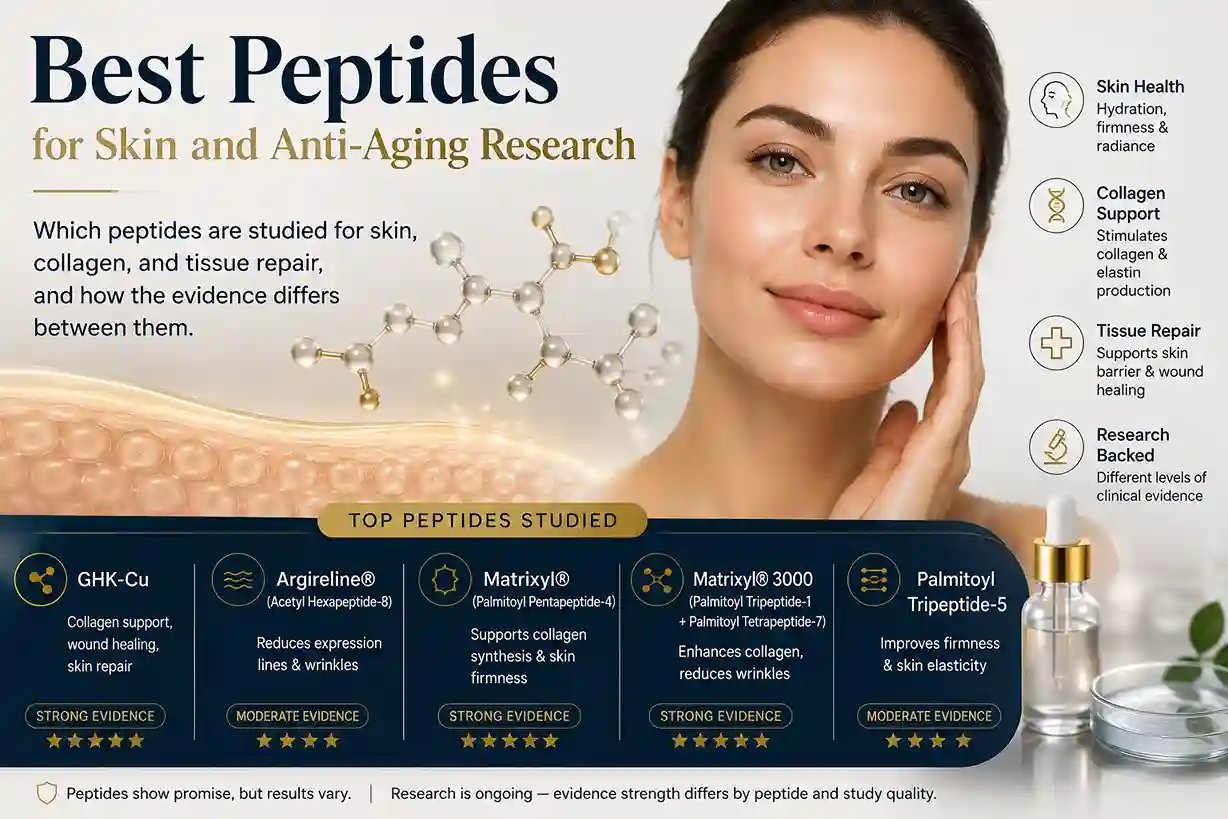
Published GHK-Cu research spans several areas. Collagen and elastin synthesis has been the most consistently studied, along with regulation of matrix metalloproteinases, enzymes involved in breaking down and remodeling tissue. Antioxidant activity and hair follicle stimulation have also been examined.
One distinction worth understanding when reviewing this literature: much of it separates topical application from injection. These are meaningfully different delivery contexts with different bioavailability profiles, and results from one don’t automatically transfer to the other. Dermatology-adjacent research has largely focused on topical use, while other research contexts involve injection. Reading a study carefully enough to know which route was used is basic diligence with this compound.
The copper in GHK-Cu introduces handling considerations that pure peptide compounds do not have.
Copper complexes are generally more sensitive to light exposure than uncomplexed peptides, which is why light protection is specified for this compound rather than treated as optional. Degradation of the copper coordination affects the molecule’s structure and therefore its activity, and unlike some forms of peptide degradation, changes to the copper complex can sometimes be accompanied by visible color changes in solution.
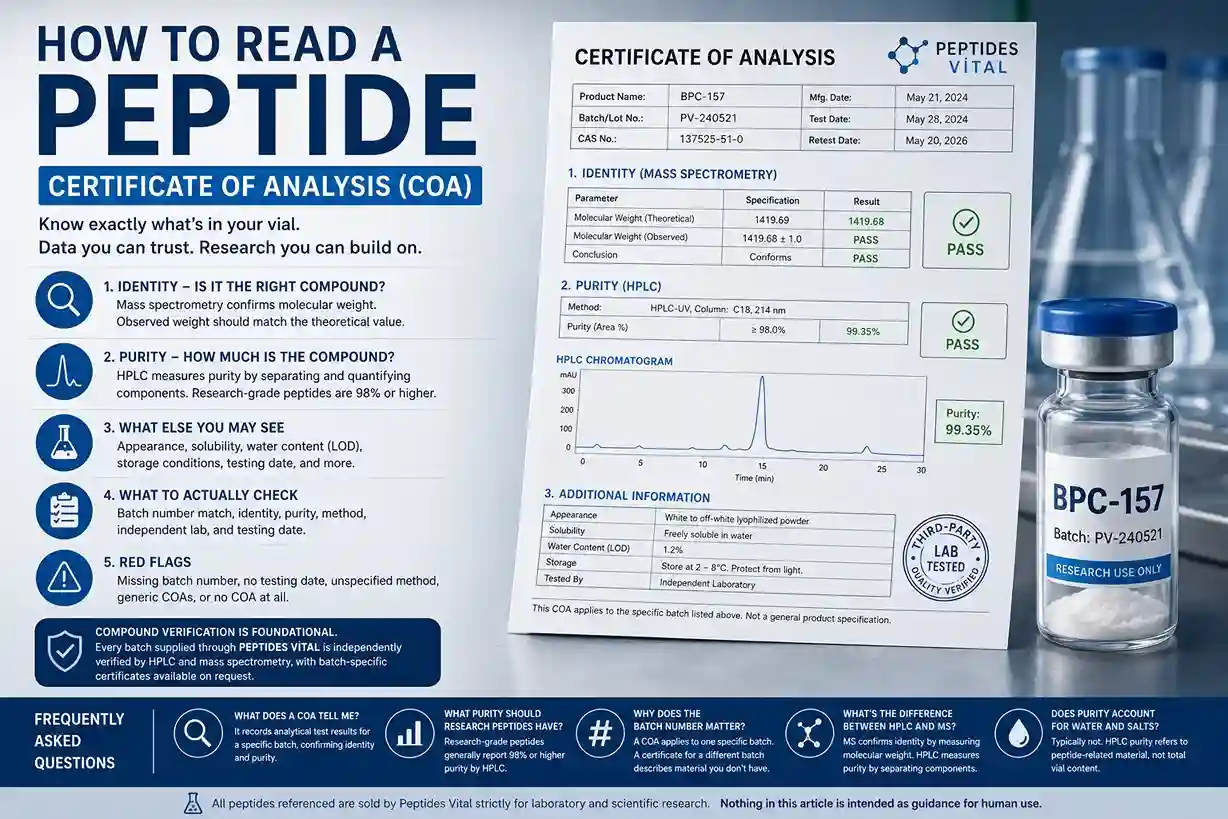
This also means verified purity matters in a slightly different way here. Confirming both peptide identity and correct copper coordination requires appropriate analytical methods, which is worth asking about when sourcing the compound for research.
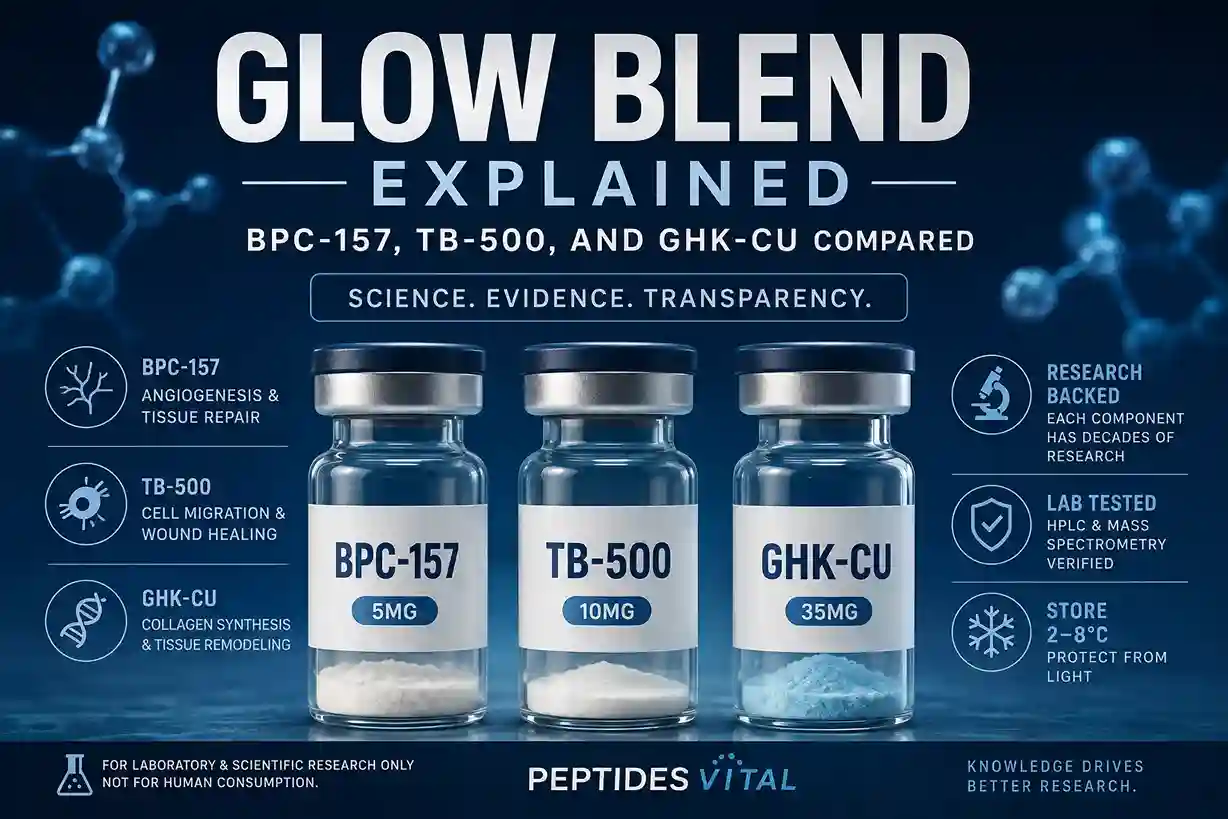
GHK-Cu is a component in two of the more common multi-peptide research blends. The GLOW blend combines it with BPC-157 and TB-500, while the KLOW blend adds KPV to that same combination.
The rationale is mechanistic complementarity. BPC-157’s research centers on angiogenesis, TB-500’s on cell migration, and GHK-Cu’s on collagen synthesis and tissue remodeling, three distinct stages of the repair process rather than three approaches to the same one. Worth stating clearly: these blends have not been studied as single formulations in published research. The reasoning behind combining them comes from each component’s individual literature.
GHK-Cu is supplied as a blue crystalline powder, highly soluble in water. It should be stored refrigerated at 2 to 8 degrees Celsius and protected from light. Standard aliquoting practice applies to limit freeze-thaw cycles. Batches supplied through Peptides Vital are verified by HPLC and mass spectrometry, with certificates of analysis available on request.
What does GHK-Cu stand for?
Glycine, histidine, and lysine, the three amino acids that make up the peptide, bound to Cu, the chemical symbol for copper.
Why is GHK-Cu blue?
The copper(II) ion coordinated to the peptide gives it a characteristic blue color, unusual among research peptides which are typically white or off-white.
Does GHK-Cu occur naturally in the body?
Yes, in trace amounts in human plasma, saliva, and urine. Circulating levels decline with age, which is the observation that prompted its original research interest.
Is topical GHK-Cu the same as injectable?
The compound is the same, but bioavailability and research context differ substantially between delivery routes. Published studies typically specify which was used.
Which blends contain GHK-Cu?
Both the GLOW blend (with BPC-157 and TB-500) and the KLOW blend (with BPC-157, TB-500, and KPV).
All peptides referenced are sold by Peptides Vital strictly for laboratory and scientific research. Nothing in this article is intended as guidance for human use.