- Free shipping on all orders over $200 (US) and $300 (International)
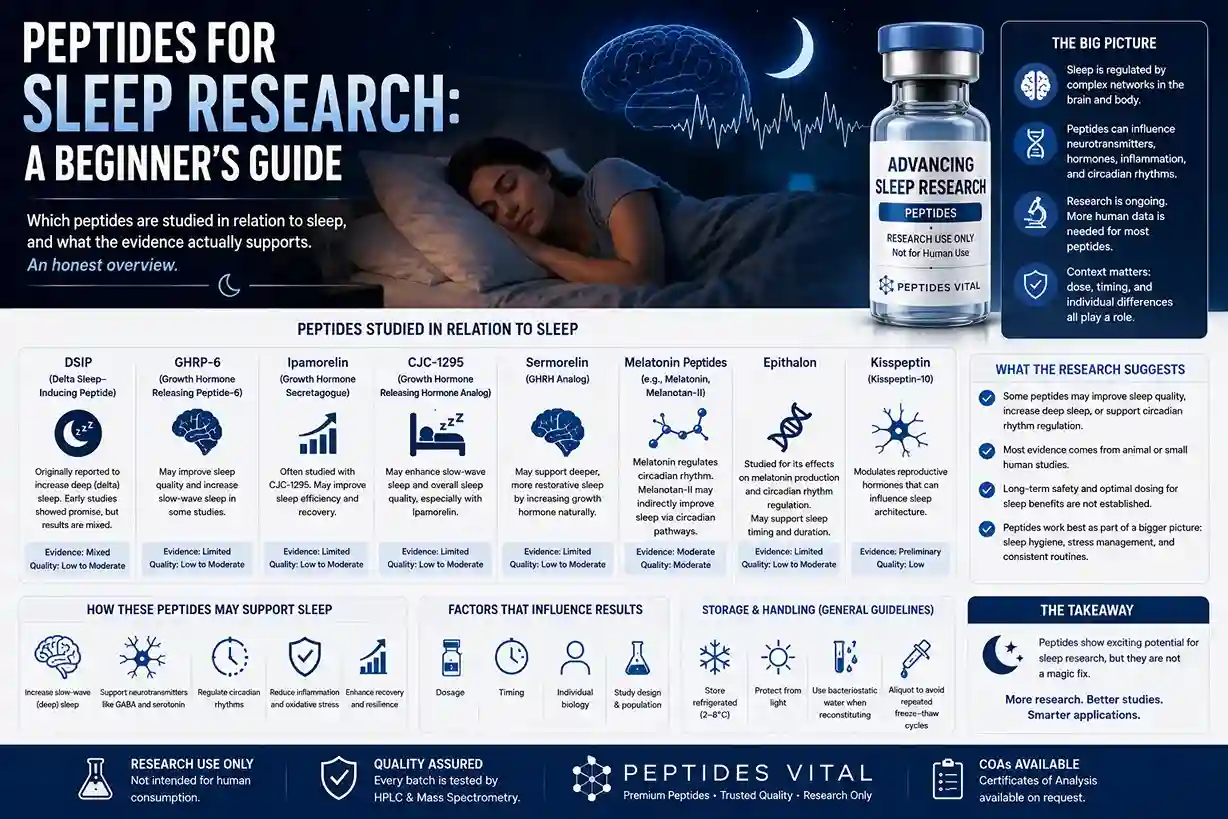
DSIP carries its original research conclusion in its name, which turned out to be a complication rather than a convenience. The compound was named for an effect observed in 1977, and subsequent decades of research have had a more mixed relationship with that original finding than the name suggests.
Understanding that history is genuinely useful, because it explains why current research on DSIP often focuses on areas the name doesn’t hint at.
DSIP is a naturally occurring nonapeptide, meaning a chain of nine amino acids. It was first isolated in 1977 from the cerebral venous blood of rabbits during induced sleep, discovered by the Swiss research group of Schoenenberger and Monnier. Complete molecular data is on the DSIP product page.
Two structural details are worth knowing. First, DSIP is classified as amphiphilic, meaning it contains both water-attracting and water-repelling regions due to its mix of hydrophilic and hydrophobic amino acid residues. This property is associated with its ability to cross the blood-brain barrier. Second, the tryptophan residue at its N-terminus gives it a characteristic UV absorbance profile, which is useful for laboratory identification.
The 1977 research that produced DSIP was straightforward in design. Researchers collected cerebral venous blood from rabbits during induced sleep, isolated a peptide fraction from it, and reported that injecting extracts containing this peptide induced delta-wave sleep in recipient animals.
Delta waves are the slow brain wave patterns characteristic of deep, restorative sleep stages. Finding a circulating molecule apparently capable of inducing them was a notable claim, and the name reflected that conclusion directly.
Replication of the original sleep-specific finding has been inconsistent. Some studies supported sleep-related effects, others did not, and over time the research community’s framing shifted.
This is worth stating plainly rather than glossing over, because it affects how the compound should be understood. Later research has generally found DSIP’s role better explained by broader effects on stress resistance, circadian regulation, and neuroendocrine signaling than by a direct, sleep-specific mechanism.
That shift doesn’t make DSIP uninteresting. It means the interesting questions moved. A compound involved in stress physiology and circadian regulation is a legitimate research subject regardless of whether the original sleep claim holds up in its strongest form.
Published DSIP research spans several threads that have developed at different times.
The original sleep physiology work forms the historical foundation, and sleep-related research has continued, though with more measured framing than the 1977 conclusion implied.
Stress resistance and HPA-axis regulation represent a more active current area. The HPA axis, hypothalamic-pituitary-adrenal, governs the body’s stress response, and DSIP’s apparent involvement in this system has drawn sustained research attention.
Circadian rhythm research rounds out the picture, examining how the compound relates to the body’s internal timing systems.
DSIP’s amphiphilic structure and associated ability to cross the blood-brain barrier is a meaningful practical characteristic, not just a structural footnote.
The blood-brain barrier is a selective membrane that separates circulating blood from brain tissue, and it blocks the majority of molecules from entering the central nervous system. Most peptides cannot cross it, which limits their usefulness for research targeting brain-based mechanisms.
A peptide that can cross is therefore positioned differently as a research tool, since it can potentially act centrally rather than only peripherally. This property is part of why DSIP remained of research interest even as the sleep-specific framing became more contested.
DSIP is a useful case study in how early research conclusions can become permanently embedded in a compound’s identity.
Naming a molecule after its first observed effect makes sense at the time of discovery, but it creates difficulty when subsequent research complicates that effect. The name continues asserting a conclusion that the literature has moved past, and anyone encountering the compound for the first time absorbs that framing before they read a single study.
This matters practically for researchers designing studies. Approaching DSIP as a sleep compound narrows the questions asked. Approaching it as a stress and circadian signaling peptide, which better reflects the current literature, opens a wider and arguably more productive set of research directions.
Researchers working on stress and central nervous system questions sometimes also examine Selank, studied for anxiolytic effects and stress response, or Semax, studied for neuroprotection and cognitive endpoints. These compounds approach the stress and CNS space from different mechanistic angles, which makes them useful comparison points when designing research in this area.
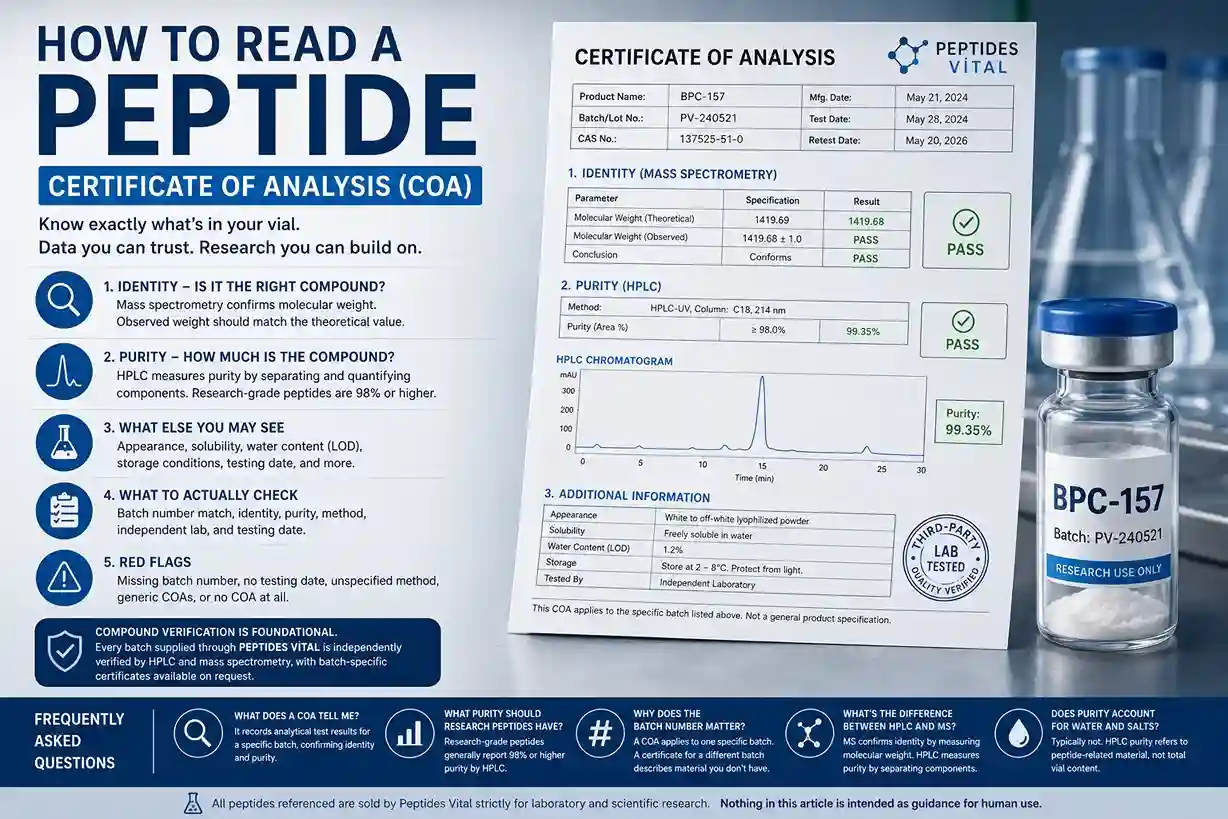
DSIP is supplied as a white lyophilized powder, soluble in water, typically reconstituted with bacteriostatic water. Store refrigerated at 2 to 8 degrees Celsius, with longer-term storage at minus 20 degrees Celsius for extended stability. Standard aliquoting practice applies to limit freeze-thaw cycles. Batches supplied through Peptides Vital are independently verified by HPLC and mass spectrometry, with certificates of analysis available on request.
What does DSIP stand for?
Delta sleep-inducing peptide, named after the delta-wave sleep effect reported in the original 1977 research.
Is the sleep-inducing effect well established?
The original 1977 finding has had mixed replication in later studies. Current research more commonly frames DSIP in terms of stress physiology and circadian regulation.
When and how was DSIP discovered?
In 1977, isolated from the cerebral venous blood of rabbits during induced sleep by the Swiss research group of Schoenenberger and Monnier.
Can DSIP cross the blood-brain barrier?
Its amphiphilic structure is associated with the ability to cross, which is unusual among peptides and part of why it remains of research interest.
What is DSIP studied for now?
Stress resistance, HPA-axis regulation, and circadian rhythm research, alongside continued but more measured sleep-related work.
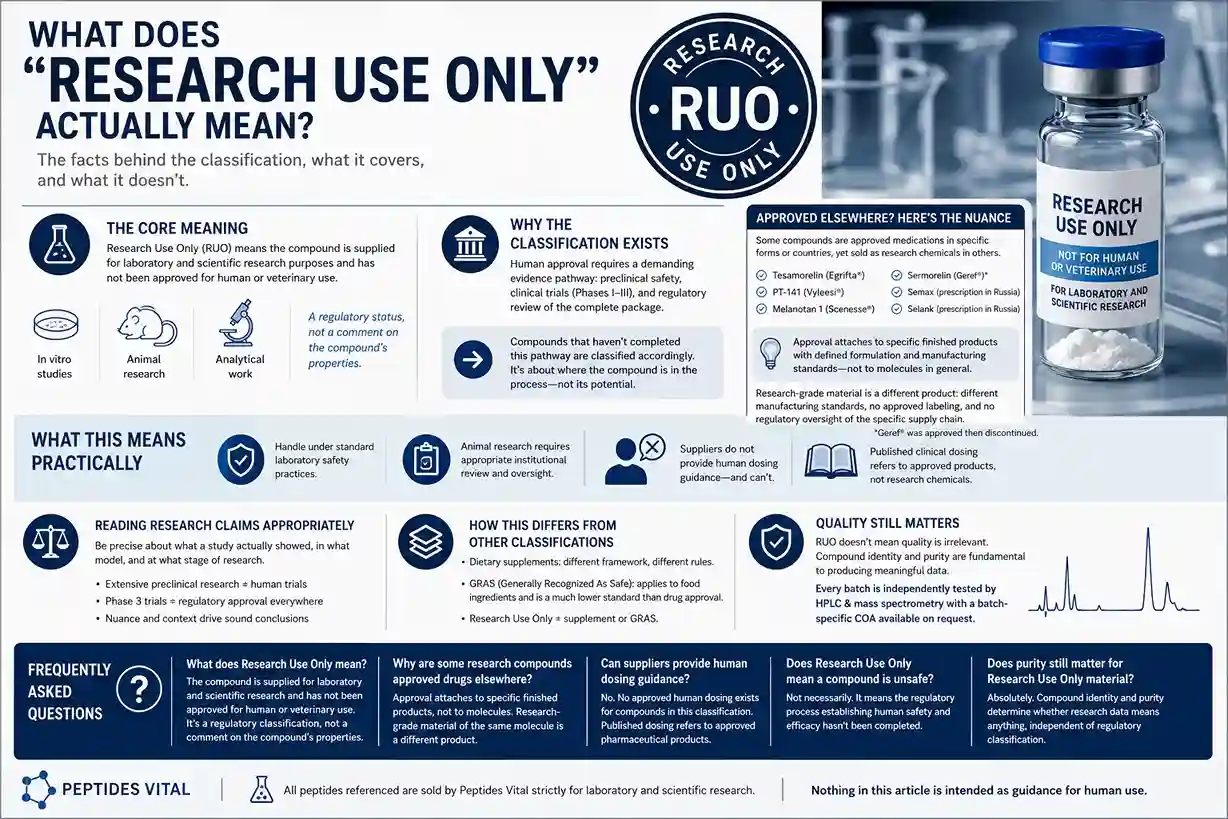
All peptides referenced are sold by Peptides Vital strictly for laboratory and scientific research. Nothing in this article is intended as guidance for human use.