- Free shipping on all orders over $200 (US) and $300 (International)
Most peptides discussed in research contexts are encoded by nuclear DNA, the genetic material stored in a cell’s nucleus. MOTS-c isn’t. It’s encoded by mitochondrial DNA, a small separate genome housed inside the mitochondria themselves, and that distinction is what makes it genuinely notable rather than just another metabolic compound.
MOTS-c is a 16-amino-acid peptide first described in 2015. Its sequence is encoded within the 12S rRNA gene of mitochondrial DNA, a region that was not previously known to produce peptides at all. Complete molecular data is on the MOTS-c product page.
It belongs to a class called mitochondrial-derived peptides, abbreviated MDPs. Only a handful have been identified, which makes this a relatively young category in peptide science compared to compounds discovered in the 1970s and 1980s.
Mitochondria are often described as the cell’s power plants, responsible for producing most of the energy cells use. What’s less commonly known outside biology is that they carry their own separate DNA, distinct from the DNA in the nucleus, a remnant of their evolutionary origin as independent organisms.
For decades, that mitochondrial genome was understood to encode a small, fixed set of proteins related to energy production, and nothing else. The discovery that regions of it also produce short peptides like MOTS-c changed that picture, and it’s why the finding attracted significant research attention.
The functional implication is what makes it interesting: a peptide produced inside mitochondria and released to act elsewhere is positioned to communicate the mitochondria’s status to the rest of the cell. That’s a signaling role, not just a metabolic one.
Research characterizes MOTS-c as a mitochondrial-to-nuclear signaling molecule. Put simply, it appears to carry information about mitochondrial energy status outward, influencing how the broader cell responds.
The most studied mechanism involves AMPK activation. AMPK is a central regulator of cellular energy balance, often described as a metabolic sensor: it responds when cellular energy runs low by shifting the cell toward energy production and away from energy consumption. MOTS-c’s connection to this pathway is the mechanistic core of most research on the compound.
Published MOTS-c research has focused on three main areas since its 2015 characterization.
Insulin sensitivity is the most developed. Studies in animal models of diet-induced obesity have investigated whether MOTS-c influences how effectively cells respond to insulin, a central question in metabolic research.
Exercise adaptation is another area. Research has examined how circulating MOTS-c levels change in response to physical activity, which connects to the broader question of how mitochondria signal metabolic demand.
Cellular energy homeostasis more generally rounds out the picture, examining the compound’s role in how cells balance energy production against consumption.
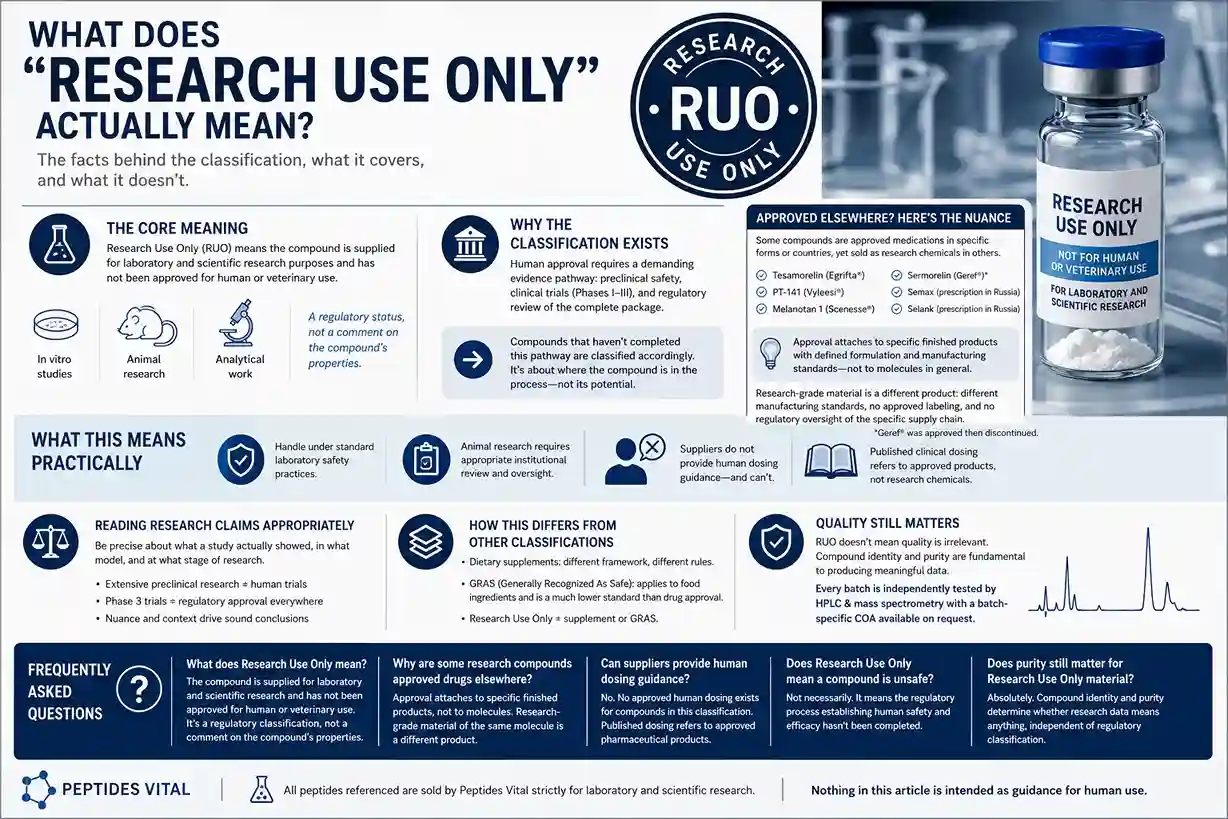
It’s worth being direct about the maturity of this evidence: because mitochondrial-derived peptides are a young research category, much of this work remains preclinical. MOTS-c does not have the depth of human clinical trial data that compounds studied since the 1980s have accumulated.
Compared to metabolic compounds like GLP-1 receptor agonists, which act on well-characterized receptor systems with extensive clinical trial backing, MOTS-c occupies a different research space. Its interest comes from mechanism and origin rather than from an established clinical evidence base. For comparison, the GLP-1 product page covers a compound class with substantially more human data behind it.
That’s not a criticism of MOTS-c, it’s a description of where each sits. Researchers interested in mitochondrial signaling specifically have reasons to work with MOTS-c that no amount of GLP-1 data would satisfy, because the questions are different.
The broader appeal of this research area comes from mitochondria’s central position in metabolism and aging.
Mitochondrial function declines measurably with age across most tissues, and that decline correlates with reduced energy availability, increased oxidative stress, and a range of age-associated metabolic changes. If mitochondria communicate their status to the rest of the cell through signaling peptides, then those peptides represent a point where that communication could potentially be studied or influenced.
That is the underlying hypothesis driving much of the interest in MOTS-c and related compounds. Whether it holds up as research matures is an open question, which is worth stating plainly rather than presenting a young research area as more settled than it is.
Researchers working on mitochondrial function sometimes also look at SS-31, a mitochondria-targeted tetrapeptide that binds cardiolipin in the inner mitochondrial membrane. SS-31 has advanced considerably further through clinical trials under the name elamipretide, making it a useful comparison point for anyone assessing the mitochondrial peptide space as a whole. NAD+ is another compound frequently studied alongside these for its central role in mitochondrial energy metabolism.
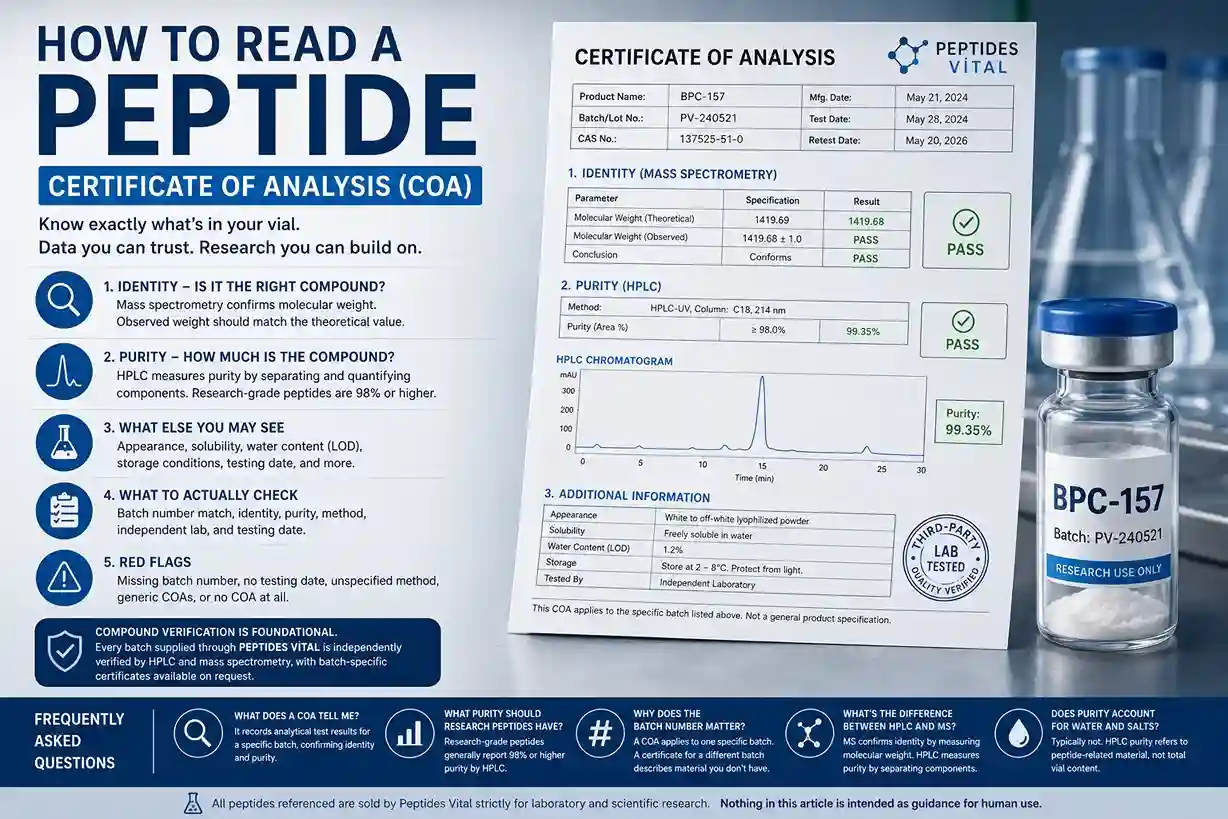
MOTS-c is supplied as a white to off-white lyophilized powder, soluble in water, typically reconstituted with bacteriostatic water. Store refrigerated at 2 to 8 degrees Celsius. Standard aliquoting practice applies to limit freeze-thaw cycles. Batches supplied through Peptides Vital are independently verified by HPLC and mass spectrometry.
What makes MOTS-c different from other peptides?
It’s encoded by mitochondrial DNA rather than nuclear DNA, one of only a handful of known peptides in this class.
What does MDP stand for?
Mitochondrial-derived peptide, the class of compounds encoded by mitochondrial rather than nuclear DNA.
What is MOTS-c studied for?
Metabolic regulation, insulin sensitivity, exercise adaptation, and cellular energy homeostasis, largely through its connection to AMPK signaling.
When was MOTS-c discovered?
It was first described in 2015, making it recent compared to most research peptides.
Is there human clinical trial data on MOTS-c?
Limited. Most published research remains preclinical, reflecting how young the mitochondrial-derived peptide category is.
All peptides referenced are sold by Peptides Vital strictly for laboratory and scientific research. Nothing in this article is intended as guidance for human use.