- Free shipping on all orders over $200 (US) and $300 (International)
Epithalon is one of the smallest peptides studied in bioregulation research, just four amino acids long. It’s also one where the quality and independence of the available evidence deserves as much attention as the findings themselves, which is worth addressing directly rather than around.
Epithalon, also spelled Epitalon or Epithalone, is a synthetic tetrapeptide with the sequence alanine, glutamic acid, aspartic acid, glycine. It was first synthesized in the 1990s, modeled on the amino acid composition of epithalamin, a peptide extract derived from the bovine pineal gland. Complete molecular data is on the Epithalon product page.
At four residues, it is among the smallest biologically studied peptides. Its sequence includes two acidic side chains, from glutamic acid and aspartic acid, which give the molecule a negative charge at physiological pH.
Epithalon’s origin traces to research on the pineal gland, a small structure in the brain best known for producing melatonin and regulating circadian rhythms.
Researchers working with bovine pineal extracts isolated a peptide fraction called epithalamin and studied its effects on circadian and neuroendocrine signaling. Epithalon was subsequently synthesized as a defined, reproducible molecule based on that extract’s amino acid composition, replacing a variable biological preparation with a specific, characterizable compound.
Epithalon’s research profile is closely tied to the work of Vladimir Khavinson and colleagues in Russia, who have published extensively on what they term peptide bioregulators.
Their published work on Epithalon has focused primarily on telomerase activation. Telomerase is the enzyme responsible for maintaining telomeres, the protective structures at the ends of chromosomes that shorten with each cell division. Telomere shortening is one of the recognized hallmarks of cellular aging, which is why a compound reported to affect telomerase draws attention in longevity research.
Studies from this program have reported telomerase-related effects in cell culture and animal models, along with investigation of pineal function and melatonin regulation reflecting the compound’s origins.
This deserves a direct answer rather than a promotional one.
The Epithalon literature is concentrated within a relatively small number of research groups and is published substantially in Russian-language journals. Independent replication in Western peer-reviewed literature is limited compared to compounds with broader international research followings.
That doesn’t mean the findings are wrong. Research concentrated in one country or one program can be entirely valid, and language barriers alone have historically kept legitimate work from wider recognition. But it does mean the evidence base has not been stress-tested through independent replication to the degree that, for example, GLP-1 receptor agonism or growth hormone secretagogue pharmacology has been.
The appropriate framing is that Epithalon represents an active, still-developing research area rather than settled science. Anyone evaluating the compound should factor that into how much weight they place on individual findings.
Understanding why telomerase attracts so much attention helps explain the interest in Epithalon specifically.
Every time a cell divides, its telomeres shorten slightly. When they become critically short, the cell stops dividing and enters senescence. This mechanism functions as a kind of biological counter, limiting how many times a cell can replicate, and its exhaustion is associated with tissue aging.
Telomerase counteracts this by extending telomeres. Most adult cells express little of it, which is why telomere shortening proceeds. A compound that influences telomerase activity therefore sits at a mechanistically interesting point in the biology of cellular aging, which explains the research attention regardless of how the evidence eventually settles.
The term peptide bioregulator appears throughout Epithalon literature and is worth defining, since it isn’t standard terminology in most Western research.
It describes short peptides proposed to influence gene expression and cellular function in specific tissues, based on the premise that different tissues respond to distinct short peptide sequences. Khavinson’s research program developed a range of such compounds, each associated with a particular organ system, with Epithalon corresponding to the pineal gland.
This framework is more established within the research tradition that produced it than in international literature generally. Understanding that context helps when reading Epithalon research, since papers often assume familiarity with the bioregulator concept as an organizing principle rather than arguing for it directly.
Researchers working in this space often examine several compounds together. NAD+ is studied for its role in mitochondrial function and DNA repair through sirtuin and PARP enzymes. MOTS-c and SS-31 approach aging-related questions from the mitochondrial angle. Each has a different evidence profile and mechanism, which makes comparing them useful when assessing the area as a whole.
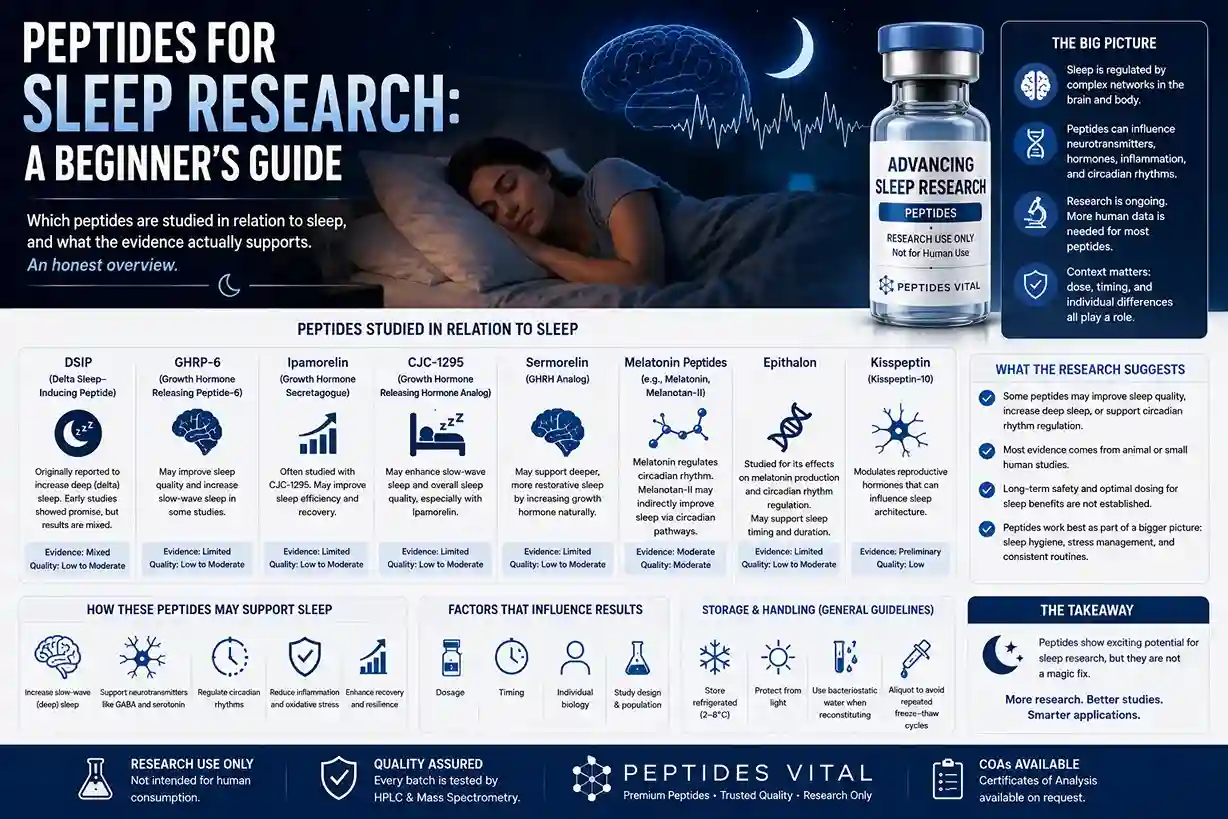
Epithalon is supplied as a white lyophilized powder that dissolves readily in water, typically reconstituted with bacteriostatic water. Store refrigerated at 2 to 8 degrees Celsius. Standard aliquoting practice applies to limit freeze-thaw cycles. Batches supplied through Peptides Vital are independently verified by HPLC and mass spectrometry, with certificates of analysis available on request.
What is Epithalon studied for?
Primarily telomerase activity and cellular aging, along with pineal gland function and melatonin regulation reflecting its origins in pineal extract research.
How strong is the evidence behind Epithalon?
The literature is concentrated among a small number of research groups, largely published in Russian-language journals, with limited independent Western replication. It’s best treated as an active research area rather than settled science.
What is epithalamin?
The bovine pineal gland extract that Epithalon’s amino acid sequence was modeled on. Epithalon replaced this variable biological preparation with a defined synthetic molecule.
How is Epithalon spelled?
It appears as Epithalon, Epitalon, and Epithalone across different sources, all referring to the same tetrapeptide.
Why is telomerase relevant to aging research?
Telomeres shorten with each cell division until cells stop replicating. Telomerase extends them, placing it at a mechanistically significant point in cellular aging biology.
All peptides referenced are sold by Peptides Vital strictly for laboratory and scientific research. Nothing in this article is intended as guidance for human use.