- Free shipping on all orders over $200 (US) and $300 (International)
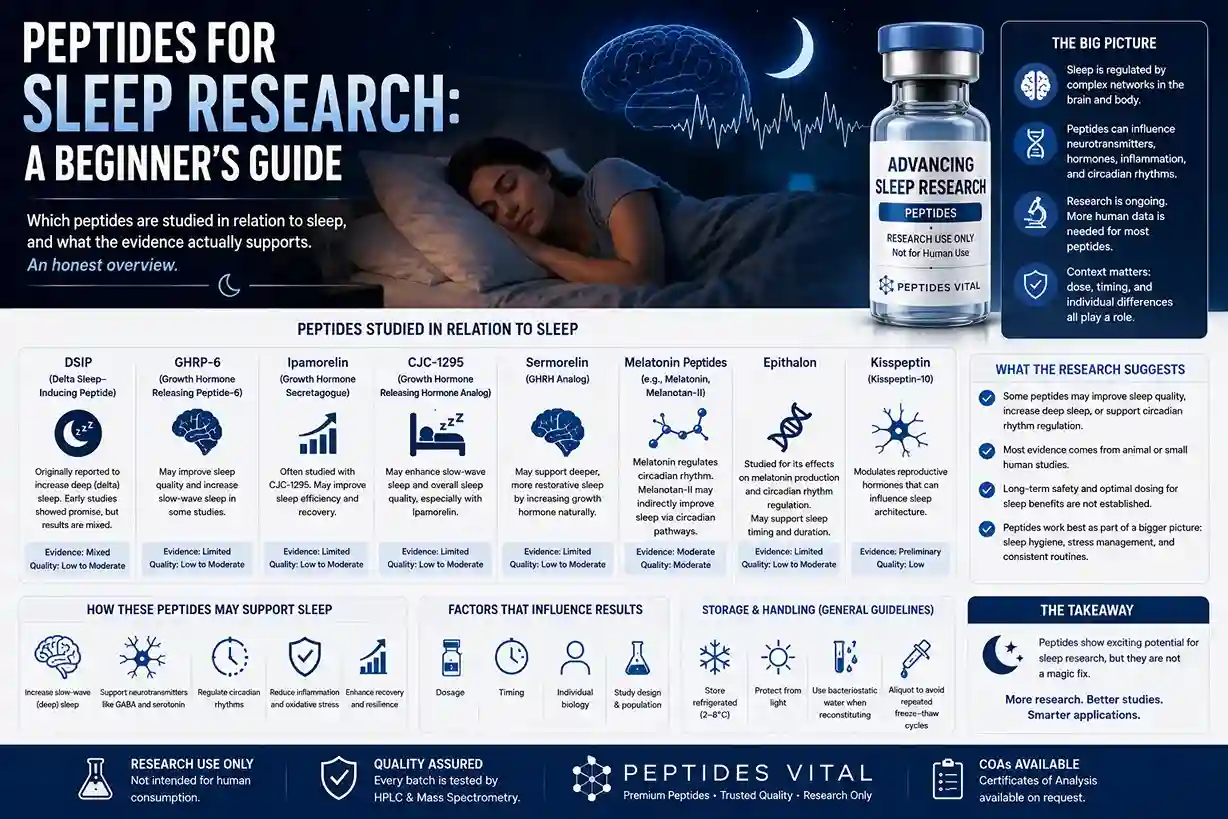
Sleep research involving peptides is a smaller and more contested area than most people expect. Several compounds have connections to sleep physiology, but the strength of that connection varies considerably between them, and one of the most commonly cited has a name that promises more than the current literature delivers.
Here is a straightforward overview of which compounds appear in this research space and what the evidence behind each actually looks like.
DSIP, delta sleep-inducing peptide, is the compound most directly associated with sleep research, and its name reflects the finding that produced it. It was isolated in 1977 from the cerebral venous blood of rabbits during induced sleep, and the original research reported that extracts containing it induced delta-wave sleep, the slow brain wave pattern characteristic of deep sleep stages. See the DSIP product page for full details.
The important caveat is that replication of the sleep-specific finding has been inconsistent. Later research has generally found DSIP’s role better explained by broader effects on stress resistance, circadian regulation, and neuroendocrine signaling than by a direct sleep-inducing mechanism.
That makes DSIP a legitimate research subject for sleep-adjacent questions, particularly around circadian rhythm and stress physiology, but it means anyone approaching it expecting a straightforward sleep compound will find the literature more complicated than the name suggests.
A less obvious connection runs through growth hormone research, and it comes from a real physiological relationship.
Growth hormone release follows a pulsatile pattern, and the largest natural pulses occur during deep, slow-wave sleep. That relationship is bidirectional in the research literature: sleep affects growth hormone release, and growth hormone signaling appears to affect sleep architecture.
This is why sleep architecture appears as a research endpoint in studies of GHRH analogs. Sermorelin in particular has been examined in this context, with research from its approval era and more recent work looking at effects on sleep patterns alongside its primary growth hormone endpoints.
Related compounds studied in the growth hormone axis include CJC-1295 and Ipamorelin, though sleep is a secondary rather than primary research endpoint for these.
Because stress and sleep are physiologically intertwined, compounds studied for anxiolytic effects sometimes appear adjacent to sleep research. Selank is the most relevant example, studied in Russian research for anxiolytic effects through GABAergic modulation without the sedation associated with benzodiazepine-class compounds.
It’s worth being precise here: Selank is not a sleep compound, and framing it as one would misrepresent the research. Its relevance to this overview is that stress and sleep questions overlap, and researchers studying one sometimes encounter the other.
Compared to research areas like growth hormone secretagogue pharmacology or GLP-1 receptor agonism, peptide sleep research is genuinely thin.
There is no peptide in this category with the depth of clinical trial evidence for sleep that, for example, tesamorelin has for visceral fat reduction. DSIP’s foundational claim has replication problems. The growth hormone connection is real but indirect, with sleep appearing as a secondary endpoint rather than a primary target.
Stating this plainly serves researchers better than presenting the area as more developed than it is. The interesting questions here are open ones, which is a legitimate reason to research something, but it’s different from working in a well-established evidence base.
Part of why this area remains thin comes down to genuine methodological difficulty rather than lack of interest.
Sleep is measured through multiple distinct methods that don’t always agree. Polysomnography records brain wave activity directly and is the gold standard for sleep architecture, but it’s resource-intensive and typically limited to laboratory settings. Actigraphy tracks movement as a proxy and scales better but captures less. Subjective sleep quality questionnaires capture something real that instruments miss, but correlate imperfectly with measured architecture.
A compound might affect one of these measures without moving the others, and studies using different methods can reach different conclusions about the same compound. Add the blood-brain barrier problem, since many peptides don’t readily reach central nervous system targets, and the difficulty of building a coherent evidence base becomes clearer.
For anyone planning research in this space, a few practical points follow from the evidence picture above.
Sleep architecture and subjective sleep quality are different endpoints requiring different measurement approaches, and studies conflating them produce data that’s hard to interpret. Circadian timing is a third distinct question that often gets grouped with sleep but involves separate mechanisms.
Being specific about which of these a study is actually measuring matters more in an area with a thin evidence base than in one where established protocols already exist.
The compounds referenced here are supplied as lyophilized powders requiring reconstitution with bacteriostatic water, with refrigerated storage at 2 to 8 degrees Celsius once reconstituted. DSIP benefits from longer-term storage at minus 20 degrees Celsius. Every batch supplied through Peptides Vital is independently verified by HPLC and mass spectrometry, with certificates of analysis available on request.
Which peptide is most associated with sleep research?
DSIP, delta sleep-inducing peptide, though its original sleep-specific finding has had inconsistent replication and current research emphasizes stress and circadian regulation.
Why do growth hormone peptides appear in sleep research?
Growth hormone’s largest natural pulses occur during deep slow-wave sleep, creating a bidirectional relationship that makes sleep architecture a relevant research endpoint.
Is there strong clinical evidence for peptides and sleep?
No. This is a comparatively thin research area with no compound approaching the evidence depth seen in other peptide research categories.
Is Selank a sleep peptide?
No. It’s studied for anxiolytic effects. Its relevance to sleep research is indirect, through the physiological overlap between stress and sleep.
All peptides referenced are sold by Peptides Vital strictly for laboratory and scientific research. Nothing in this article is intended as guidance for human use.