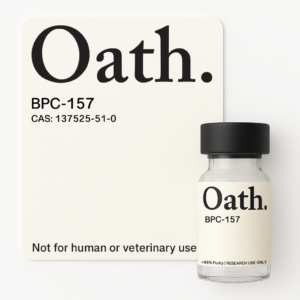
BPC-157 is a synthetic pentadecapeptide — a chain of 15 amino acids — with the sequence Gly-Glu-Pro-Pro-Pro-Gly-Lys-Pro-Ala-Asp-Asp-Ala-Gly-Leu-Val. It has a molecular weight of 1,419.53 g/mol and the molecular formula C62H98N16O22. The peptide is derived from a partial sequence of a larger protein identified in human gastric juice, first characterized in the early 1990s. BPC-157 is classified as a gastric pentadecapeptide…
Select options
This product has multiple variants. The options may be chosen on the product page
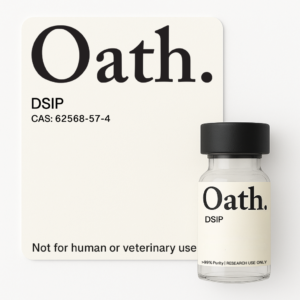
Delta sleep-inducing peptide (DSIP) is a naturally occurring nonapeptide — a chain of nine amino acids — with the sequence Trp-Ala-Gly-Gly-Asp-Ala-Ser-Gly-Glu. It has a molecular weight of 848.81 g/mol and the formula C35H48N10O15 (CAS 62568-57-4). First isolated in 1977 from rabbit cerebral venous blood, DSIP is classified as amphiphilic, meaning it contains both water-attracting and water-repelling regions. The tryptophan residue at…
Select options
This product has multiple variants. The options may be chosen on the product page
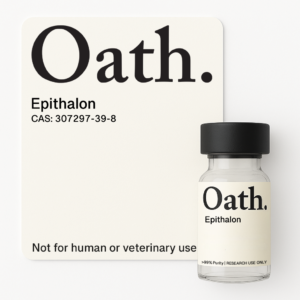
Epithalon (also spelled Epitalon or Epithalone) is a synthetic tetrapeptide — a chain of four amino acids — with the sequence Ala-Glu-Asp-Gly. It has a molecular weight of 390.34 g/mol and the formula C14H22N4O9 (CAS 307297-39-8). It was first synthesized in the 1990s, modeled on the amino acid composition of epithalamin, a peptide extract from the bovine pineal gland. Epithalon is…
Select options
This product has multiple variants. The options may be chosen on the product page
KLOW is a four-peptide research blend totaling 80mg of lyophilized powder. It contains BPC-157 (10mg), a 15-amino-acid synthetic peptide derived from a sequence found in human gastric juice protein; TB-500 (10mg), a 43-amino-acid fragment of the naturally occurring protein thymosin beta-4; GHK-Cu (50mg), a copper-bound tripeptide first isolated from human blood plasma in 1973; and KPV (10mg), a three-amino-acid fragment…
Select options
This product has multiple variants. The options may be chosen on the product page
GHRP-2 (pralmorelin) is a synthetic hexapeptide — a chain of six amino acids with the sequence D-Ala-D-2-Nal-Ala-Trp-D-Phe-Lys-NH2. It has a molecular formula of C45H55N9O6, a molecular weight of 817.99 g/mol, and a CAS number of 158861-67-7. The peptide incorporates two unnatural D-amino acids and the non-standard residue D-2-naphthylalanine, giving it a structure distinct from naturally occurring peptides. GHRP-2 was developed…
Select options
This product has multiple variants. The options may be chosen on the product page
GHRP-6 is a synthetic hexapeptide with the amino acid sequence His-D-Trp-Ala-Trp-D-Phe-Lys-NH2. Its molecular formula is C46H56N12O6, its molecular weight is 873.01 g/mol, and its CAS number is 87616-84-0. The peptide contains two D-amino acids (D-tryptophan and D-phenylalanine), which are mirror-image forms of their natural counterparts that increase the molecule’s resistance to enzymatic degradation. GHRP-6 was first synthesized in the 1980s,…
Select options
This product has multiple variants. The options may be chosen on the product page
GLP2-T is a research-designated synthetic 39-amino acid peptide classified as a dual GIP/GLP-1 receptor ligand. First described in patent filings around 2016, the molecule is built on a GIP backbone with a C20 fatty diacid modification — a lipidation strategy common in modern peptide analog design. It has the molecular formula C225H348N48O68, a weight of approximately 4,810.52 g/mol, and CAS number…
Select options
This product has multiple variants. The options may be chosen on the product page
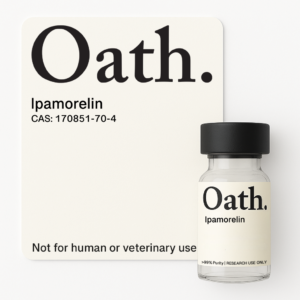
Ipamorelin is a synthetic pentapeptide — a chain of five amino acids — with the sequence Aib-His-D-2-Nal-D-Phe-Lys. It has a molecular weight of 711.86 g/mol and the formula C38H49N9O5 (CAS 170851-70-4). First described in the mid-1990s, it is classified as a growth hormone secretagogue (GHS), a category of compounds designed to interact with the ghrelin/GHS receptor. Its structure includes two non-standard…
Select options
This product has multiple variants. The options may be chosen on the product page
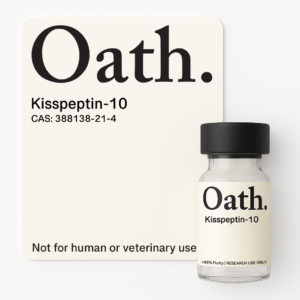
Kisspeptin-10 is a decapeptide — a chain of ten amino acids — with the sequence Tyr-Asn-Trp-Asn-Ser-Phe-Gly-Leu-Arg-Phe-NH₂. It is the shortest bioactive fragment of the kisspeptin-54 protein, which is encoded by the KISS1 gene, first identified in 1996 at Pennsylvania State University. The peptide has the molecular formula C₆₃H₈₃N₁₇O₁₄, a molecular weight of 1302.45 g/mol, and CAS number 374675-21-5. The C-terminal…
Select options
This product has multiple variants. The options may be chosen on the product page
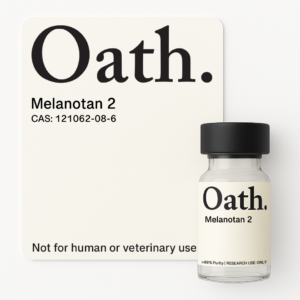
Melanotan 2 (MT-2) is a synthetic cyclic heptapeptide — a ring-shaped chain of seven amino acids — and an analog of alpha-melanocyte-stimulating hormone (alpha-MSH). It has the molecular formula C50H69N15O9, a molecular weight of 1024.20 g/mol, and a CAS number of 121062-08-6. Its defining structural feature is a lactam bridge, an internal bond that closes the amino acid chain into…
Select options
This product has multiple variants. The options may be chosen on the product page
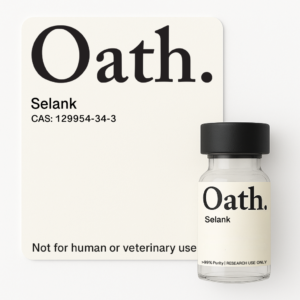
Selank is a synthetic heptapeptide based on tuftsin, a naturally occurring tetrapeptide (Thr-Lys-Pro-Arg) found as a fragment of the immunoglobulin G heavy chain. First described in the late 1990s, it extends tuftsin with a Pro-Gly-Pro tripeptide tail to resist enzymatic breakdown. The compound has the molecular formula C33H57N11O9, a weight of 751.87 g/mol, and CAS number 129954-34-3. Also designated TP-7,…
Select options
This product has multiple variants. The options may be chosen on the product page
Semax is a synthetic heptapeptide derived from the 4-10 fragment of adrenocorticotropic hormone (ACTH), with an added Pro-Gly-Pro tripeptide tail for improved stability. It was first described in the late 1980s. The molecule has the sequence Met-Glu-His-Phe-Pro-Gly-Pro, a molecular weight of approximately 826.92 g/mol, and the molecular formula C38H54N12O9. It dissolves readily in water and is supplied as a lyophilized…
Select options
This product has multiple variants. The options may be chosen on the product page
TB-500 is the synthetic form of Thymosin Beta-4, a 43-amino-acid peptide first isolated from calf thymus tissue in the 1960s. It has the molecular formula C212H350N56O78S, a molecular weight of 4,963.4 g/mol, and is identified by CAS number 77591-33-4. The peptide is notable for containing a central actin-binding domain — a region structurally complementary to actin, a major structural protein…
Select options
This product has multiple variants. The options may be chosen on the product page
Tesamorelin is a synthetic analog of growth hormone-releasing hormone (GHRH), composed of 44 amino acids with the molecular formula C221H366N72O67S and a molecular weight of 5,135.9 g/mol. It is also known by the research designation TH9507 (CAS 218949-48-5). Its structure is identical to naturally occurring human GHRH, except for a trans-3-hexenoic acid group added to the tyrosine at position 1,…
Select options
This product has multiple variants. The options may be chosen on the product page
This blend pairs Tesamorelin with Ipamorelin. Tesamorelin is a 44-amino-acid synthetic analog of growth hormone-releasing hormone (GHRH), formed by adding a trans-3-hexenoic acid group to the native GHRH(1-44) sequence. It has a molecular weight of 5135.9 g/mol and CAS number 901758-09-6. Ipamorelin is a pentapeptide — five amino acids — with the sequence Aib-His-D-2-Nal-D-Phe-Lys-NH₂, a molecular weight of 711.86 g/mol,…
Select options
This product has multiple variants. The options may be chosen on the product page
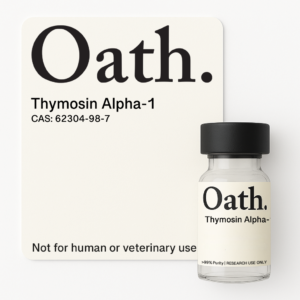
Thymosin Alpha 1 is a 28-amino-acid peptide with the molecular formula C129H215N33O55 and a molecular weight of 3,108.32 g/mol (CAS 62304-98-7). First isolated in 1977 from a calf thymus extract called Thymosin Fraction 5, it is also known as thymalfasin. The peptide has an acetyl group attached to its N-terminus and begins with serine. It contains no cysteine residues and no…
Select options
This product has multiple variants. The options may be chosen on the product page
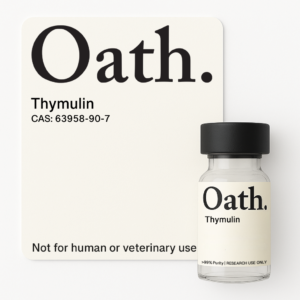
Thymulin is a nonapeptide — a chain of nine amino acids — produced by epithelial cells in the thymus gland. It was first isolated and characterized in 1977 and has the sequence Pyr-Ala-Lys-Ser-Gln-Gly-Gly-Ser-Asn, with a molecular weight of approximately 858 g/mol (without zinc). Its molecular formula is C₃₃H₅₄N₁₂O₁₅. Thymulin is chemically unique among thymic peptides because it requires a zinc…
Select options
This product has multiple variants. The options may be chosen on the product page